What is Article 371(K), and what could it mean for Ladakh?
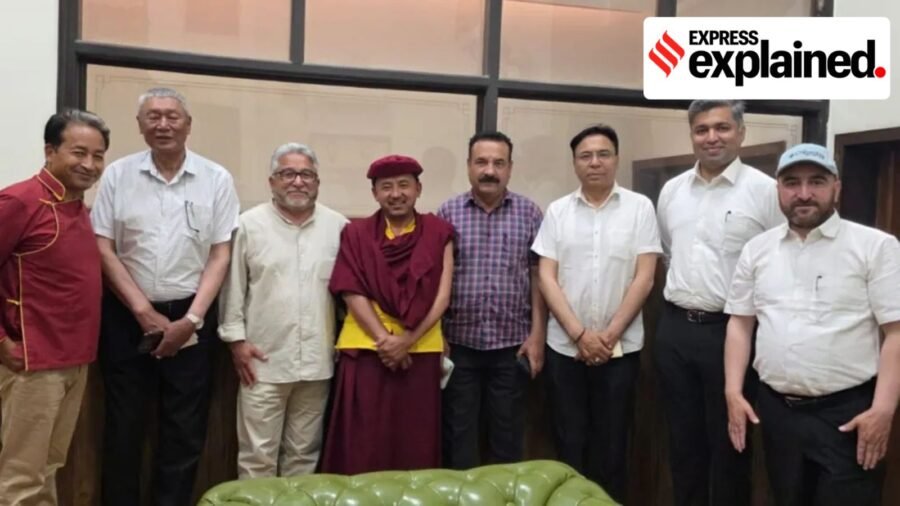
The Centre has offered to add a new constitutional provision, Article 371(K), to extend additional protections to Ladakh, learnt after a meeting between the Ministry of Home Affairs and representatives of the Leh Apex Body and Kargil Democratic Alliance on Wednesday.
The proposed arrangement would provide for a directly elected governing body with legislative powers over areas including land, culture and language, forests, environment and natural resources.
But there is no draft yet, and several key questions remain unresolved, including executive, financial and planning powers, as well as control over police and law and order. Further talks are expected in October. Representatives from Ladakh have said that without a draft spelling out the powers of the proposed body, the offer remains incomplete.
The proposal builds on an “in-principle understanding” reached in earlier rounds of talks in May and July, when the Centre and Ladakh representatives discussed restoring democracy in the region and creating tailor-made constitutional safeguards under Article 371.
Why has Ladakh been demanding constitutional safeguards?
Ladakh’s demand for greater political and constitutional protection dates back to the reorganisation of Jammu and Kashmir in August 2019.
There was initially considerable enthusiasm, particularly in Leh, after Ladakh was made a separate Union Territory. The Buddhist-dominated Leh district had long sought UT status, arguing that it had been neglected by the erstwhile Jammu and Kashmir government.
That waned after it became clear that while the Union Territory of Jammu and Kashmir would have a legislature, Ladakh would not.
Story continues below this ad
The region had four MLAs in the erstwhile J&K Assembly. After 2019, its administration was largely led by bureaucrats, not by elected officials, deepening a sense of political alienation.
Changes to domicile rules in Jammu and Kashmir also sharpened concerns in Ladakh over land, employment, demography and cultural identity.
The Union Territory currently has two Hill Councils, in Leh and Kargil, but neither is under the Sixth Schedule. Their powers remain limited. These concerns eventually fed into demands for statehood, inclusion under the Sixth Schedule and greater democratic control over Ladakh’s administration.
What is the Sixth Schedule?
The Sixth Schedule, under Article 244 of the Constitution, provides for autonomous administrative divisions called Autonomous District Councils, or ADCs, which enjoy a degree of legislative, judicial and administrative autonomy within a state. ADCs can make laws, rules and regulations relating to subjects such as land, forests, water, agriculture, village councils, health, sanitation, inheritance, social customs and mining.
Story continues below this ad
The Sixth Schedule currently applies to tribal areas in Assam, Meghalaya, Mizoram and Tripura.
In September 2019, the National Commission for Scheduled Tribes recommended that Ladakh be brought under the Sixth Schedule, noting that the new Union Territory was overwhelmingly tribal and had a distinct cultural heritage requiring protection. However, no region outside the Northeast has so far been included under the Sixth Schedule.
What protections does Article 371 offer?
Articles 371 and 371-A through J contain “special provisions” for specific states. These provisions vary considerably from state to state, but broadly seek to protect local political, cultural, social or economic interests.
When the Constitution first came into force, Article 371 required the creation of development boards for certain regions of Maharashtra and Gujarat. More provisions were added as new states were created and specific political arrangements evolved.
Story continues below this ad
Under Article 371-A, for example, laws made by Parliament relating to Naga religious or social practices, customary law and procedure, and ownership and transfer of land and resources do not automatically apply to Nagaland unless the state Assembly agrees. Similar protections have been extended to Mizoram under Article 371-G.
Articles 371-B and 371-C provide for special committees within the Legislative Assemblies of Assam and Manipur, while Article 371-F provides special arrangements for representation in the Sikkim Assembly. Special provisions also exist for Arunachal Pradesh and Goa.
If Article 371(K) is introduced for Ladakh, it would mark a significant departure from this pattern because Ladakh is a Union Territory, not a state.
How would Article 371(K) differ from the Sixth Schedule?
The Sixth Schedule creates autonomous district-level institutions with constitutionally defined powers. The proposed Article 371(K), by contrast, appears to be aimed at creating a directly elected governing body at the Union Territory level with legislative authority over specified subjects.
Story continues below this ad
This would give Ladakh a separate constitutional arrangement, rather than simply extending the Sixth Schedule to the Union Territory. The exact difference will depend on the wording of the draft.
The most important unresolved questions concern whether the elected body would have executive authority, control over budgets and planning, and powers over police and law and order. Until these are settled, it remains unclear how much power the proposed body would actually exercise.

Flydubai attack: How Israel’s security lapses almost led to another ‘October 7’
By Sohail Khan · 5 Oct
‘Is 140/90 a normal blood pressure reading at age 60?’
By Sohail Khan · 5 Oct