What does Trump’s unusual threat to Fed signal, why it matters to India?
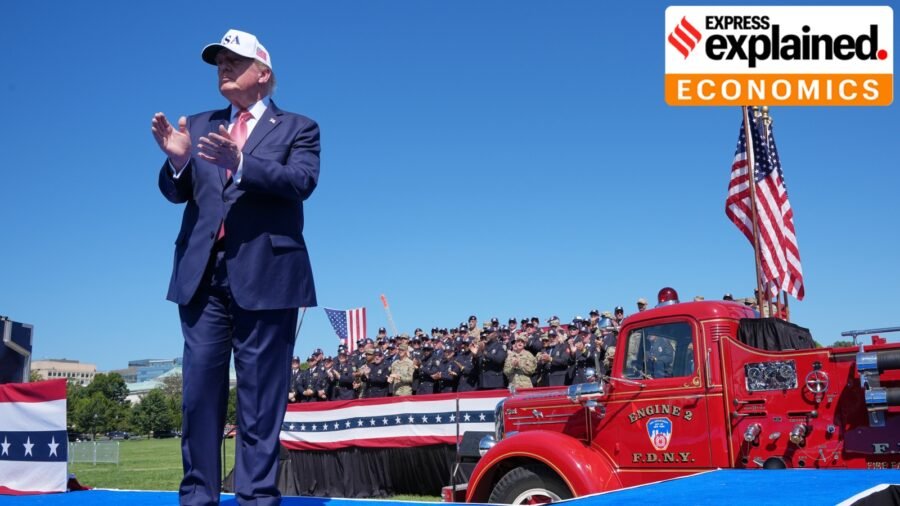
After months of threatening allies and rivals alike with tariffs to coerce them into signing lopsided trade deals, US President Donald Trump seemingly went a step further late last week and warned the Federal Reserve (Fed) to cut interest rates, or else the US would stop trading with countries with which it has a trade deficit.
While Trump’s threat to the Fed has raised eyebrows among policy circles globally, this is not the first time that Trump has suggested extreme measures to influence the Fed to lower interest rates. During his first term too, Trump routinely pushed for lower interest rates and in September 2019 went on to suggest that the Fed should get the interest rates down to “zero or less” so that the US can start to “refinance its debt”.
Trump’s warnings have gotten more and more aggressive amid growing worry over US debt and trade deficit. The latest data showed that US debt has crossed a record $40 trillion and the trade deficit also widened despite a slew of tariffs on trade partners. High debt numbers are increasingly making investors nervous amid rising oil prices due to the US-Iran war and are pushing US 10-year bond yield (a benchmark for global borrowing costs) towards 5%.
International think tanks estimated that the US government will spend little over $1 trillion this fiscal year paying interest on the debt, which is equivalent to its national defence spending. According to the Council on Foreign Relations, the US debt-to-GDP ratio has now reached 125%, adding that federal borrowing needed to finance the US effort in World War II had only pushed the debt-to-GDP ratio to 106%.
India among other trade partners at crossroads
Uncomfortable debt and deficit numbers explain why Trump is going after even the closest trade partners in a bid to bridge the trade gap and simultaneously pushing for lower interest rates. As the US aggressively narrows its trade deficit with China to its lowest in 2 decades, Washington has begun pressuring trade partners like India to do the same.
On Wednesday, the US banned a broad number of Canadian alcoholic beverages, motorcycles and dairy products after escalation in trade ties with Canada. US has already re-negotiated its existing deal with Mexico and has imposed one of the two broad Section 301 tariffs on countries globally.
For India, US pressures are playing on three fronts. One, steep market access demands under trade deals; two, outflow of investment from India to the US; and three, pressure to lower dependency on input items originating from China, which the US believes is operating a ‘shadow transhipment network’ which ultimately helps Beijing widen the effective trade deficit, displace domestic production, reduce GDP growth, and lower associated federal tax receipts in the US.
Story continues below this ad
India and the US have been negotiating a bilateral trade agreement since February 2025, and in February this year, the two countries announced a framework for an Interim Agreement. This framework agreement has already created considerable tensions, particularly among farmers. International trade experts have warned that if India lowers customs duties on US imports, the livelihoods of Indian farmers engaged in growing apples, cotton, grapes, oranges, soybeans, walnuts and some other agricultural products would face direct pressure.
These fears have taken hold as the US for years has been pushing against India’s Minimum Support Price (MSP) on rice and wheat at the World Trade Organisation (WTO) for years.
“There is also an apprehension that the terms of the Interim Agreement would compel India to set aside its domestic laws and regulations, and instead mandatorily allow imports from the US, if the consignments are accompanied by certificates of relevant US authorities. This would create a backdoor for the imports of genetically modified products from the US,” an expert who did not wish to be named said.
Impact on India
While India is trying to accommodate American demands amid concerns over tariffs, India has already taken various steps to assuage the US by stepping up energy imports and lowering tariffs on broad swaths of products that are of US interest, from bikes to whiskey and tax holiday for data centres and items required to boost nuclear power production in India.
on Tuesday reported that the US’s share in India’s liquefied petroleum gas (LPG) imports has already surged to over 50% in the six months since the West Asia crisis started. The comparable number was less than 10% in the preceding six months. Before the West Asia war, India’s LPG import pie was dominated by Gulf suppliers like the United Arab Emirates (UAE), Qatar, Kuwait, and Saudi Arabia.
Story continues below this ad
After the US started forced labour-related Section 301 tariffs, the Directorate General of Foreign Trade (DGFT) explicitly announced the prohibition of imports of goods produced using forced labour. Industry sources said that fear of US scrutiny is pushing cotton prices higher. Indian apparel exporters last month approached the Commerce and Industry Ministry and the Textile Ministry seeking regulation of cotton yarn exports to arrest a sharp surge in prices amid US restrictions on the use of cotton originating from China’s Uyghur region.
The Apparel Export Promotion Council (AEPC) said cotton yarn prices have increased by around 60%, from approximately Rs 250 per kg in early 2026 to around Rs 400 per kg currently, putting increasing pressure on the apparel manufacturing value chain. In a letter to the ministries, the council sought measures “to regulate the export of cotton yarn, specifically 20s count (a medium-thickness thread) and above”, and to stabilise prices so that cotton yarn remains available to apparel manufacturing and exporting units at competitive rates.
Earlier this year, India’s top export promotion council, Federation of Indian Export Organisations (FIEO), also advised exporters to maintain detailed employee data such as wage records, age verification and supplier declarations as strong labour and supply chain documentation would become a “commercial necessity” for exporters aiming to cater to the US market.
“High-risk inputs such as cotton, polysilicon, minerals and other sensitive material require traceability. Unsupported broad declarations should be avoided, and any exception statement must cite precise Harmonised Tariff Schedule (HTS).” the export promotion council told exporters while advising them on compliance and due diligence beyond tariffs.

The jungle knows where the tiger is — here’s how to read the signs
By Sohail Khan · 1 Oct
Jyotika praises her mother-in-law, says ‘only a queen can raise a prince’
By Sohail Khan · 1 Oct
Can a police confession justify NSA detention? What Supreme Court said in Sambhal case
By Sohail Khan · 1 Oct