Universities as labs of entrepreneurship
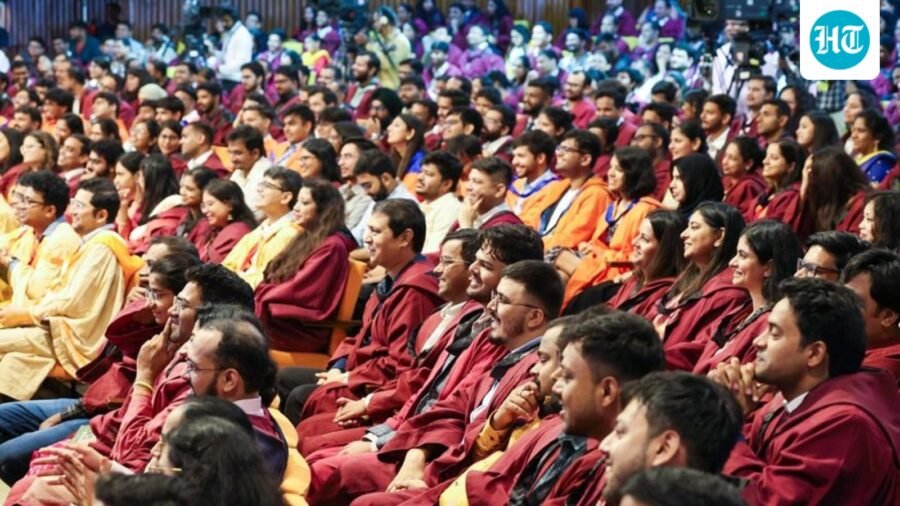
India's universities are now competing to commercialise research, work with industry, and produce graduates able to start businesses.
Updated on: Sep 22, 2026, 06:36:53 IST
Prefer HTon Google
Share via
Copy link
India just pulled off something remarkable: Eight of its universities ranked highly on PitchBook’s 2026 list of the world’s top 100 institutions for producing venture-backed entrepreneurs. Seven are public institutions, including five IITs. From those five alone, came 2,705 entrepreneurs who founded 2,256 companies and raised more than $156 billion.
This is astonishing, because for decades, India’s elite public universities were known for exams, academic hierarchy, and bureaucracy. Over the past decade, however, that culture has changed, and entrepreneurship has moved into the mainstream. The schools are now competing to commercialise research, work with industry, and produce students able to start businesses. This is a national advantage for India and highlights why it should get over the inferiority complex that the West has made it suffer.
For generations, Indians were conditioned to believe that Stanford, MIT, Harvard, Berkeley, and other western institutions represented the model to emulate. Yes, India does need to invest more in scientific research, but it does not need to copy the western model. India has real problems to solve and needs to focus on solving them.
I spent years teaching and researching at universities including Harvard, Duke, Stanford, and Carnegie Mellon, and one of my recurring frustrations with American academia has been the vast distance between discovery and impact. American universities spent $118 billion on research and development in fiscal 2024 alone, $64 billion of it from the federal government. A very tiny proportion creates real value; the rest produces worthless papers to help faculty secure tenure, the academic equivalent of a government job for life. There are some exceptions, particularly Stanford, MIT, and Berkeley. But in much of US academia, incentives still favour publication, citations, and the next research grant. A university may boast an entrepreneurship club or hold a startup competition, yet that does not create an entrepreneurial ecosystem.
This is what has impressed me so much at IIT Delhi and IIT Kharagpur in particular: At both institutions, the commitment to entrepreneurship and industry collaboration starts at the top; you don’t see anything like this in the US.
At IIT Delhi, director Rangan Banerjee chairs the Foundation for Innovation and Technology Transfer (FITT), while a dean for corporate relations and dedicated teams handle incubation, investment, IP and technology transfer. Together with their Research and Innovation Park, they have already enabled more than 2,100 industry collaborations and 185 technology transfers, while incubating more than 150 startups.
IIT Kharagpur is moving with equal determination. Its director, Suman Chakraborty, a distinguished scientist and engineer, is pushing the institute to become one of the world’s leading launchpads for deep-tech entrepreneurship, where knowledge does not end at publication and innovations do not die at the prototype stage. KGP Launchpad is part of that effort. Kharagpur has created formal mechanisms enabling faculty and students to launch startups, serve as advisers or directors, seek seed funding, and commercialise intellectual property. Its Sponsored Research and Industrial Consultancy organisation works directly with companies and has established a “Lab to Market” mechanism specifically for translational research.
These two entrepreneurial launchpads enjoy a wonderful rivalry, as I have seen in working with both of them. IIT Delhi wants to demonstrate that it can work with industry faster and better, while IIT Kharagpur wants to become the country’s leading deep-tech launchpad. They are pushing each other forward, as I am sure is happening at other top universities.
My company, Vionix Biosciences, is working with IIT Delhi to develop and refine a breakthrough spectral-intelligence platform spanning cold plasma, optics, RF electronics, sensors and biomedical engineering; and with IIT Kharagpur to apply these capabilities to water, environmental monitoring and health, with the goal of detecting contamination and disease earlier and making advanced diagnostics affordable at scale.
The entrepreneurial transformation could not be more timely. Advances in AI, robotics, sensors, synthetic biology and genomics are enabling startups to do what only governments and giant corporations could do before; as these technologies converge, they are making it possible to tackle some of humanity’s greatest challenges. This is something Indian entrepreneurs — who live close to the problems humanity needs solved — understand better than Americans. They see failures in health care, water, pollution, agriculture, transportation, energy and education; they understand what affordability really means, because a medical technology that costs thousands of dollars per test is useless to most of the world.
Silicon Valley, where I live, is one of the most insular places in the world. At Stanford and across the wealthy communities surrounding it, clean water comes from the tap, electricity is dependable, world-class medicine is readily available, and infrastructure works. Students are surrounded by amazing technology and investors eager to throw millions of dollars at the next fashionable idea, while seeing none of the hardship most of humanity lives with.
Indian students step outside their campuses into a world full of urgent problems waiting to be solved. With the entrepreneurship spirit now taking hold, they have a chance to build companies go beyond creating wealth: They can improve the lives of billions.
That, then, is what India should capitalise on now. The PitchBook rankings show that this shift is already producing results. The opportunity is to turn that entrepreneurial energy into technologies, products and companies that improve lives on a massive scale. That may prove to be one of India’s great superpowers.
Vivek Wadhwa is CEO, Vionix Biosciences. The views expressed are personal.
Get Current Updates on India News, Elections 2024, Lok sabha election 2024 voting live , Karnataka election 2024 live in Bengaluru , Election 2024 Date along with Latest News and Top Headlines from India and around the world.
See Less

The science of Gaganyaan parachutes | Explained
By Sohail Khan · 22 Sep
40 years ago September 22, 1986: Barnala hits out at Badal group
By Sohail Khan · 22 Sep
Magic of performing arts in a mundane digital world
By Sohail Khan · 22 Sep
Leave a Reply