This is what really happens when you pull a train’s emergency chain
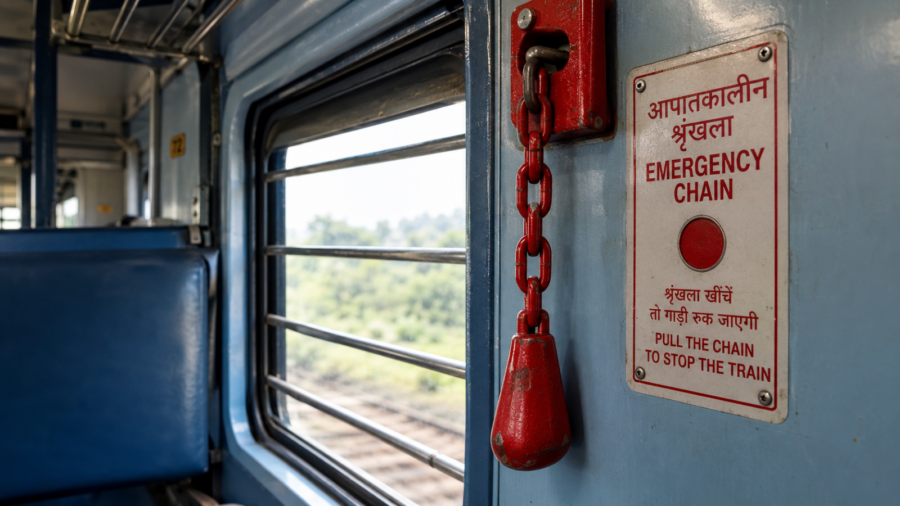
If you’ve ever travelled by train, chances are you’ve noticed the emergency chain inside the compartments. And if you’ve watched enough Bollywood films, you’ve probably seen it being pulled at least once.
Missed your station? Boarded the wrong train? Realised too late that you were supposed to get off at the previous stop? Or, as the movies would have it, want to declare your love to someone waving goodbye from a departing train? Just pull the emergency chain, and the train comes to a halt.
Except, it’s not quite that simple. Pulling the emergency chain without a valid reason can land you in legal trouble—and even result in a hefty fine or imprisonment. So, when are you actually supposed to pull it? What happens once you do, and when is the emergency chain genuinely meant to be used?
Story continues below.
Subscribe to see fewer ads.
What happens when you pull the emergency chain?
“The emergency chain is designed to alert the train crew and initiate the process of stopping the train,” Reeva Sakaria, Co-Founder, Yatri, tells indianexpress.com.
Pulling it sets off a process in which railway staff can identify the coach and compartment from which the alarm was activated. Once the train stops, the crew can find out who pulled the chain and why.
“Railway instructions state that a red disc/indicator identifies the carriage, while the slackness of the chain helps identify the compartment. Once the train stops, the Guard/Assistant Guard is required to ascertain who applied the chain and the reason.”
Story continues below this ad
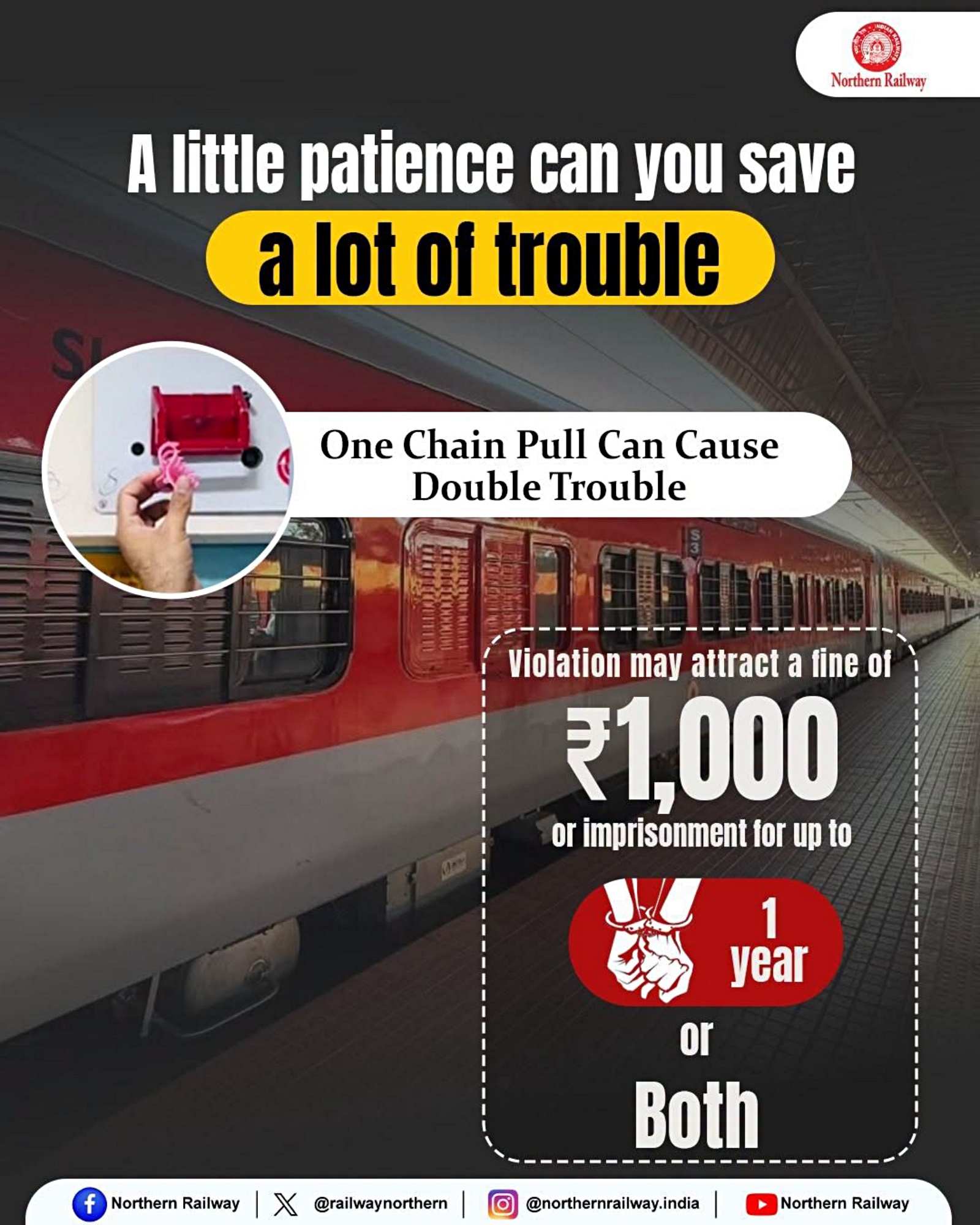 Unnecessary chain pulling can attract a ₹1,000 fine or up to one year of imprisonment or both
But stopping one train can have consequences beyond that particular coach.
“What passengers often don’t see is what happens next,” Sakaria says. “An unplanned stop can affect the movement of that train and create knock-on effects for other services operating along the same corridor.”
It can also make live-status information harder to interpret until train movements return to normal.
So, when should you actually pull it?
“The emergency chain is intended for situations where immediate railway intervention is necessary to protect the safety of passengers or address a serious incident. It should not be used to resolve routine travel inconveniences,” says Sakaria.
That could include situations such as:
Story continues below this ad
- A passenger falling between the train and platform
- A serious medical emergency inside a crowded coach
- A fire or another immediate threat to passengers
- A serious safety incident on or near the tracks
In other words, the chain is for situations where waiting until the next station could put someone at risk or allow a serious incident to escalate.
What if you miss your station or board the wrong train?
This is where the emergency chain should not come into play.
“Missing your station, boarding the wrong train or wanting to get off at a particular station does not constitute a genuine emergency,” Sakaria clarifies.
“Passengers can also use journey planning and live-status tools like Yatri before and during their commute,” the expert recommends.
Story continues below this ad
Her advice is simple: “The simplest solution is: don’t panic, and don’t pull the chain.”
If you’ve missed your stop, stay on the train and get down at the next suitable station. From there, you can figure out the best way to get back or continue your journey.
“A wrong train or missed station can be inconvenient. It does not need to become an emergency.”
Yes, there can be a penalty
🚨 Alarm Chain Pulling is for Emergencies Only! 🚨
Use the alarm chain only in medical emergencies, fire incidents, accidents, or threats to passenger safety.#NCRailway #AlarmChainPulling #RailwaySafety #SafeJourney #IndianRailways@RailMinIndia @AshwiniVaishnaw pic.twitter.com/dWL4tAmL7j
— North Central Railway (@CPRONCR) June 18, 2026
There is a legal consequence to using or interfering with a train’s communication system without reasonable or sufficient cause.
“Under Section 141 of the Railways Act, 1989 provides for punishment when a passenger, without reasonable and sufficient cause, uses or interferes with the means of communication provided in a train,” Sakaria tells indianexpress.com.
Story continues below this ad
The person may have to have to face imprisonment of up to one year, a fine of up to ₹1,000, or both.
“For an unjustified use of the alarm chain, the Act provides for a minimum fine of ₹500 for a first conviction and three months’ imprisonment for a second or subsequent conviction, unless the court records special and adequate reasons to the contrary.”
But the penalty isn’t the only issue.
An unnecessary stoppage can delay the train you’re travelling on and potentially affect trains behind it as well. On a busy railway corridor, even a small disruption can mean delays, crowding and changes to train movement further along the route.
As Sakaria puts it: “An emergency mechanism exists to help people in emergencies. Using it unnecessarily can create a new problem for everyone else.”
Story continues below this ad
So, if the situation is genuinely dangerous and needs immediate railway intervention, the emergency chain is there for exactly that. But if it is simply a case of a missed station, wrong train or last-minute change of plan, the safest option is to stay on board and figure out the next stop.

10 weekend getaways from Delhi within 300 km that are perfect for a bike ride
By Sohail Khan · 2 Oct
Flydubai flight: How tighter post-9/11 rules could have impacted cockpit access
By Sohail Khan · 2 Oct
From Varanasi to Tashkent, how Mahatma Gandhi influenced Lal Bahadur Shastri
By Sohail Khan · 2 Oct