This banyan tree in Bihar is at least 700 years old — and science has finally proved it
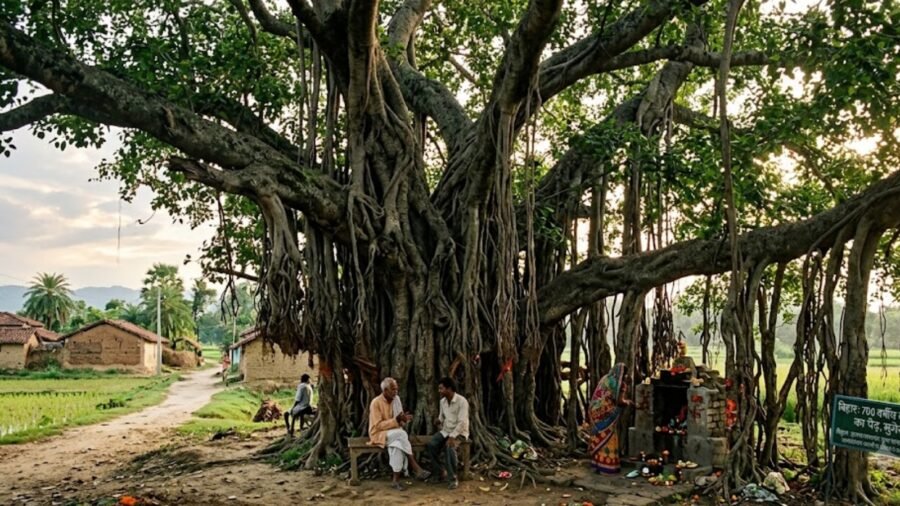
A Cambridge University study has accurately dated a monumental banyan tree in Munger, Bihar, settling a question long answered by folklore. Published on April 26, 2026, the study concluded that the tree is at least 700 years old, making it the oldest accurately dated Ficus benghalensis (banyan tree) in the world. Using advanced radiocarbon dating, researchers analysed wood from the tree’s secondary trunk and primary branch to establish its minimum age, marking a significant breakthrough in dating tropical hardwoods.
The finding has since received official recognition. On July 3, 2026, the Department of Science and Technology confirmed that the Munger banyan had been scientifically dated using radiocarbon methods rather than historical records or local lore, calling it the world’s oldest accurately dated banyan tree.
Story continues below.
Subscribe to see fewer ads.
Beyond establishing the age of a single tree, environmentalist Jasmit S Arora believes that the study represents a milestone for both science and conservation.
Why was accurately dating the banyan so challenging?
Dating tropical trees has always been difficult because they rarely develop the clear annual growth rings seen in temperate forests. “This landmark breakthrough establishes a robust AMS radiocarbon dating methodology using alpha cellulose extraction, successfully ageing the Munger banyan as the oldest Ficus benghalensis,” says Arora.
He explains that conventional tree-ring dating is largely ineffective for tropical species. “Accurately dating tropical trees is notoriously challenging. Because tropical trees lack distinct annual growth rings due to continuous growth and often have complex, hollow, or multi-stemmed structures, traditional dendrochronology is ineffective. By pioneering precise pith targeting and advanced calibration, this research replaces speculative folklore with empirical data,” Arora tells indianexpress.com.
View this post on Instagram
A post shared by Vajiram & Ravi (@vajiramandravi)
Why does this matter for conservation?
Arora believes the study could fundamentally change how heritage trees are protected. “Confirming the antiquity of these trees provides the hard evidence needed to secure legal heritage status and long-term conservation plans,” he says.
He adds that the research “not only rewrites the ecological history of the Munger region but also sets a vital precedent for protecting culturally and ecologically significant botanical heritage across South Asia and globally.”
Story continues below this ad
More than just old trees
According to Arora, ancient trees function as far more than historical landmarks—they are ecological powerhouses. “Centuries-old heritage trees like the Munger banyan are irreplaceable ecological pillars and ecosystem engineers,” he says.
“Their massive biomass and complex structures create vital microhabitats, making them biodiversity hotspots that provide year-round food and shelter for countless species,” Arora explains.
He also highlights their role in climate regulation. “They are monumental carbon sinks. Studies show that just 3% of the largest trees can store up to 42% of a forest’s carbon. Their deep roots stabilise soil and recharge groundwater, while expansive canopies moderate microclimates, reduce the urban heat island effect and help purify air.”
Why protecting ancient trees is becoming more urgent
As cities expand and climate change intensifies, Arora warns that heritage trees are becoming increasingly valuable. “They act as powerful climate buffers and biological archives, possessing time-tested genetic resilience against extreme weather,” he says.
Story continues below this ad
Losing them, he cautions, has consequences that cannot be quickly reversed.
“Removing these living monuments instantly releases centuries of stored carbon and destroys foundational biodiversity that modern reforestation cannot quickly replicate. It also erases an irreplaceable part of our living natural heritage,” Arora says.

81-year-old grandmother travels to Alaska: Her healthy-ageing advice
By Sohail Khan · 16 Sep
Mop-up seen at Rs 15,000 crore: why Govt thinks MDR on UPI is worth it despite backlash
By Sohail Khan · 16 Sep

Leave a Reply