Pakistani ship collides with Indian vessel: The 1991 treaty it violated
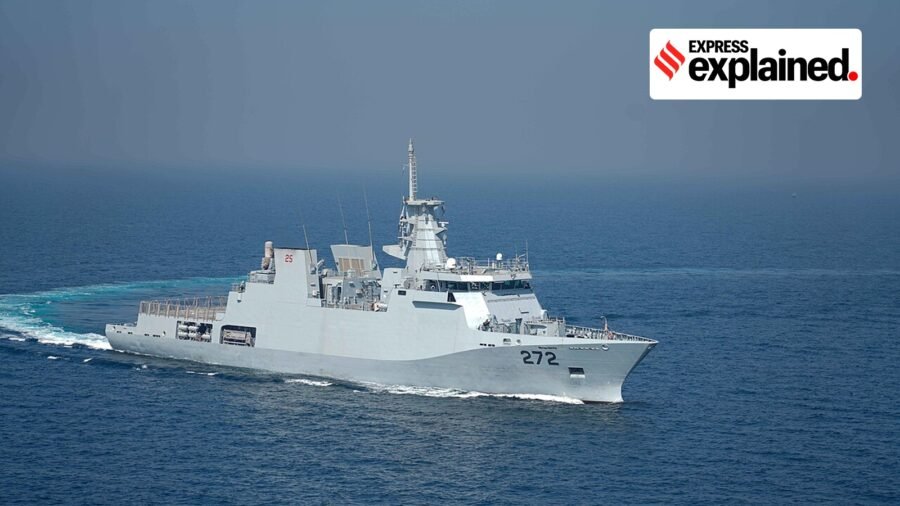
India summoned Pakistan’s Charge d’Affaires (top diplomat in absence of High Commissioner) in New Delhi over “unacceptable and unprofessional conduct”, after a Pakistani ship collided with an Indian Navy vessel on Tuesday (September 15).
India said the Pakistani vessel’s conduct was in “direct contravention” of Article 10 of the 1991 Agreement between India and Pakistan on Advance Notice on Military Exercises, Manoeuvres and Troops Movements.
What did the Pakistani ship do, what is this agreement, and why was it signed? We explain.
What happened at sea?
Story continues below.
Subscribe to see fewer ads.
According to the Ministry of External Affairs, Pakistan Naval Ship (PNS) Hunain approached an Indian naval warship at high speed in international waters and manoeuvred in an unsafe manner, resulting in a minor collision. The incident took place about 120 nautical miles (I nautical mile equals 1.852 km) from the Gulf of Oman. Under the UN Convention on the Law of the Sea, a country’s territorial sea extends up to 12 nautical miles from its coast. India’s Exclusive Economic Zone (EEZ), however, extends up to 200 nautical miles, and in this area, India has the right to explore and manage seabed resources.
The Indian warship was on a routine surveillance mission in the North Arabian Sea. PNS Hunain was damaged in the collision, while no damage was reported to the Indian vessel, which continued its mission.
The incident reminded many of the last such incident between Indian and Pakistani naval ships at sea – on June 16, 2011, the Pakistani naval warship PNS Babur brushed past the Indian Navy frigate INS Godavari in the Gulf of Aden, causing minor damage to the Indian warship’s helicopter safety net.
What is the 1991 Agreement between India and Pakistan on Advance Notice on Military Exercises, Manoeuvres and Troops Movements?
According to the text of the agreement, it was signed to establish a mechanism for India and Pakistan to inform each other about military exercise or troop movements “in order to prevent any crisis situation arising due to misreading of the other side’s intentions.”
Story continues below this ad
It lays down rules for the land, naval and air forces of both countries, saying that while major military exercises close to each other’s territories should be avoided, if they are to take place, they should follow certain regulations and the other party should be informed.
For naval forces, a major exercise is defined as “involving six or more ships of destroyer/frigate size and above, exercising in company and crossing into the other’s Exclusive Economic Zone (EEZ).”
Article 10, which the government specifically referred to, says, “The Naval ships and submarines belonging to the other country are not to close less than three Nautical Miles (NMs) from each other so as to avoid any accident while operating in international waters.”
It is this provision that India says was violated in the September 15 incident.
Story continues below this ad
The rules for aircraft include, “Combat aircraft including fighter, bomber reconnaissance, jet military trainer and armed helicopter aircraft will not fly within ten kms of each other’s airspace, including the Air Defence Identification Zones (ADIZ), except when such aircraft are operating form Jammu, Pathankot, Amritsar and Suratgarh air bases on the Indian side, as well as Pasrur, Lahore, Vehari and Rahimyar Khan air bases on the Pakistan side, in which case they will maintain a distance of five kms from each other’s airspace.”
Why was this agreement signed?
After the bloody war of the previous decade in which India comprehensively defeated Pakistan, the 1980s saw some confidence-building measures. The contributing factors, to put it very briefly, included the heightened activity to build a nuclear weapon in both countries, which dramatically escalated the cost of war, and the Soviet invasion of Afghanistan in December 1979, which made both Pakistan and the US keen to avoid any disturbance on Pakistan’s eastern border, with India.
Thus, on March 10, 1983, came the Agreement for the establishment of a joint commission between India and Pakistan. On December 31, 1988, two agreements were finalised, Cultural cooperation Agreement between India and Pakistan and Agreement on the prohibition of attack against nuclear installations and facilities between India and Pakistan.
The 1991 treaty came after a specific incident — Brass Tacks IV, a massive military exercise India carried out in January 1987, in Punjab and Rajasthan along the India-Pakistan border.
Story continues below this ad
This was the final sequence in a series of four exercises that began in the summer of 1986, and involved two opposing corps-level forces, including India’s two armoured divisions and its mechanised division. The exercise was accompanied by simultaneous Indian Air Force and Navy exercises. A report in the New York Times from March 6, 1987, says some 150,000 troops were mobilised for the exercise.
It also quoted a Western diplomat as saying, “This is not a third-world army…This is a modern army, fully competent for any mission, easily as good as the Chinese, the Koreans or the French.”
The scale of the exercise rattled Pakistan.
The 1991 agreement therefore created mechanisms for reducing that uncertainty. Depending on the size and nature of an exercise, India and Pakistan were required to give advance notice — from 15 days for certain air and naval exercises to 60 days for corps-level exercises and 90 days for army-level exercises. The agreement also allowed either side to seek clarification about the assembly of forces, the direction and extent of an exercise and its duration.
On the same day, April 6, 1991, another related treaty, Agreement between India and Pakistan on prevention of air space violations and for permitting over flights and landings by military aircraft, was signed.

This banyan tree in Bihar is at least 700 years old — and science has finally proved it
By Sohail Khan · 16 Sep
Mop-up seen at Rs 15,000 crore: why Govt thinks MDR on UPI is worth it despite backlash
By Sohail Khan · 16 Sep

Leave a Reply