The need for political unity in Kashmir
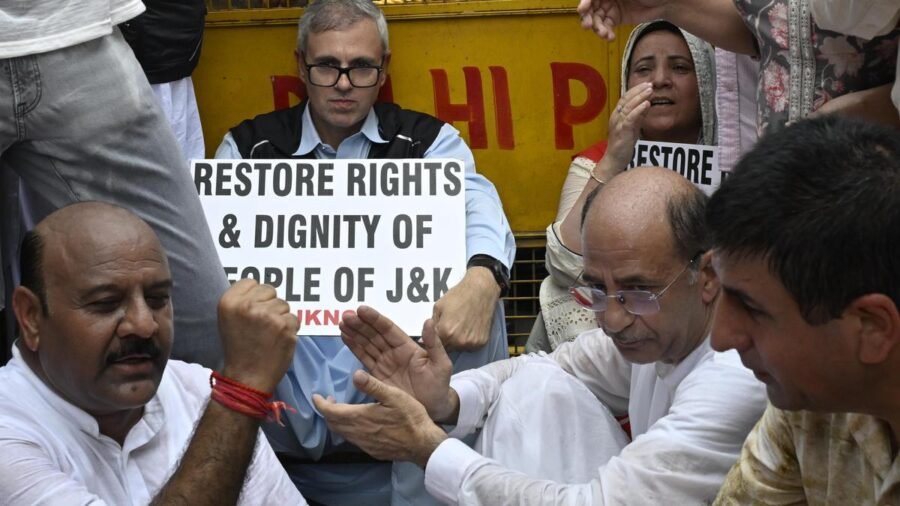
Jammu and Kashmir Chief Minister Omar Abdullah descended onto New Delhi’s streets, in July, with his Cabinet in tow to press for restoration of J&K’s federal guarantees — he was denied permission to protest at the emblematic Jantar Mantar. The Peoples Democratic Party chief Mehbooba Mufti, and Srinagar MP Ruhullah Mehdi spearheaded separate programmes in Delhi in the following days. If one had expected this line up of events in the capital to be a surreal moment of reclaiming Kashmir’s democratic space for dissent, one was not enthused. What was more prominently illustrated was the deep divisions within the Kashmiri leadership.
After Omar Abdullah came to power in October 2024, he prudently focused on repairing ties with New Delhi. He had hoped that a calibrated navigation would be helpful in negotiating a respectable arrangement for J&K. But in Srinagar, Mr. Abdullah’s political opponents described his exploration of areas of agreement with New Delhi and the tailored camaraderie it entailed, as pusillanimous. They iterated that there couldn’t be a lesser political goal post in Kashmir than reversing the August 5, 2019 legislations that stripped the Himalayan region of its semi-autonomous status.
While Kashmir’s right to dignity and respectable federal arrangement is non-negotiable, the way to realising it cannot be the daily whipping of a rather disempowered local government for not being combative enough. Though this resentment is received well in the echo canyons of people’s online lives, it serves no other purpose except to create a veneer of ideological supremacy for a few. The need of the hour for all of Gupkar’s politicians is to contemplate political unity even when grave disagreement simmers beneath the surface. The importance of political unity cannot be overlooked at a time when rest of India’s Opposition is palpably wary of involving itself in the Kashmir question.
Nearly two years after the electorate turned out in impressive numbers to elect a local Government and upend the “bureaucratic apparatus” that had settled snugly in its absence, the unelected office of the Lieutenant Governor (LG) continues to wield significant power, heightening confusion. In a region with proximity to violence, it may express itself in a spatter of political dismissiveness: not just of the local government but of participatory democracy itself.
Ensuring Kashmiri participation in elections has always been tricky. It is often the outcome of mainstream leaders’ penetrating patronage networks. Rural belts vote more briskly because people have dependence on local politicians, for amenities, and as protective shields against police arbitrariness.
Editorial | Fulfil the promise: On restoring Statehood to Jammu and Kashmir
Case studies of several Public Safety Act detainees underscored that local legislators are often the “go to” persons for political and legal support, a favour paid off with the ballot even when one may not be otherwise upbeat about elections. The bureaucratic apparatus created a vacuum which people voted to reverse. Disarming elected legislators not only runs roughshod on the country’s federal underpinning but has the potential to erode their ground connect and influence on which Kashmir’s participatory democracy is erected.
The importance of handing over full executive powers to J&K’s elected government has also to be understood in terms of its indispensability in law and order related decision-making, especially in a fragile security situation. The non-local bureaucrats advising the LG on Home Affairs are walled off from the region’s political topography, and may deploy rushed, tactless mechanisms in the face of a threat.
After the Baisaran terrorist attack in April 2025, the houses of at least 10 alleged militants were razed, including that of Aadil Thoker, the key suspect, at Guri Thukarpora village in Anantnag. Guri Thakurpora had been an Ikhwan (renegade) village, reportedly pro-India even when militancy raged in the 1990s. If the elected leadership was a stakeholder in security, it could flag the use of brute force, especially at a peripheral space invested with years of trust-building.
The National Conference ought to have understood much earlier that New Delhi was in no mood to cede full-scale executive powers to J&K. It perhaps does so now, and is contemplating a range of resistance activities, though orchestrating street-protests is off its table. While Kashmiris’ struggle is for dignity and rights, not merely statehood, a plausible course to it has to be contrived with political ingenuity and collectively.
Anando Bhakto is a New Delhi-based senior journalist reporting on Kashmir developments
Essar eyes $18-billion US steel plant: Why Indian firms are investing in US amid tariffs
By Sohail Khan · 29 Sep
The volume knob we often forget to turn down
By Sohail Khan · 29 Sep
Woman loses 43 kg in 8 months: What experts say about losing 10 kg in a month
By Sohail Khan · 29 Sep