The Mirzapur test: Can a hit streaming series become a hit movie?
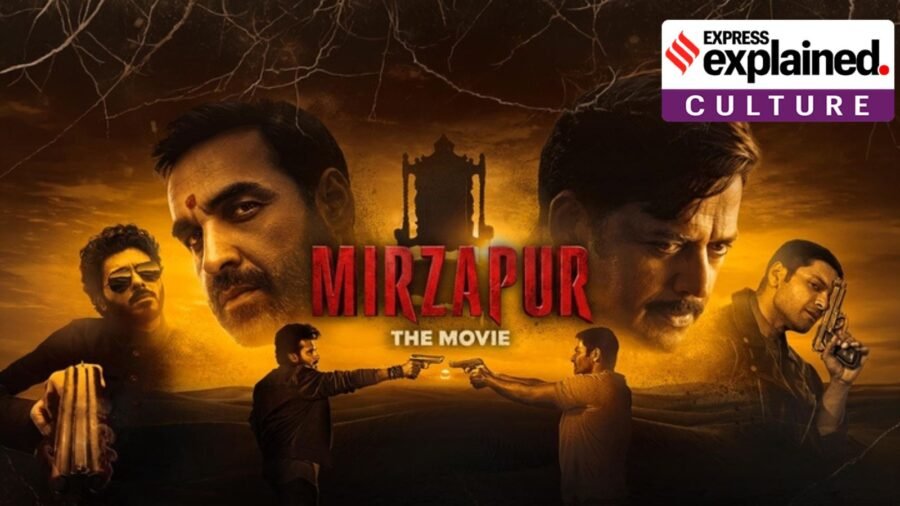
Mirzapur: The Movie is set to release on September 4. While it is not a continuation of the Amazon Original series of the same name, it does bring back the original cast reprising their roles, including Ali Fazal, Shweta Tripathi and Pankaj Tripathi.
Set in the violent world of crime, political power and rival gangs in eastern Uttar Pradesh’s Purvanchal region, the series has built its story around the struggle for control of Mirzapur.
The show’s third season was the most-watched OTT original series in India in 2024, boasting over 30 million streams and a global audience. It was on the Top 10 Trending list on Prime Video in over 85 countries worldwide, including the US, UK, Canada and Australia.
Story continues below this ad
The film now takes that violent Purvanchal underworld to the big screen, testing whether an audience built largely on OTT can be persuaded to pay separately to watch the same characters and universe in cinemas.
Why take Mirzapur to the theatres?
A new theatrical release has to spend on building awareness and convincing audiences to turn up, but Mirzapur enters cinemas with viewers who already know its characters, world and story. Farhan Akhtar, who is producing the film, has said that the demand from fans was one of the reasons the decision was made to take Mirzapur to theatres. The more than 30 million streams for Season 3 point to the scale of that existing audience, while its global rankings also help explain the production’s interest in a wider theatrical release.
But an audience that is willing to stream a show is not necessarily one that will pay separately to watch it in a cinema, making the film a test of whether OTT popularity can translate into theatrical demand.
“While cinema may not be the economic powerhouse it once was relative to games and streaming, it nonetheless carries a cultural cachet that the other mediums do not have,” Liam Burke, Associate Professor and Discipline Leader of Cinema and Screen Studies, told .
Story continues below this ad
“The assumption with a theatrical release is that it’s an event that justifies the audience leaving their home and paying money for something they feel they get for free at home,” he added, pointing to properties such as Game of Thrones and Stranger Things, whose scale and genres can lend themselves to this kind of theatrical treatment.
The promos for the film thus seek to make the theatrical release itself feel like an event for an audience already familiar with the franchise. Ahead of its release, PVR INOX has rebranded select theatres across cities including Mumbai, Hyderabad, Ahmedabad, Jaipur and Lucknow as “MIRZAPVR”, making the campaign something larger than a promo running on a screen; the cinema itself becomes part of the Mirzapur experience.
Tupur Chatterjee, Assistant Professor of Communication and Asian Studies at Tulane University in New Orleans, told that this value can extend beyond the immediate box office, arguing that theatrical cinema can give an IP “a different kind of cultural visibility” and “a different kind of cultural capital” because “the theatrical space still carries a certain prestige.”
The value of the move, then, may extend beyond the immediate box office. A theatrical release could add another layer of cultural and commercial value to an IP whose audience has already been built elsewhere.
Will streaming fans actually buy tickets?
Story continues below this ad
Whether Mirzapur can convert its streaming audience into paying cinema-goers remains an open question. One reason is that streaming popularity and theatrical demand are measured very differently.
“Streaming success is extraordinarily opaque,” Chatterjee says, because platforms have access to “very granular data about who is watching, for how long, where people drop off, what they sample, what they complete,” while much of this information is not available outside the platforms.
“A theatrical release produces a much more public and legible measure of audience demand,” she says, because “people have to leave home, buy an individual ticket, and choose this film over other films playing at the same time.”
This makes the existing streaming audience valuable, but not an automatic box-office guarantee. “The existing streaming audience lowers the cost of familiarity but does not guarantee conversion,” Chatterjee says.
Story continues below this ad
“In any case of adaptation or extension, an existing audience lessens the risks associated with a new release or wider distribution,” Burke similarly argues, but he adds that “each example needs to be taken on a case-by-case basis.”
The question then becomes what makes an IP “theatricalisable”, rather than simply popular.
For Chatterjee, however, the answer also lies in the kind of stardom that streaming has created.
“Streaming has created its own kind of stars,” she says, pointing to actors and characters whose cultural recognition has been built through streaming rather than traditional theatrical cinema. Even though Mirzapur featured established Bollywood names, “Kaleen Bhaiya and Guddu Pandit gave them another scale and kind of recognition through streaming. Divyenndu’s Munna Bhaiya became inseparable from the cultural identity of the show”, Chatterjee said.
Story continues below this ad
So the test is not simply whether Mirzapur has enough viewers. It is whether familiarity with its characters, stars and world is strong enough to make watching them in a cinema feel like a distinct experience worth paying for.
Despite collaborating with the production team on the marketing campaign, PVR INOX says it is treating Mirzapur like any other feature film when allocating screens and shows.
“We are treating it like any other feature film,” Kamal Gianchandani, Chief Business Planning & Strategy, PVR INOX Limited, told , adding that the chain assesses “the box office potential” before allocating screens and shows, with week two determined by the film’s week one performance.
Could streaming and theatres become one IP ecosystem?
The movement of Mirzapur into theatres may appear to reverse the traditional film-to-streaming trajectory, but Chatterjee argues that the relationship between the two mediums is better understood as a circulation of IP, audiences and cultural capital.
Story continues below this ad
“So I see a loop rather than a one-way shift,” she says. “Multiplex cinema helps produce an aesthetic, a star ecology, and an audience formation; early streaming inherits and expands that formation; streaming creates new kinds of mass recognition and stardom around it; and now that cultural capital returns to theatrical cinema.”
Peaky Blinders followed a comparable route in 2026: after six seasons as a television series, Peaky Blinders: The Immortal Man received a limited theatrical release before arriving on Netflix, with Cillian Murphy reprising his role.
“The key distinction is that the boundaries between film and TV have blurred,” Burke says. The reverse movement (from series to film) does not necessarily mean that streaming is replacing the theatrical system, but that the two can increasingly feed into one another.
For Gianchandani, this is also where Mirzapur may have wider commercial significance. He describes the film less as creating a new category for exhibitors and more as “another way to monetise IP” through a property that already has “a built-in audience” and therefore “a high probability of success at the box office.”
Story continues below this ad
If Mirzapur works, he says, “many other producers will follow Excel”, and exhibitors could benefit “in the long term.”
Gianchandani sees the relationship between the OTT and theatres as potentially working both ways. “Often media has spoken about one at the cost of the other, one distribution platform at the cost of another,” he says, but Mirzapur could be “an example of one platform feeding the other platform.”
The theatrical film could even expand the streaming franchise rather than simply drawing from it, he says: “It will attract tons of people, and in fact it will build new audiences for Mirzapur as an IP,” with some viewers potentially going back to streaming to watch the original series.
The success of a single title, however, would not be enough to establish how significant this move is for the wider film industry. Films have long adapted different kinds of source material, and their success has depended on a range of factors beyond the strength or popularity of the original source.
Story continues below this ad
Mirzapur will offer an early test of how far a streaming audience can travel from OTT platforms to cinema halls.

Nepal tragedy shows climate ignores borders. China and India must understand this
By Sohail Khan · 2 Sep
Floodwater fish warning: Why Bihar has advised people against eating them
By Sohail Khan · 2 Sep

Leave a Reply