Speed-breakers are a necessary evil
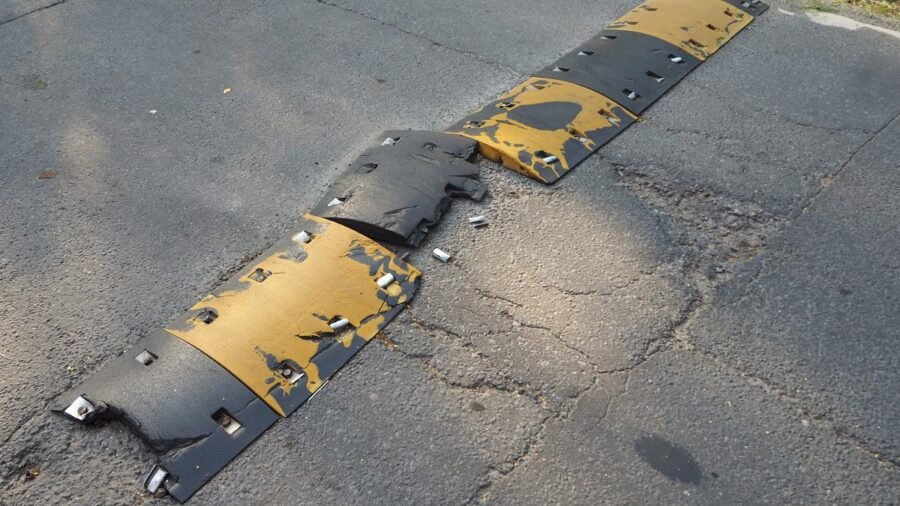
Every evening, when I go for a walk, I face motor vehicles encroaching on the footpath at specific spots. These spots have speed-breakers. Drivers prefer to avoid them as it is convenient to go on the footpath. Occasionally, some motorcyclists even honk at me to move aside and let them pass while I am on the footpath.
Everybody dislikes speed-breakers for their own reasons. Motorists do not like them for the discomfort they cause while driving. They cause wear and tear to the vehicles when they are not built to standards. People with health issues and those pregnant see them as devils.
Pedestrians hate them equally for ruining their peaceful walk when the vehicles start crossing over the footpath to avoid the bump. Bicyclists often wish they had a separate lane free of all such nuisances. But speed-breakers are supposed to augment safety. Well, in theory, yes. Practically, it is somewhat debatable.
A government response in Parliament presents some data to reflect upon. In the year 2014, as many as 11,008 road accidents occurred due to speed-breakers in which about 3,633 persons were killed and 9,428 injured. A year later, 11,084 road accidents were attributable to speed-breakers, causing 3,409 deaths and injuring 9,764 people.
Empirical studies have found that vehicles consume significantly more fuel if speed-breakers are present because of the deceleration and the acceleration that follows. Apart from the energy and the economic loss, speed-breakers slow down traffic in urban scenarios and increase air pollution.
Speed-breakers might have a utility in certain areas such as parking lots, schools, and hospitals. However, their omnipresence fuels annoyance for sure. Principles of design thinking must be applied to achieve the positives that the speed-breakers are supposed to offer. Instead of making vehicles slow down at regular intervals, make it taxing for vehicles to accelerate in certain circumstances, which is possible through modern technology.
Though one wishes to see them go, the rich history that the speed-breakers carry along with them cannot be ignored. Romans have used such bumps on roads to slow down the horse-driven carriages. A Nobel-winning physicist, Arthur Holly Compton, was bothered by the speeding motorists at his university and thus the modern speed-breakers were invented. A group of researchers were awarded the Ig Nobel Prize for linking pain suffered by some when passing over speed-breakers to the possibility of appendicitis.
Speed-breakers have earned various nicknames around the world. In the U.K., they go by “sleeping police officers” and in New Zealand, they are known as “judder bars”. They honour their inventor when they are called “holly hump”. Today, while researchers are exploring ways of generating energy from speed-breakers, one waits patiently for that invention that serves as a viable alternative to those bumps.
emailtoaakashbajpai@gmail.com
Rishi Sunak, Ro Khanna, Dinesh D’Souza: united by colour; divided among white nationalists
By Sohail Khan · 28 Sep
From Nepal to India, how AI is improving disaster management
By Sohail Khan · 28 Sep
40 years ago September 28, 1986: Relief for Haryana farmers
By Sohail Khan · 28 Sep
Leave a Reply