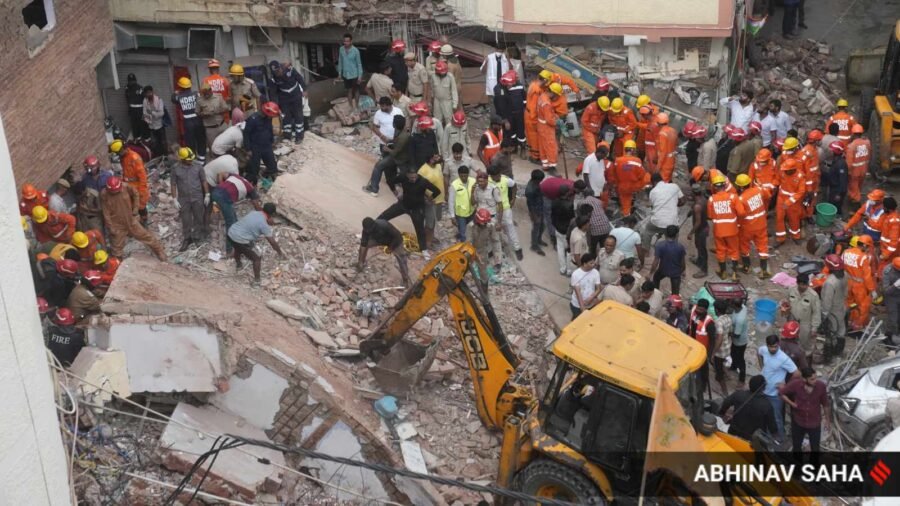
Satya Niketan tragedy and the normalisation of planning failure
By Zachariah Jacob
Delhi must be uncompromising about unsafe buildings. An unsound structure, illegally altered, without safe exits, or dangerous to its occupants and neighbours must be identified early and acted against firmly.
Advertisement
About that, there can be no dispute. But the building collapse in Saidulajab in May, the Hauz Rani fire in June, and now the Satya Niketan tragedy, where seven people died in a building used as student accommodation, should force the city to ask a far more uncomfortable question: Where was the system before the disaster?
A blanket announcement that all illegal construction above four floors will now be sealed may sound decisive, but it cannot be the answer. It does not explain how such buildings are allowed to come up, get altered, occupied, connected to services and used for years before they come to the attention of the authorities.
The Supreme Court’s 2006 directions in the M C Mehta case are often cited whenever Delhi launches a sealing drive. These directions were principally concerned with commercial misuse of residential premises. They contemplated public notice, an opportunity to stop misuse and a structured enforcement process.
Advertisement
None of this can or should protect a dangerous building. If a building is unsafe, it must be evacuated and acted against. If an unauthorised addition is structurally hazardous, it cannot be allowed to remain. But the administration must be clear about what it is acting against: Unauthorised construction, hazardous alteration, commercial misuse, unsafe occupancy, failure of fire compliance, or some combination of these.
The deeper problem is the normalisation of planning failure. For a small business in South Delhi, the choices are brutally narrow. Either pay prohibitive rents in a mall or an established high street market, or find a location where there is demand but the legal and planning position is unclear. A handful of malls and decades-old markets cannot absorb the commercial aspirations of a city this large. That is why urban villages and peripheral settlements, such as Hauz Khas Village, Shahpur Jat, Chhatarpur and Saidulajab, have become the city’s accidental commercial incubators. Many of Delhi’s most interesting businesses began in locations that gave them room to start before they could afford the rents in the formal high streets. Blue Tokai’s first cafe, for example, came up in Champa Gali, while Cafe Dori took a chance on an old warehouse complex in Chhatarpur’s Dhan Mill.
The state should have learned from this. Instead, it has often tolerated commercial activity informally, licensed it in fragments, collected charges around it, and then treated the same ecosystem as wholly illegal when something goes wrong.
The Master Plan for Delhi 2021 recognises some of this complexity. It permits particular categories of small retail and commercial activity, subject to conditions, including in village abadis and unauthorised regularised colonies. But a modern café, studio, small restaurant, design business or student-accommodation cluster cannot be governed through narrow exceptions and contradictory departmental approvals.
The old language of “lal dora” cannot be allowed to do the work of an urban policy. But neither can it be treated as a licence to build anything anywhere. The practical questions are straightforward: Is the structure safe; can a fire tender reach it; are exits, electrical systems, kitchens, sanitation and occupancy limits compliant; and is the activity suitable for the locality?
That is what planned regularisation should mean — structural audits, fire upgrades, occupancy limits, access improvements, necessary penalties and a time-bound opportunity to cure remediable defects. Buildings that cannot be made safe should not continue. Those that can comply should be shown how.
Delhi needs to move from panic to systems. It needs a citywide, risk-based safety audit rather than a floor-count-based reaction. Buildings should be publicly classified as safe, requiring rectification, or requiring immediate evacuation. Structural and fire risk must lead the exercise.
Every building should have a single shared digital record covering its sanctioned plan, alterations, occupancy, trade licence, fire status, complaints, inspections and enforcement history, so tenants are not blindsided after investing significant capital expenditure. One arm of government should not be able to license an activity while another treats the same activity as impermissible, without transparency and a reasoned decision.
Coaching centres and affordable, structurally safe student PGs must be expressly permitted in suitable planned areas, especially near education hubs and public transport. Not planning for this demand pushes students and operators into unregulated buildings and narrow lanes. Permission must be tied to non-negotiable structural certification, fire clearance, evacuation access, occupancy norms and periodic inspections.
The recently announced Master Plan 2047 speaks of mixed-use development, commercial-centre renewal, planned expansion and ease of doing business. The test will be whether it produces practical, lawful and affordable options for ordinary entrepreneurs, students and small businesses, not only for large developers.
Ease of doing business does not mean relaxed safety. It means that a business knows exactly what it must do, receives a coordinated inspection, and has a predictable path to compliance.
The question is not whether Delhi should enforce the law. Of course it should. The question is whether it will enforce the law fairly, intelligently and before people die.
The writer is founding partner, Mahabelly and Mahabelly Canteen. Mahabelly Canteen in Saidulajab has challenged an MCD sealing notice. The Delhi High Court has granted interim protection while directing the MCD to consider its response through a reasoned decision. This article does not address the merits of that case

The jungle knows where the tiger is — here’s how to read the signs
By Sohail Khan · 1 Oct
Jyotika praises her mother-in-law, says ‘only a queen can raise a prince’
By Sohail Khan · 1 Oct
Can a police confession justify NSA detention? What Supreme Court said in Sambhal case
By Sohail Khan · 1 Oct