New problem loading for oil mkt as Hormuz is shut
Benchmarks
Nifty23,398.10-79.71
FEATURED FUNDS★★★★★
Motilal Oswal Midcap Fund Direct-Growth
5Y Return
21.93 %
Invest Now
Enter search text:
Business News›Industry›Energy›Oil & Gas›New problem shaping up for the oil market as Hormuz remains shut
Read Today's Paper
New problem shaping up for the oil market as Hormuz remains shut
Synopsis
Houthi forces have seized Perim Island, threatening the vital Bab el-Mandeb Strait shipping lane. This development occurs as the Strait of Hormuz faces severe disruptions, impacting global oil flows. Saudi Arabia increasingly relies on the Red Sea route, which is now at risk from these advances. Higher oil and diesel prices reflect the growing strain on the global energy system.
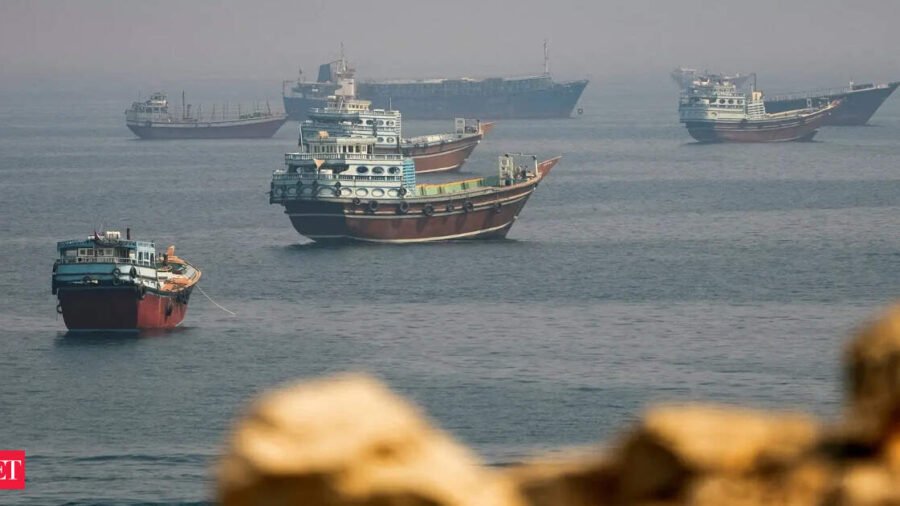
 Reuters
The oil market is facing the prospect of a second major choke point at a time when the first one, the Strait of Hormuz, is already severely disrupted. Iran-backed Houthi forces have seized Yemen's Red Sea port town of Mocha and moved onto Perim Island at the mouth of the Bab el-Mandeb Strait, as per a CNN report, putting them in a position to threaten a route that has become far more important to Saudi Arabia since Hormuz was effectively closed to most traffic. Brent crude briefly climbed above $107 a barrel this week and was still headed for an 8% weekly gain on Friday, while US diesel prices crossed $6 a gallon for the first time.
The immediate threat is not that the Houthis suddenly stop every ship passing through Bab el-Mandeb. The bigger danger is that they make the route too risky for commercial operators at precisely the moment when Gulf producers need it most. That would leave an already strained global oil system with fewer ways to move crude from the Middle East to Europe and beyond.
A second choke point emerges
Perim is a small volcanic island sitting almost in the middle of the Bab el-Mandeb Strait. Its geography matters far more than its size. The island is close to the Yemeni mainland at the southern entrance to the Red Sea and sits along the maritime corridor connecting the Gulf of Aden with the Red Sea.
Trump rejects Saudi request for strikes on Houthis: Axios
That gives the group something it has not had in quite this form before — a combination of territory on the coast and a position directly beside the maritime chokepoint.
It does not mean the Houthis automatically control Bab el-Mandeb. Ships can still pass and the strait is wide enough to prevent a simple physical closure by a small force. But modern shipping does not need a waterway to be physically sealed for it to become commercially unusable. A credible threat from missiles, drones or other weapons can be enough to make shipowners reroute.
The Houthis demonstrated that during their earlier Red Sea campaign. Shipping through Bab el-Mandeb fell by roughly 60% after attacks began in late 2023, according to AP citing Lloyd's List Intelligence. Traffic subsequently recovered and Saudi Arabia increasingly relied on the Red Sea route in 2026 to compensate for the collapse in Hormuz traffic. That recovery is now at risk.
Hormuz made Bab el-Mandeb much more important
The strategic significance of the Houthi advance cannot be understood without looking at what happened to Hormuz. Before the Iran war, the Strait of Hormuz carried an average of 21.6 million barrels per day of crude oil and petroleum liquids in the fourth quarter of 2025. By the second quarter of 2026, that had fallen to just 4.9 million bpd, according to the US Energy Information Administration. The disruption forced Gulf producers to look harder for alternative ways to move their oil.
You Might Also Like:
As Saudi tensions with Iran-backed Houthis escalate, mediator Pakistan faces pressure to choose a side
The Saudi workaround is under pressure
The timing is particularly bad for Saudi Arabia. Its crude production and exports have already been hit by the wider conflict. The International Energy Agency said Saudi crude supply fell by 2.3 million barrels per day in August to around 6 million barrels per day, its lowest level in more than three decades. Reuters attributed part of the disruption to attacks involving shipping around the Red Sea and wider attacks on Saudi energy infrastructure.
Satellite imagery reviewed by Reuters on Thursday also showed smoke near the East-West pipeline. There was no confirmation from Saudi authorities that the pipeline itself had been attacked, so the imagery should not be treated as proof of damage. But even the possibility is significant because the pipeline has become an important alternative to Hormuz.
The Houthis have already shown that their campaign is no longer limited to occasional attacks on commercial shipping.
On September 8 they launched a wave of attacks against southern Saudi Arabia, targeting locations around Abha, Jazan, Najran and Khamis Mushait. AP reported that the strikes ignited fires at oil-related facilities, including the area around the 400,000-barrel-per-day Jazan refinery. Saudi Arabia has responded with airstrikes inside Yemen.
The result is a widening circle of risk. Oil production can be disrupted at the wellhead. Pipelines can be attacked. Export terminals can be threatened. Tankers can be targeted. Even when physical damage is limited, insurers and shipowners can decide that the risk premium is too high. This factor may prove more important than the number of missiles fired.
The oil market is already showing the strain
The price reaction this week has been sharp. Brent rose more than 6% on Thursday to settle at $107.63 a barrel. WTI settled at $102.48. Both were their highest levels since May 19. On Friday prices fell as reports emerged of possible talks over shipping through Hormuz, but Brent was still around $104 and remained on course for an 8% weekly gain.
The decline on Friday therefore does not amount to a resolution of the supply problem. It mainly reflects the possibility that diplomacy could restore some traffic through Hormuz. If Hormuz improves while Bab el-Mandeb deteriorates, the oil market may not get the relief it expects. Saudi Arabia and other Gulf producers could regain some ability to move crude through one route only to find that another route has become unsafe.
The market is also becoming more sensitive to refined products. US diesel prices crossed $6 per gallon this week, according to Reuters. The pressure comes from the combination of Middle Eastern supply disruptions and attacks on Russian refineries by Ukraine. Diesel has therefore been hit by problems on both the crude supply side and the refining side.
That makes the current episode different from a straightforward crude-price shock. Diesel, jet fuel and other products are becoming more expensive because the physical system that produces and transports them is under stress. Commerzbank has already raised its year-end Brent forecast to $85 a barrel from $75. It also raised its forecasts for diesel and jet fuel. The bank's new numbers may still look conservative if the disruption of both Hormuz and Bab el-Mandeb persists. Goldman Sachs predicts crude oil can touch $120.
Bab el-Mandeb is smaller than Hormuz, but that does not make it minor. It is not a substitute for Hormuz in terms of the volume of oil that normally passes through it. Hormuz was the world's most important oil chokepoint before the war. But the importance of a chokepoint depends on what the alternative routes look like. For Europe-bound Gulf oil, closing or severely restricting Bab el-Mandeb can force tankers to travel around the Cape of Good Hope. That adds thousands of nautical miles to some journeys and ties up ships for longer. The same problem applies to container shipping and other commercial traffic using the Red Sea-Suez corridor.
The EIA's latest figures show oil flows through the Suez Canal and the SUMED pipeline averaged about 5.8 million barrels per day in the second quarter of 2026. Bab el-Mandeb carried 8.1 million barrels per day during the same period. The Red Sea therefore sits between a major source of energy and a major consumer region. A sustained Houthi threat could force more tankers around Africa even if there is no formal blockade. That would increase freight costs, absorb more tanker capacity and lengthen delivery times. The impact would eventually show up in crude differentials and refined-product prices.
The Houthis do not need to stop every ship
There is a tendency to describe chokepoints in binary terms — either ships can pass or they cannot. But the commercial reality is different. A shipping company does not need to believe that every vessel will be attacked. It needs to believe that the expected cost of using the route is higher than the cost of taking a longer route. That calculation includes insurance, war-risk premiums, security arrangements, crew safety and the possibility of a vessel being stranded after an attack.
The group has said its latest campaign is aimed at Saudi-linked shipping rather than international maritime traffic generally. But shipowners have little reason to assume that distinction will remain reliable once the fighting spreads around the coastline. Reuters reported that Houthi advances have already curtailed shipping activity after Houthis have already demonstrated that they understand this dynamic.
The seizure of Perim adds another layer because it gives the Houthis a position close to the actual maritime corridor rather than merely a launch point deeper inside Yemen. That could make the threat more persistent.
The military problem for Washington
The US now faces a difficult strategic choice. If Washington decides to protect Bab el-Mandeb with naval forces, it risks opening another military commitment while already trying to keep Hormuz open. The two waterways sit on opposite sides of the Arabian Peninsula, meaning that a serious campaign to secure both would require sustained naval and air resources.
That is precisely the pressure Iran would want to create through its regional network. The Houthis give Iran a way to impose costs on Saudi Arabia and global shipping without Iran having to directly confront every vessel itself. Reuters has reported that Iranian Revolutionary Guard personnel were involved in the Houthi offensive, although Tehran denies that it commands the group's operations.
There is also a risk of escalation inside Yemen. The country had largely avoided a return to the full-scale war that preceded the 2022 truce. The latest offensive threatens that equilibrium. AP reported that more than 46,000 people have already fled amid the renewed fighting.
A Saudi-backed counteroffensive could therefore turn the Red Sea coast into another major battlefield. That would make commercial shipping even harder to insure.
The supply numbers are getting uncomfortable
The broader oil balance is already deteriorating. The IEA now expects global oil supply in 2026 to fall by 5.7 million barrels per day, or around 6%, because of the Middle East conflict and related disruptions. It also estimates that oil inventories fell by 3.1 million barrels per day in August. Saudi output has fallen particularly sharply.
At the same time, demand is weakening because high prices and economic disruption are destroying some consumption.
That can provide some cushion to the market. It is one reason a $100-plus oil price does not necessarily imply an immediate physical shortage for consumers everywhere. But the cushion is not unlimited. A market can absorb a temporary shipping disruption by drawing down inventories, using spare capacity or diverting cargoes. It becomes much harder when several of those mechanisms are being tested simultaneously.
Hormuz is already severely constrained. Russian refining has been disrupted by Ukrainian attacks. Saudi production has fallen. Now Bab el-Mandeb is at risk. The concern is therefore less about one dramatic supply loss than about several smaller disruptions reinforcing each other.
The real danger is a prolonged two-chokepoint squeeze. The Houthis may not hold Perim indefinitely as front lines in Yemen can change quickly, and Saudi-backed forces are already talking about counteroffensives. But the perception of risk survives even if the battlefield keeps changing.
If insurers continue charging high war-risk premiums and shipping companies keep diverting vessels around Africa, the Red Sea will remain commercially impaired. Retaking Perim would not immediately restore normal traffic if shipowners still believe the route could come under attack again. That is why the latest Houthi advance can impact the oil market even before there is a formal blockade.
Add 

(You can now subscribe to our WhatsApp channel)
(Catch all the Business News, Breaking News and Latest News Updates on The .)
…moreless
(You can now subscribe to our WhatsApp channel)
Read More News on
oil market disruptionglobal oil supply challengesHouthi forces impact on oilSaudi Arabia oil exportsStrait of Hormuz issuesRed Sea maritime corridordiesel prices surgecrude oil transport risksIran Houthi conflict
(Catch all the Business News, Breaking News and Latest News Updates on The .)
…moreless


Enter search text:
Continue reading with one of these options:
Limited Access
Free
Login to get access to some exclusive stories
& personalised newsletters
Login Now
Unlimited Access
Starting @ Rs120/month
Get access to exclusive stories, expert opinions &
in-depth stock reports
Subscribe Now
ET
Unlock Access to All Exclusives with ETPrime FREE TRIAL
15 Days Free: Unlock All ETPrime Exclusives, Market Tools & ePapers
Trial offer expiring in00 : 05 : 00
I'd rather pay ₹2599 now


Uh-oh! This is an exclusive story available for selected readers only.
Worry not. You’re just a step away.

Prime Account Detected!
It seems like you're already an ETPrime member with
Login using your ET Prime credentials to enjoy all member benefits
Log out of your current logged-in account and log in again using your ET Prime credentials to enjoy all member benefits.
Unlock ETPrime's Exclusive Stories Today!
Subscribe to gain powerful insights on business, stock market and industry trends.
Big Price Drop! Flat 40% Off
Student Only Offer
Already a Member? Sign In now
Already a Member? Sign In now
Already a Member? Sign In now
Offer Exclusively For You
Save up to Rs. 700/-
ON ET PRIME MEMBERSHIP
Avail Offer
Offer Exclusively For You
Get 1 Year Free
With 1 and 2-Year ET prime membership
Avail Offer
Offer Exclusively For You
Get 1 Year Free
With 1 and 2-Year ET prime membership
Avail Offer
Offer Exclusively For You
Get Flat 40% Off
Then ₹ 1749 for 1 year
Avail Offer
Offer Exclusively For You
ET Prime at ₹ 49 for 1 month
Then ₹ 1749 for 1 year
Avail Offer
Special Offer
Get flat 40% off on ETPrime
Avail Offer
Avail Offer
Claim NowAlready a Member? Sign In now
Need Assistance?
Connect with an ETPrime expert for personalized support and guidance
+91 9484700004
' + h3 + '
' + h4 + '
- ' + listing + '
What’s Included with

1Exclusive Insights That Matter
Uncover the truth with our investigative stories
Make strategic moves using the real-world case studies
Read industry-specific stories to identify emerging trends
Spot opportunities with in-depth insights that matter

Trump temper on H-1B visas is forcing Indians to do these things to stay put in US

What Adani’s US indictment means for India Inc’s overseas fundraising

Why veterans like Reliance, L&T are on acquisition spree? Aswath Damodaran has an answer.

Will China’s dollar bond sale in Saudi Arabia trump the US in financial world?

Huawei launches its own OS to compete with Google and Apple. But can it win beyond China?

The problem with lab grown diamonds

Why a falling rupee is a better option for the economy

A list of top 20 momentum stocks that have delivered massive returns in one year
2Invest Wisely With Smart Market Tools & Investment Ideas
Alpha Trade

Get daily trade ideas from SEBI-registered research analysts.
Investment Ideas

Grow your wealth with stock ideas & sectoral trends.
Stock Reports Plus

All-in-one stock research with Stock Score, peer comparison & key signals.
BigBull Portfolio

Get to know where the market bulls are investing to identify the right stocks.
Stock Analyzer
Check the score based on the company's fundamentals, solvency, growth, risk & ownership to decide the right stocks.
Market Mood

Analyze the market sentiments & identify the trend reversal for strategic decisions.
Stock Talk Live at 9 AM Daily

Ask your stock queries & get assured replies by ET appointed, SEBI registered experts.
3Stay informed anytime, anywhere with ET ePaper
ePaper – Print View
Read the PDF version of ET newspaper. Download & access it offline anytime.
ePaper – Digital View
Read your daily newspaper in Digital View & get it delivered to your inbox everyday.
Wealth Edition

Manage your money efficiently with this weekly money management guide.
4Times Of India Subscription (1 Year)
ePaper

Read the PDF version of newspaper. Download & access it offline anytime.
Deep Explainers

Explore the In-depth explanation of complex topics for everyday life decisions.
Health+ Stories

Get fitter with daily health insights committed to your well-being.
Personal Finance+ Stories
Manage your wealth better with in-depth insights & updates on finance.
New York Times Exclusives
Stay globally informed with exclusive story from New York Times.
5Enjoy Complimentary Subscriptions From Top Brands
Docubay Subscription

Stream new documentaries from all across the world every day.
Stories you might be interested in

What are ghost particles? Nobel’s answer
By Sohail Khan · 6 Oct
Govt may consider ATF price stabilisation fund
By Sohail Khan · 6 Oct
B’luru to get nine new townships, 300-km metro line
By Sohail Khan · 6 Oct