Naxalbari to Dimagi Naxal: The Left’s evolution and fragmentation
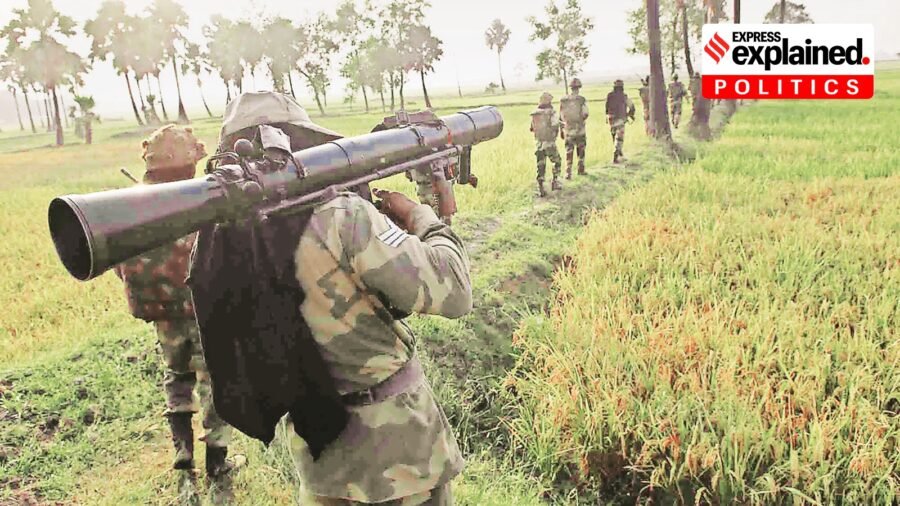
Prime Minister Narendra Modi used the term ‘Dimagi Naxal’ (those with a ‘Naxalite mindset’) again recently, in an address to the students of Shri Ram College of Commerce. Modi said that in his Independence Day speech, he had used the term as a “homeopaethic pill” and that the ‘Dimagi Naxals’ had revealed themselves through their reactions.
Following the controversy over the term after Modi’s Independence Day speech, Minister of Parliamentary Affairs Kiren Rijiju had clarified that the term ‘Dimagi Naxal’ did not refer to Opposition leaders but to those who ‘stood with Maoists and separatists, supported Article 370 and Northeast separatism, and rejected the Constitution’.
Who is a Naxal?
The term ‘Naxal’ comes from Naxalbari, a village in West Bengal’s Darjeeling district, which in May 1967 saw a peasant uprising on the lines of the Chinese Communist Revolution led by Mao Zedong.
In mainstream understandings, the ideas associated with the Naxal movement in India have undergone a substantial transformation over the years, with it now largely understood to mean armed revolt against the State, and more broadly associated with mindless violence. However, its origins lay in questions of justice and inequality, epitomised in the popular Maoist slogan ‘land to the tillers’.
Professor Tanweer Fazal of the School of Liberal Studies at Gurgaon’s BML Munjal University pointed out that “the demand for ‘land to the tillers’ was also part of the Indian national movement, though it did not hold on to it”.
How are Naxals, Maoists, and Marxists different?
Under the leadership of Charu Mazumdar, a prominent Naxalbari leader, the Communist Party of India (Marxist–Leninist), or CPI(ML), was formed on April 22, 1969. It went on to become one of the principal political formations of the Naxalite movement, which is also broadly called the Maoist movement in India. ‘Maoist’ and ‘Naxal’ are often interchangeably used.
But even as Naxalbari is often considered as the birthplace of Indian Maoism, it was a faction of the Communist Party of India that, much earlier in 1948, had formally adopted the ideology of Mao Zedong’s “Chinese liberation struggle” in Telangana.
Story continues below this ad
In Beyond Naxalbari: A Comparative Analysis of Maoist Insurgency and Counterinsurgency in Independent India, scholars Jonathan Kennedy and Sunil Purushotham trace its genesis all the way back to the 1946–1951 Telangana peasant revolt, when villages backed by Communists fought the Nizam’s regime and oppressive landlords, in a movement that intensified when the princely state of Hyderabad refused to join the Indian Union.
These cadres faced “heavy-handed” suppression by the Congress-led Union government following the 1948 Army operation that led to Hyderabad’s accession to India. Many fled to the hills where, as the paper puts it, tribal rebellion met Maoist insurgency, and the armed struggle continued into the later years, even after the CPI, wanting to contest the new nation’s first elections, had called it off in 1951.
In 1964, the CPI split, and thus was born the Communist Party of India (Marxist), or CPI(M), which aligned more with the Chinese communist approach — emphasising peasant mobilisation and revolutionary struggle — than the Soviet model of centralised, state-led development.
The CPI(M), whose cadres are specifically called Marxists in the Indian context, even as both parties take their ideology from Marxist theory and remain integrated in the Indian democratic framework, went on to push for sharper positions against the then-dominant Congress.
Story continues below this ad
Following Naxalbari, the late 1960s and 1970s were marked by similar uprisings in Andhra Pradesh, Bihar, Uttar Pradesh, Odisha, and parts of what are now Jharkhand and Maharashtra.
In central Bihar, the Naxalites resorted to land grabs and assassinations in the backdrop of the Bihar Abolition of Zamindari Act (1948) and the Land Ceiling Act (1961) largely failing to transfer land to agricultural labourers, leaving them “highly vulnerable” to oppression, including that stemming from caste hierarchy, scholar Rajesh Kumar Nayak has argued in his paper, Naxalism, Private Caste Based Militias and Violence in Central Bihar.
During the late 1970s and 1980s, landowners, framing the activities as a lower-caste movement against the interests of other castes, formed their own private caste-based militias to crush the uprising.
In Chhattisgarh and Odisha (then Orissa), it was the exclusion of tribal communities from development plans that created conditions for the spread of Naxalism, scholar Rajat Kumar Kujur’s paper, Left Extremism in India: Naxal Movement in Chattishgarh & Orissa, has noted. The protracted war in the later years, however, came under criticism in the same communities where it had found space, with Kujur’s paper linking the rise of Salwa Judum, a militia in Chhattisgarh formed to fight the Naxals, to local backlash.
Story continues below this ad
Gradually, the CPI(ML) also split up, and that too into many factions. The People’s War Group, a major armed branch in undivided Andhra Pradesh, along with the Maoist Communist Centre of India that operated primarily in Bengal-Bihar and had earlier absorbed the Punjab-based Revolutionary Communist Centre of India (Maoist), formed the CPI (Maoist) as late as 2004, pledging to overthrow the State.
Of the factions that joined India’s electoral democracy, CPI(ML) Liberation, which gave up arms in 1992, is now represented by two MPs in the Lok Sabha (both from Bihar).
How does the State see Naxalism?
The larger public, as Jawaharlal Nehru University (JNU) assistant professor at Centre for Political Studies, Amir Ali, told , largely no longer associates Naxalism with a response to “prevailing, persisting inequalities that are only getting worse, becoming aggravated”.
This narrowing of the meaning of Naxalism, as similar-sounding words stripped of its historiography enter our vocabulary, is significant at a time when Home Minister Amit Shah claims that the ideology has been “completely eradicated”.
Story continues below this ad
The State has all along mainly viewed Naxals under a law-and-order framework, said Tanweer Fazal. In the paper, ‘Peace Talks’ as Strategic Deployment: the State, Maoists and Political Violence in India, he made this argument documenting how, after civil society managed to get the two sides to the table for negotiations towards a “just peace” in 2004, talks fell apart as the Centre persisted that Maoists should first lay down arms.
In 2010, during a second attempt, the Maoists had agreed to a ceasefire, which the State had demanded, but the killing of Azad, the CPI (Maoist) leader leading the peace talks, brought the process to a halt.
Still later, talks between the Trinamool Congress and the Naxalites ended after Kishenji was killed in an alleged fake encounter in Bengal in 2011. The TMC supported the 2008 protests of the Naxals against the police and their camps in Lalgarh but, after coming to power, switched the framework.
So, as security forces rout Naxals in their strongholds and the term takes on different connotations in the popular discourse, who is speaking up for the historical roots of the movement of fighting inequality and injustice?
Story continues below this ad
If the Congress is silent because “even if not necessarily in terms of exact military tactics, but largely, it shares the BJP’s opinions on the issue”, the Communists “probably have strategic reasons or, more simply, the Maoists have isolated themselves by seeing everyone else as a betrayer to the cause of revolution”, said Tanweer Fazal. Amir Ali attributes the Left’s silence to its “internal fragmentation” and “a state of paralysis in sufficiently articulating the problem”.

The jungle knows where the tiger is — here’s how to read the signs
By Sohail Khan · 1 Oct
Jyotika praises her mother-in-law, says ‘only a queen can raise a prince’
By Sohail Khan · 1 Oct
Can a police confession justify NSA detention? What Supreme Court said in Sambhal case
By Sohail Khan · 1 Oct