NASA’s 1995 unique embryo experiment
Benchmarks
Nifty23,897.7024.25
Precious Metal
Gold (MCX) (Rs/10g.)152,936.00-2839.0
Enter search text:
Business News›News›International›Global Trends›In 1995, NASA sent 30 fertilised Japanese quail eggs to the Mir space station for 16 days; what scientists found after they returned raised new questions about life without gravity
Read Today's Paper
In 1995, NASA sent 30 fertilised Japanese quail eggs to the Mir space station for 16 days; what scientists found after they returned raised new questions about life without gravity
Synopsis
In 1995, NASA launched a fascinating experiment by sending fertilized quail eggs to the Mir space station. The objective was to explore how embryos develop in a microgravity environment and observations revealed various deformities in the embryos' eyes, limbs, and beaks. Researchers then analyzed these findings against Earth-bound control groups, concluding that space conditions have a significant impact on early life development.
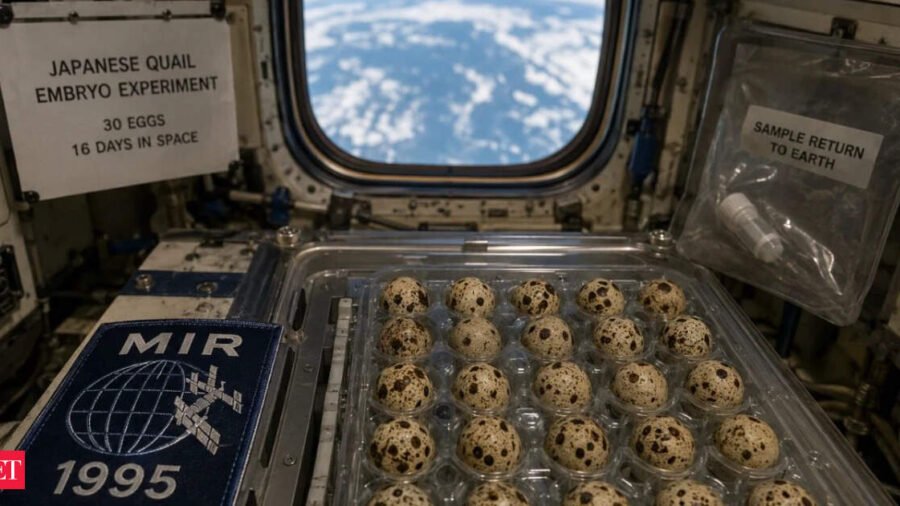
The eggs spent 16 days inside an incubator aboard Mir before their developing embryos were preserved and brought back to Earth for examination (AI generated)
In 1995, NASA sent a batch of fertilised Japanese quail eggs from Earth to the Mir space station as part of an experiment built around a deceptively simple question: can embryos develop normally without the pull of gravity?
The eggs spent 16 days inside an incubator aboard Mir before their developing embryos were preserved and brought back to Earth for examination.
ALSO READ: In 2011, NASA built a 50,000-square-foot California office that used 90% less drinking water and was designed to produce 20% more energy than it needed
At first glance, it may have seemed like a small biological experiment. But researchers were investigating whether the earliest stages of life could unfold normally in an environment where one of the most familiar forces on Earth was almost completely absent. And when scientists examined what had happened to the embryos, the results were not quite what they expected.
Why did NASA send fertilised quail eggs into space?
The experiment was part of NASA’s broader effort to understand how living organisms respond to microgravity.
As astronauts began spending longer periods in orbit, researchers needed to investigate more than the effects of spaceflight on adults. They also wanted to understand what happened to biological processes that normally developed under Earth’s gravity.
ALSO READ: In 2021, NASA grew Hatch chile peppers on the International Space Station; over 137 days, the plants produced harvestable fruit with unusually straight stems
Bird embryos provided a useful way to study the question. The fertilised Japanese quail eggs travelled to Mir aboard the same Space Shuttle mission that carried NASA astronaut Shannon Lucid to the space station. Once there, they were placed inside an onboard incubator.
For the next 16 days, the developing embryos grew in an environment dramatically different from the one they would have experienced on Earth.

The experiment was part of NASA’s broader effort to understand how living organisms respond to microgravity.
The experiment was harder than it sounds
Keeping the eggs inside an incubator was only part of the challenge. Lucid eventually had to remove the eggs individually and preserve the developing embryos so they could be examined after returning to Earth.
ALSO READ: In 1989, Kentucky engineers built a 750-foot road base using about 80 tons of ponded fly ash; the 11% ash section was reported to perform well against the conventional control
Doing this in microgravity created an unusual safety problem. The embryos had to be fixed using a chemical solution. On Earth, a spilled drop would fall onto a surface. Inside a spacecraft, however, a liquid droplet could float through the cabin.
NASA therefore had to develop a specialised system that would allow the astronaut to work with the eggs without releasing potentially dangerous chemicals into the station.
Engineers at NASA’s Ames Research Center designed a system using interlocking bags and attached gloves, giving Lucid a controlled way to handle the eggs and preserve the embryos.
The embryos were growing in a completely different environment
Inside Mir, the eggs were exposed to microgravity rather than the constant gravitational pull experienced by embryos developing on Earth. But gravity wasn't the only difference.
The space station also exposed the experiment to other conditions that could influence biological development, including increased radiation and differences in temperature.
Astronaut Shannon W. Lucid communicates with the ground
support team inside the Core Module of the Russian Mir Space Station
If something unusual appeared in the embryos, scientists would have to determine whether gravity was responsible or whether another aspect of the space environment had played a role. The researchers therefore compared the space-flown embryos with control groups on Earth.
Then scientists examined the embryos
After the embryos were preserved and returned to Earth, researchers could finally examine them in detail. NASA’s records documented the developmental stages reached by the embryos and compared them with the control groups.
What they discovered provided one of the most intriguing clues yet about how the space environment could affect developing life.
The results did not suggest that development simply stopped in microgravity. Instead, the researchers observed a more complicated picture, one that included developmental differences and an unexpected finding that stood out when the space embryos were compared with their Earth-based counterparts.
What did NASA discover?
According to Lucid’s NASA-published account of the mission, 13% of the embryos incubated aboard Mir showed abnormalities, a rate she reported as more than four times higher than that of the Earth-based control embryos.
Later scientific records added more detail to the picture.
Many of the embryos had reached broadly expected stages of development, but some showed abnormalities involving the eyes, limbs and beaks. Researchers also recorded slight differences in growth when the space-flown embryos were compared with laboratory and synchronous control groups.
The findings, however, did not establish that microgravity itself was solely responsible.
Lucid noted that researchers also considered the higher temperature inside the Mir incubator and the greater radiation exposure aboard the space station as possible contributing factors.
Add 

(You can now subscribe to our WhatsApp channel)
(You can now subscribe to our WhatsApp channel)
Read More News on
NASA fertilised quail eggs experimentMir space stationJapanese quail eggs in spacemicrogravity effects on embryosspace station biological researchlife without gravityNASAShannon Lucid astronaut mission


Enter search text:
Continue reading with one of these options:
Limited Access
Free
Login to get access to some exclusive stories
& personalised newsletters
Login Now
Unlimited Access
Starting @ Rs120/month
Get access to exclusive stories, expert opinions &
in-depth stock reports
Subscribe Now
ET
Unlock Access to All Exclusives with ETPrime FREE TRIAL
15 Days Free: Unlock All ETPrime Exclusives, Market Tools & ePapers
Trial offer expiring in00 : 05 : 00
I'd rather pay ₹2599 now


Uh-oh! This is an exclusive story available for selected readers only.
Worry not. You’re just a step away.

Prime Account Detected!
It seems like you're already an ETPrime member with
Login using your ET Prime credentials to enjoy all member benefits
Log out of your current logged-in account and log in again using your ET Prime credentials to enjoy all member benefits.
Unlock ETPrime's Exclusive Stories Today!
Subscribe to gain powerful insights on business, stock market and industry trends.
Big Price Drop! Flat 40% Off
Student Only Offer
Already a Member? Sign In now
Already a Member? Sign In now
Already a Member? Sign In now
Offer Exclusively For You
Save up to Rs. 700/-
ON ET PRIME MEMBERSHIP
Avail Offer
Offer Exclusively For You
Get 1 Year Free
With 1 and 2-Year ET prime membership
Avail Offer
Offer Exclusively For You
Get 1 Year Free
With 1 and 2-Year ET prime membership
Avail Offer
Offer Exclusively For You
Get Flat 40% Off
Then ₹ 1749 for 1 year
Avail Offer
Offer Exclusively For You
ET Prime at ₹ 49 for 1 month
Then ₹ 1749 for 1 year
Avail Offer
Special Offer
Get flat 40% off on ETPrime
Avail Offer
Avail Offer
Claim NowAlready a Member? Sign In now
Need Assistance?
Connect with an ETPrime expert for personalized support and guidance
+91 9484700004
' + h3 + '
' + h4 + '
- ' + listing + '
What’s Included with

1Exclusive Insights That Matter
Uncover the truth with our investigative stories
Make strategic moves using the real-world case studies
Read industry-specific stories to identify emerging trends
Spot opportunities with in-depth insights that matter

Trump temper on H-1B visas is forcing Indians to do these things to stay put in US

What Adani’s US indictment means for India Inc’s overseas fundraising

Why veterans like Reliance, L&T are on acquisition spree? Aswath Damodaran has an answer.

Will China’s dollar bond sale in Saudi Arabia trump the US in financial world?

Huawei launches its own OS to compete with Google and Apple. But can it win beyond China?

The problem with lab grown diamonds

Why a falling rupee is a better option for the economy

A list of top 20 momentum stocks that have delivered massive returns in one year
2Invest Wisely With Smart Market Tools & Investment Ideas
Alpha Trade

Get daily trade ideas from SEBI-registered research analysts.
Investment Ideas

Grow your wealth with stock ideas & sectoral trends.
Stock Reports Plus

All-in-one stock research with Stock Score, peer comparison & key signals.
BigBull Portfolio

Get to know where the market bulls are investing to identify the right stocks.
Stock Analyzer

Check the score based on the company's fundamentals, solvency, growth, risk & ownership to decide the right stocks.
Market Mood

Analyze the market sentiments & identify the trend reversal for strategic decisions.
Stock Talk Live at 9 AM Daily

Ask your stock queries & get assured replies by ET appointed, SEBI registered experts.
3Stay informed anytime, anywhere with ET ePaper
ePaper – Print View

Read the PDF version of ET newspaper. Download & access it offline anytime.
ePaper – Digital View

Read your daily newspaper in Digital View & get it delivered to your inbox everyday.
Wealth Edition

Manage your money efficiently with this weekly money management guide.
4Times Of India Subscription (1 Year)
ePaper

Read the PDF version of newspaper. Download & access it offline anytime.
Deep Explainers

Explore the In-depth explanation of complex topics for everyday life decisions.
Health+ Stories

Get fitter with daily health insights committed to your well-being.
Personal Finance+ Stories

Manage your wealth better with in-depth insights & updates on finance.
New York Times Exclusives

Stay globally informed with exclusive story from New York Times.
5Enjoy Complimentary Subscriptions From Top Brands
Docubay Subscription

Stream new documentaries from all across the world every day.
Stories you might be interested in

The Messi brand may outlive the footballer
By Sohail Khan · 4 Sep
RBI turns to 30-day VRRR to absorb liquidity
By Sohail Khan · 4 Sep
Leave a Reply