Missed ITR deadline? Don’t lose your TDS refund

Synopsis
Missed the ITR filing deadline? Don't panic! You might still claim your TDS refund. Learn about filing belated returns, potential fees, interest, and the crucial condonation process if even that window has passed. Understand the implications for carry-forward losses and deductions. Avoid common mistakes to ensure your refund is processed smoothly.
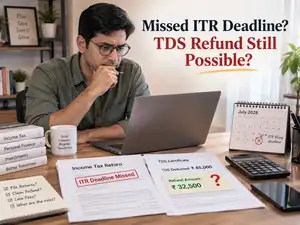
Missing the ITR filing deadline does not necessarily mean losing the income tax refund due to you. But if you file late, there are certain rules, fees and conditions you need to know. So, can you still claim your TDS refund after missing the deadline, and what happens if the belated return window has also passed?
How does TDS work?
Tax Deducted at Source (TDS) is not an income tax amount; it is like an advance tax, but one that is deducted from your income so that the Income Tax Department can track the transaction.
This means that taxpayers who don’t have any income tax liability in India, or whose income tax liability is less than the TDS amount deducted, can file ITR to get an income tax refund (of the TDS deducted).
For example, if your income tax liability is Rs 700, but a TDS of Rs 1,000 has been deducted, you can get a refund of Rs 300 while filing ITR.
Some examples showing TDS refund scenarios:
- NRIs selling property in India can get back the TDS deducted by the buyer while filing ITR if they have no Income tax liability in India or the TDS amount is more than the income tax liability.
- Another example can be a retired senior citizen who earns more than Rs 1 lakh from FD interest, yet his total annual income is less than Rs 12 lakh; these seniors can get the TDS refund back while filing ITR if they have no other income tax liability or the TDS amount is more than the tax liability.
Can you claim a TDS refund if you missed the ITR deadline?
TDS is a tax credit, not an automatic refund. A refund arises only when the tax already paid is more than the taxpayer's final tax liability after the return is filed.
“For FY 2025-26 (AY 2026-27), an individual who has missed the original due date can file a belated return under section 139(4) up to December 31, 2026, subject to the applicable provisions of law,” says Itesh Dodhi, Director, Nangia & Co LLP.
A belated return can, however, attract applicable interest and a late-filing fee of Rs 1,000 or Rs 5,000, depending on total income. If the belated-return window is already over, the taxpayer may need to approach the tax authorities for condonation of the delay.
Condonation of delay in filing an ITR is a special relief provided by the Income Tax Department to taxpayers who miss the prescribed deadline for filing or verifying their return. Every taxpayer is required to file their Income Tax Return and complete its verification within the specified time limit.

What if the deadline for filing a belated return has also passed?
“A taxpayer can make an application to the tax authorities requesting them to condone the delay under section 239(3)(b) (erstwhile section 119(2)(b)), subject to the prescribed conditions,” says Sudhakar Sethuraman, Partner, Deloitte India.
The taxpayer would generally need to demonstrate that there was a reasonable cause for the delay and that the case involves genuine hardship. Condonation is not automatic and is subject to approval by the concerned income-tax authority.
“CBDT Circular No. 11/2024 also provides that a condonation application for a refund claim generally cannot be entertained beyond five years from the end of the relevant assessment year,” says Sethuraman.
Once the condonation request is approved, the taxpayer can file the tax return and claim a refund, he adds.
Taxpayers should keep documents such as Form 16, Form 26AS, Annual Information Statement (AIS) and other records supporting their income and TDS claim ready before making the application.
“Where the amount involved is significant, or the circumstances leading to the delay are complicated, taxpayers should consider consulting a qualified tax advisor before making the application,” says Dodhi.
What late-filing fee and interest can apply?
Filing an ITR after the prescribed deadline can have financial consequences even when the taxpayer is expecting a refund.
“The fee under Section 234F is Rs 1,000 where total income is up to Rs 5 lakh and Rs 5,000 above that. The trigger is worth understanding correctly. It applies where the taxpayer was required to file under Section 139(1) and did not do so in time,” says CA Parag Jain, Tax Head at 1 Finance.
That depends on whether total income crossed the basic exemption limit, not on whether any tax was ultimately payable. A taxpayer whose entire liability was covered by TDS still pays this fee if income exceeds the exemption limit. Where income was below it, there was no filing obligation and no fee arose, he adds.
The fee is not applicable where the taxpayer is not liable to furnish a return. Interest may also be payable where there is an outstanding tax liability.
“Interest at the rate of 1% per month or part thereof is payable on the total income less advance tax, withholding tax and other eligible tax credits. The interest is calculated following the due date for filing tax return until the month of paying the tax dues,” says Sethuraman.
Depending on the taxpayer's circumstances, additional interest u/s 424 & 425 (erstwhile sections 234B and 234C) may also apply where there is a shortfall in payment of advance tax or deferment of advance-tax instalments. These provisions are separate from the late-filing consequences, he adds.
Can filing a belated return affect other tax benefits?
According to Sethuraman, in addition to the late-filing fee and interest, filing a belated return may have other tax implications, including:
- Carry-forward loss: Certain losses, such as business losses and capital losses, may not be eligible for carry forward if the return is filed after the prescribed due date, subject to specific provisions of the Act.
- Impact on deductions and exemptions: Certain deductions, exemptions, or tax benefits may be available only where the return is filed within the stipulated time.
- Continued or wilful non-compliance may, in extreme cases, lead to prosecution proceedings under the applicable provisions of the Income-tax Act.
What mistakes should you avoid while claiming a late TDS refund?
A taxpayer who has missed the filing deadline should not panic. According to Sethuraman, here are the common mistakes to avoid:
- Assuming that a missed due date means the withholding tax (TDS) refund is lost
- Claiming TDS without reconciling Form 168 ( erstwhile Form 26AS): Taxpayers should reconcile the TDS claimed in the ITR with Form 168 before filing. If the TDS reported in the return exceeds the tax credit reflected in Form 168, the refund may be restricted. The Income Tax Department specifically advises taxpayers to address such tax-credit mismatches
- Reporting correct income details: A refund claim should be based on the taxpayer's actual taxable income and eligible deductions/exemptions. Omitting salary, interest income, capital gains, rental income or other taxable income can result in tax demand, interest and potentially penalty/proceedings.
- Forgetting the late-filing fee and applicable interest: Filing a belated return does not mean that the taxpayer only needs to report the refund. Applicable late-filing fee and interest should also be considered.
- Not validating the bank account for receiving the refund: A taxpayer may correctly claim a refund but face difficulty receiving it if the selected bank account is not validated, is inactive/closed, or has a PAN/name mismatch. The e-filing portal provides for bank-account validation and revalidation
- Ignoring a TDS mismatch after filing: If the mismatch is because the deductor has reported incorrect TDS, the taxpayer should approach the employer/deductor for correction of the TDS statement. Simply claiming a higher TDS amount in the ITR does not automatically establish entitlement to that credit.
(Join our ETWealth WhatsApp channel for all the latest updates)
Add 

(Catch all the Personal Finance News, Breaking News, Budget 2025 Events and Latest News Updates on The .)
…more

Tata Sons power battle: Who’s who in the high-stakes boardroom tussle
By Sohail Khan · 21 Sep
Gold rate today: 24k vs 22k vs 20k vs 18k prices
By Sohail Khan · 21 Sep
Hormuz shuttles keep oil flowing, but at a high cost
By Sohail Khan · 21 Sep
Leave a Reply