Hormuz shuttles keep oil flowing, but at a high cost
Benchmarks
Nifty23,418.4572.05
FEATURED FUNDS★★★★★
Motilal Oswal Midcap Fund Direct-Growth
5Y Return
22 %
Invest Now
Enter search text:
Business News›Industry›Energy›Oil & Gas›Hormuz shuttles keep oil flowing, but at a high cost
Read Today's Paper
Hormuz shuttles keep oil flowing, but at a high cost
Synopsis
Middle East oil producers are increasingly using ship-to-ship (STS) transfers off Oman to keep crude exports moving despite disruptions from the Iran conflict and risks around the Strait of Hormuz.
 Reuters
A new shuttling system is reshaping the Middle East oil market, as producers seek to keep exports flowing despite the escalating regional conflict. The question now is whether this complex, expensive process is a stopgap measure or the global energy market's new normal.
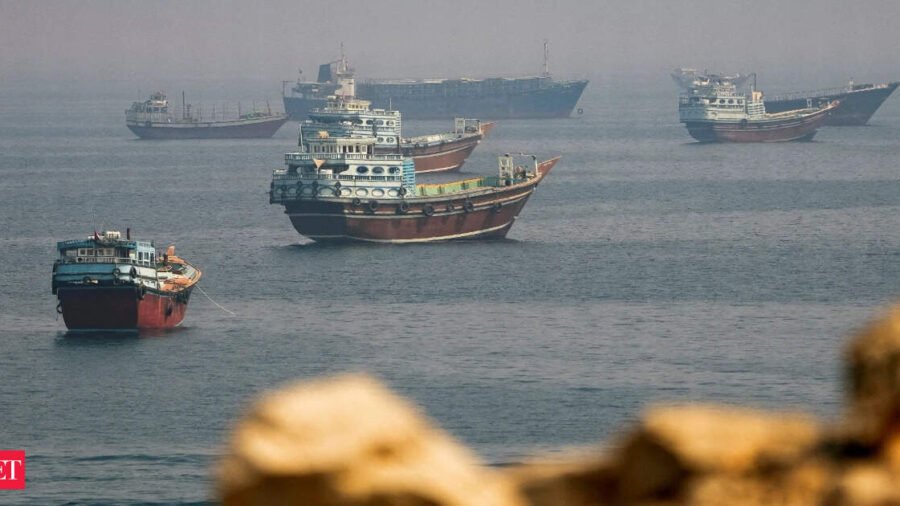
Several miles off Oman's coast, south of the Strait of Hormuz, rows of tankers lie at anchor. Many sit alongside each other, connected by ropes and hoses as they transfer crude from one vessel to another, creating a floating bridge between the Middle East's oilfields and the global market.
ALSO READ | Trump warns he has entered 'deciding mode' on Iran, says 'big things' are in store
Ship-to-ship (STS) transfers have become a vital lifeline for Gulf producers as they adapt to the disruptions caused by the Iran war, now entering its seventh month. Once loaded, a tanker disconnects and heads for its destination, typically a refinery in Asia. The "mother vessel" then returns to the Gulf via Hormuz to reload and repeat the process.
The system cuts the distance any one ship must travel, reducing the risk of transiting the strait, even as an increasing number of tankers are crossing through a narrow corridor along Oman's coastline under US naval protection, with their navigation systems switched off.
ALSO READ | US issues Iran travel warning, urges citizens to leave country amid rising West Asia tensions
Exports through Hormuz have reached around 6.5 million barrels per day (bpd) so far in September, the highest since the brief spike after the June ceasefire, according to Kpler data.
This operation is a testament to the energy industry's remarkable ability to adapt to supply shocks. Yet, it is also a sign of how costly and complex it has become to move oil out of the world's most important exporting region.
Hormuz standoff
Before the US-Israeli conflict with Iran erupted in February, the Strait of Hormuz handled roughly a fifth of global oil consumption. Iran's blockade brought traffic to an abrupt halt, however, forcing producers to divert flows where possible and cut output.
Many shipowners balked at sending vessels through an active conflict zone, and the few willing to take the risk demanded unprecedented premiums.
The energy industry, however, rarely stands still.
Faced with a shortage of available tankers, Abu Dhabi National Oil Company (ADNOC) developed the STS workaround. Instead of using vessels to complete round-trip voyages of several weeks to buyers in Asia, it began employing them in April as shuttle tankers, transporting crude from Gulf terminals to the safer waters of the Gulf of Oman. There, the cargoes could be transferred to larger ships for the onward journey.
The strategy maximised the use of a limited and expensive tanker fleet and allowed at least some vital exports to continue.
In fact, UAE oil exports in September are set to reach 3.6 million bpd, higher than the 2025 average of 3.4 million bpd.
Aramco's in, too
What began as an emergency response has evolved into a sizable new industry.
Saudi Aramco is now increasingly relying on STS operations as disruptions to Red Sea export routes reduce the effectiveness of the kingdom's alternative outlet.
In recent weeks, Yemen's Iran-backed Houthi forces have been tightening their grip on the Bab el-Mandeb Strait at the southern entrance to the Red Sea. And Iran-backed militants in Iraq struck Saudi Arabia's East-West pipeline on September 10, cutting off roughly 4% of global oil supplies that had been flowing to international markets via the Red Sea port of Yanbu.
That confluence of events pushed Brent crude to over $108 a barrel last week before the Saudis began informing buyers that they would keep shipments flowing through STS transfers via the Omani route.
Other regional producers have also adopted the STS method.
According to Kpler, around 2.5 million bpd of crude are expected to be loaded via STS transfers in the Gulf of Oman in September alone, compared with 1.4 million bpd in August. That equates to roughly 40% of the volumes currently moving through Hormuz. STS was rarely used before the war.
Adaptation, not paralysis
The emergence of this floating logistics network has helped prevent a far more severe supply shock, but it comes at a steep price.
Benchmark freight rates for a very large crude carrier (VLCC) transporting Gulf crude to China have surged in recent months to above $30 per barrel, by far the highest level on record, according to LSEG data. With current crude prices around $105, freight now represents over a quarter of the cost, compared with 2% to 3% before the war.
Every additional transfer requires more ships, more time and more money, adding to the costs facing global oil markets.
Producers have been forced to offer deeper discounts on their crude to keep exports competitive, absorbing part of the increased transportation costs themselves.
The expansion of STS transfers in the Gulf has also limited the availability of tankers, pushing up global freight rates dramatically.
"We are witnessing one of the biggest wealth transfers from oil producers to tanker owners," said Keshav Lokhiya, CEO of HiLo Analytics.
Fundamentally, the global energy market is adapting to today's heightened geopolitical risk rather than being paralysed by it. But the Middle East's oil trade is becoming increasingly inefficient, dependent on a patchwork of military escorts, temporary transfer hubs and alternative routes that were never designed to handle such volumes.
The longer the conflict lasts and the more routes come under threat, the more expensive and fragile the global energy system becomes.
(The opinions expressed here are those of Ron Bousso, a columnist for Reuters.)
Add 

(You can now subscribe to our WhatsApp channel)
(Catch all the Business News, Breaking News and Latest News Updates on The .)
…moreless
(You can now subscribe to our WhatsApp channel)
Read More News on
Strait of Hormuzoil exportsMiddle East oil marketBrent crude pricesSaudi AramcoAbu Dhabi National Oil Companyoil shuttling system
(Catch all the Business News, Breaking News and Latest News Updates on The .)
…moreless


Enter search text:
Continue reading with one of these options:
Limited Access
Free
Login to get access to some exclusive stories
& personalised newsletters
Login Now
Unlimited Access
Starting @ Rs120/month
Get access to exclusive stories, expert opinions &
in-depth stock reports
Subscribe Now
ET
Unlock Access to All Exclusives with ETPrime FREE TRIAL
15 Days Free: Unlock All ETPrime Exclusives, Market Tools & ePapers
Trial offer expiring in00 : 05 : 00
I'd rather pay ₹2599 now


Uh-oh! This is an exclusive story available for selected readers only.
Worry not. You’re just a step away.

Prime Account Detected!
It seems like you're already an ETPrime member with
Login using your ET Prime credentials to enjoy all member benefits
Log out of your current logged-in account and log in again using your ET Prime credentials to enjoy all member benefits.
Unlock ETPrime's Exclusive Stories Today!
Subscribe to gain powerful insights on business, stock market and industry trends.
Big Price Drop! Flat 40% Off
Student Only Offer
Already a Member? Sign In now
Already a Member? Sign In now
Already a Member? Sign In now
Offer Exclusively For You
Save up to Rs. 700/-
ON ET PRIME MEMBERSHIP
Avail Offer
Offer Exclusively For You
Get 1 Year Free
With 1 and 2-Year ET prime membership
Avail Offer
Offer Exclusively For You
Get 1 Year Free
With 1 and 2-Year ET prime membership
Avail Offer
Offer Exclusively For You
Get Flat 40% Off
Then ₹ 1749 for 1 year
Avail Offer
Offer Exclusively For You
ET Prime at ₹ 49 for 1 month
Then ₹ 1749 for 1 year
Avail Offer
Special Offer
Get flat 40% off on ETPrime
Avail Offer
Avail Offer
Claim NowAlready a Member? Sign In now
Need Assistance?
Connect with an ETPrime expert for personalized support and guidance
+91 9484700004
' + h3 + '
' + h4 + '
- ' + listing + '
What’s Included with

1Exclusive Insights That Matter
Uncover the truth with our investigative stories
Make strategic moves using the real-world case studies
Read industry-specific stories to identify emerging trends
Spot opportunities with in-depth insights that matter

Trump temper on H-1B visas is forcing Indians to do these things to stay put in US

What Adani’s US indictment means for India Inc’s overseas fundraising

Why veterans like Reliance, L&T are on acquisition spree? Aswath Damodaran has an answer.

Will China’s dollar bond sale in Saudi Arabia trump the US in financial world?

Huawei launches its own OS to compete with Google and Apple. But can it win beyond China?

The problem with lab grown diamonds

Why a falling rupee is a better option for the economy

A list of top 20 momentum stocks that have delivered massive returns in one year
2Invest Wisely With Smart Market Tools & Investment Ideas
Alpha Trade

Get daily trade ideas from SEBI-registered research analysts.
Investment Ideas

Grow your wealth with stock ideas & sectoral trends.
Stock Reports Plus

All-in-one stock research with Stock Score, peer comparison & key signals.
BigBull Portfolio
Get to know where the market bulls are investing to identify the right stocks.
Stock Analyzer
Check the score based on the company's fundamentals, solvency, growth, risk & ownership to decide the right stocks.
Market Mood

Analyze the market sentiments & identify the trend reversal for strategic decisions.
Stock Talk Live at 9 AM Daily

Ask your stock queries & get assured replies by ET appointed, SEBI registered experts.
3Stay informed anytime, anywhere with ET ePaper
ePaper – Print View
Read the PDF version of ET newspaper. Download & access it offline anytime.
ePaper – Digital View
Read your daily newspaper in Digital View & get it delivered to your inbox everyday.
Wealth Edition

Manage your money efficiently with this weekly money management guide.
4Times Of India Subscription (1 Year)
ePaper

Read the PDF version of newspaper. Download & access it offline anytime.
Deep Explainers

Explore the In-depth explanation of complex topics for everyday life decisions.
Health+ Stories

Get fitter with daily health insights committed to your well-being.
Personal Finance+ Stories
Manage your wealth better with in-depth insights & updates on finance.
New York Times Exclusives
Stay globally informed with exclusive story from New York Times.
5Enjoy Complimentary Subscriptions From Top Brands
Docubay Subscription
Stream new documentaries from all across the world every day.
Stories you might be interested in

Tata Sons power battle: Who’s who in the high-stakes boardroom tussle
By Sohail Khan · 21 Sep
Missed ITR deadline? Don’t lose your TDS refund
By Sohail Khan · 21 Sep
Gold rate today: 24k vs 22k vs 20k vs 18k prices
By Sohail Khan · 21 Sep
Leave a Reply