Mining, mountains, and my family’s past: How we can actually save the Aravallis
Advertisement
I come to this argument with a family history of mining. After Independence, my grandfather’s arms and ammunition licence was seized; after Partition, the government no longer trusted that business with a Muslim. He then took eight mining leases from the government, covering enormous stretches of the hills around Udaipur, each for a hundred years.
At the time, there were no roads from the forests to the railheads. Royalties had to be paid whether or not your mineral ever reached a train. In the late 1960s, when my chacha returned from Aligarh Muslim University after studying geology, he persuaded the family to surrender the mines. The mountains had defeated the business.
But mining in our family was never an excuse to treat a mountain as a quarry with a sunset view. My grandfather, father and uncles lived alongside and supported forest-dwelling tribal communities in remote areas where government and NGOs often had little presence. They tried to mine with what they understood as scientific temper and with as little destruction as possible.
Advertisement
That experience leaves me with a position that may annoy both sides of this debate. I don’t think the question is simply whether we should mine. It is where mining can be permitted, how it is done, who monitors it and what happens when the rules are broken.
A legal mine is supposed to operate within defined boundaries, follow environmental conditions, manage overburden, undertake reclamation and comply with monitoring requirements. Illegal mining has no such inconvenient relationship with the law.
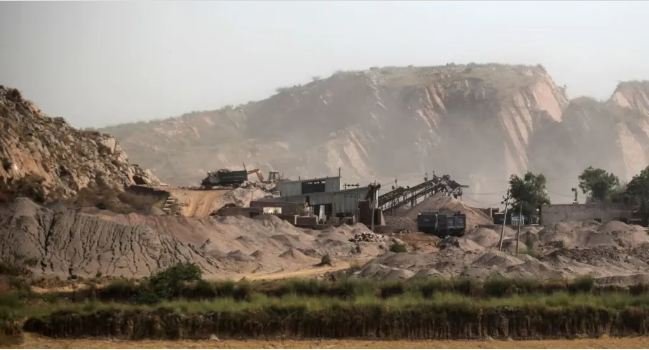
A recent CAG performance audit in Rajasthan found illegal mining near 34 per cent of the test-checked leases, with remote sensing identifying extraction outside sanctioned boundaries. It also pointed to ineffective inspections and failures in monitoring. The Environment Ministry says only 0.19 per cent of the landscape is open to mining, which may be true, legally, but not rationally.
Who, then, has wronged the Aravallis? The illegal miners, certainly. For them, the mineral is almost incidental — the hill itself is the commodity. No processing, no refinement. Just dynamite, stone crushers and dumpers running the nakas at night to feed the concrete hunger of rapidly expanding cities. When you mine stone, the mountain does not yield a mineral. The mountain leaves.
And it does not leave alone. Rajasthan has identified more than 25,000 cases of silicosis, with over 1,100 deaths — an incurable disease acquired one lungful of stone dust at a time, disproportionately affecting the poorest people in the quarrying belt. Between 2018 and 2023, Aravalli districts in Rajasthan recorded more than 29,000 instances of illegal mining. Recorded, mind you. In 2022, a Haryana DSP was crushed under a stone-laden dumper while trying to stop illegal mining.
But the problem does not end with the miners. It includes officials who look away, systems that fail to use technology effectively, departments that do not coordinate and political networks that make enforcement selective. And yes, it includes all of us who watched the story with mild interest until the heat waves arrived, the dust rolled in from the Thar, and our AC bills reached escape velocity.
That was when the urban conversation discovered the Aravallis.
Yet the answer cannot be to squeeze legal mining until illegal mining becomes more profitable. Rajasthan is the country’s sole producer of wollastonite, mined near Udaipur. Jawar’s zinc has a history stretching back to medieval times. There is copper, tungsten and rock phosphate at Jhamar Kotra, as well as graphite and prospects for lithium and rare earths. These are not vanity minerals; they matter to agriculture, energy and strategic industries. Nor is every mine the same. A regulated mine operating within its permitted area is not equivalent to a quarry that blasts away an entire hill at night and disappears before the authorities arrive.
So the first thing we need is a proper map of the Aravallis: ecological, hydrological and geological — not a ruler and an arbitrary height threshold that turns a living mountain range into a bureaucratic technicality. There should be no-go zones based on ecological sensitivity: wildlife corridors, forests, catchments, irreplaceable habitats and culturally significant landscapes. Elsewhere, mining should be permitted only where the science supports it, with cumulative-impact assessments rather than mine-by-mine paperwork that pretends mountains do not have neighbours.
And illegal mining needs to become a genuinely bad business. The Forest Department, district administration, police, mining authorities, pollution-control agencies and local communities cannot continue working in silos. Satellite imagery, drones, GPS-based transport tracking, weighbridges and public dashboards can make enforcement much harder to evade. What is missing is not technology. It is the will to use it.
Some of the most effective conservation remains unglamorous: fencing a rocky patch, preventing grazing, woodcutting and illegal quarrying. Give a damaged patch some protection and the dhok and khair return by themselves. The leopards and sloth bears still holding out in these hills are not waiting for a committee’s definition. They are waiting for protection.
We should also stop treating responsible miners as enemies merely because irresponsible miners exist. It makes the problem easier to explain but not necessarily easier to solve.
The Aravallis do not need a choice between ecology and survival. They need intelligent governance. My grandfather, father and uncles learned that a mine could not be run sustainably if the mineral could not be transported. Today, we need to understand something equally obvious: a mountain cannot be saved by a law that is not enforced.
Arefa Tehsin is an author and former Honorary Wildlife Warden, Udaipur. Her recent novel is The Fourth Girl

The paradox of de-Sinification in global production
By Sohail Khan · 28 Sep
Letters to The Editor — September 28, 2026
By Sohail Khan · 28 Sep
Kashmir as India’s gateway to Eurasian opportunity
By Sohail Khan · 28 Sep
Leave a Reply