India outclass Afghanistan again to seal T20I series with seven-wicket victory
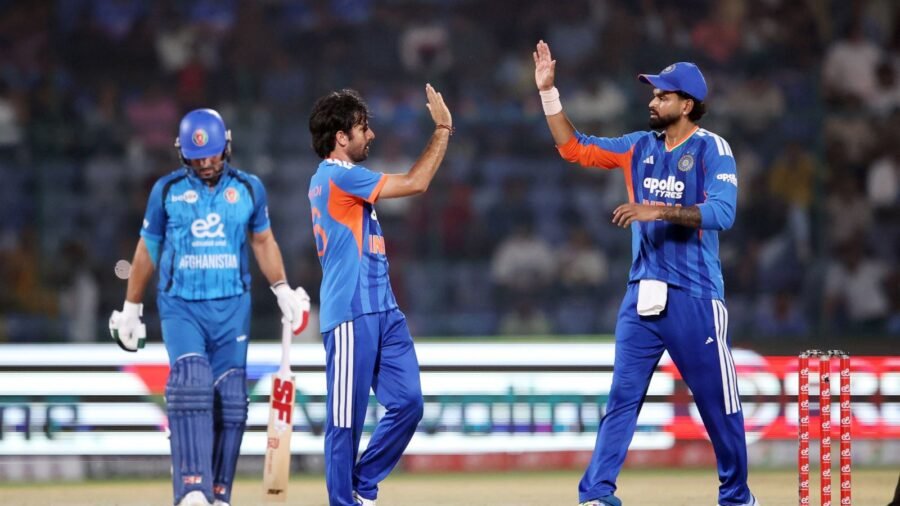
The first over set the tone for the remaining 33.5.
A sharp outswinger resulted in the swing of the bat meeting nothing but air. An inswinger very nearly kissed the inside edge. A yorker only toe-ended to safety.
Six deliveries, six illusions from a magician with the ball. The first over that Jasprit Bumrah bowled on Tuesday — that set the stage for India’s seven-wicket win that sealed the three-match T20 series against Afghanistan — didn’t yield a wicket. And yet, in that over of near-misses, he showed once again how he regularly makes batsmen look like novices.
Story continues below.
Subscribe to see fewer ads.
Bumrah, for the first time in his career, opened the bowling for India with a maiden over — on the cusp of becoming only the sixth Indian to reach a hundred T20I caps. It came in a series stripped of any intensity or animosity, but coming on his return from a knee injury, had significance of his own.
However, Tuesday’s triumph was less about individualism and more about collectivism. Bumrah’s mastery with the new ball was matched — or perhaps, even eclipsed — by Arshdeep Singh, who lived up to his status as India’s leading T20I wicket-taker. In his first over, he removed opener Rahmanullah Gurbaz.
That was the only wicket in the first eight overs. Ibrahim Zadran did what any captain worth his salt is meant to when the chips are down — shoulder the burden, crafting a defiant 37 off 33 balls before holing out to deep midwicket off Nitish Kumar Reddy.
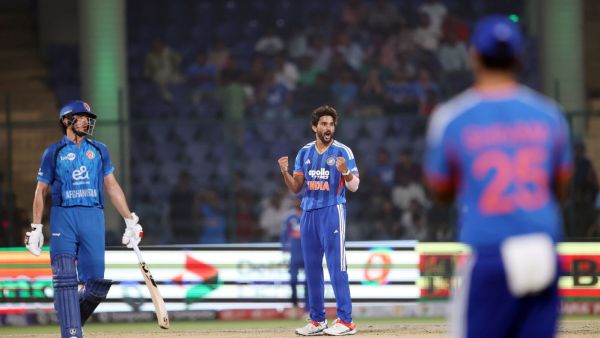 Indian Bowler NITISH KUMAR celebrates the wicket of Afghanistan Batsman IBRAHIM ZADRAN during India and Afghanistan T20, at Arun Jaitley Cricket Stadium in New Delhi on Tuesday. EXPRESS PHOTO BY PRAVEEN KHANNA 15 09 2026.
The all-rounder could be considered one of India’s biggest tick marks on the night.
Story continues below this ad
The last time Reddy took a wicket in T20I cricket, captain Shreyas Iyer could not find a place in the team, shirts with ‘Sooryavanshi’ on the back were yet to be printed, and Gautam Gambhir was yet to win an ICC trophy as India’s head coach. With injury proving to be an increasingly familiar companion for Hardik Pandya, even a flicker of dependability from a seam-bowling all-rounder would have been a gift to India in this series.
Yet, with 30 runs off two overs, Reddy’s performance did not offer any optimism on Sunday. Tuesday’s numbers of 3-0-24-3 — his best figures in international cricket across formats — was a much better return. Nearly every bowler did his job, the sole blemish being Shivam Dube’s lone over of 13. Beyond the bowling itself, Iyer deserved credit too for the shrewdness of his resource management.
Optimum utilisation
At 43/5 a couple of nights ago, Iyer perhaps got carried away to overuse his main wicket-takers earlier than usual. It resulted in three of the last seven overs having to be bowled by non-regulars, of which 46 runs were scored. This time, both Arshdeep and Bumrah were held back after their opening burst.
Afghanistan, on a deck that had no demons but for the psychological ones posed by the Indian bowlers, could only score 159/8.
Story continues below this ad
Over the next hour or so, Sanju Samson would showcase an accurate portrayal of his capability — one that was on display at the T20 World Cup. Following the three near-centuries which earned India their second crown in this format, Samson had aggregated just 43 in his next five T20Is, leading to his exclusion from the squad for the series against Zimbabwe in July.
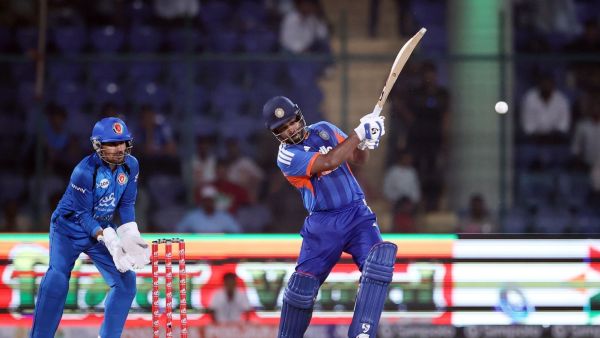 Indian Batsman Sanju Samson plays a shot during India and Afghanistan T20, at Arun Jaitley Cricket Stadium in New Delhi on Tuesday. EXPRESS PHOTO BY PRAVEEN KHANNA 15 09 2026.
Tuesday’s 22-ball 57 was his seventh half-century in this format, but would rank much higher in terms of significance once the layer of context is added — he now has stern competition for his role in the form of a 15-year-old. His batting approach made it evident. As many as 91.23% of Samson’s runs came in boundaries alone, and his strike rate — 259.09 — was his highest-ever in a knock of more than 25.
As with the bowling, India’s batting was a concerted effort. In Samson’s shadow was Sunday’s protagonist, Abhishek Sharma, who scored a 19-ball 39. The Powerplay yielded 82 runs — anything that happened post that period was academic in nature.
In that exercise, should the microcosmic facets of the game be reflected upon, Shreyas Iyer lost his wicket to a Rashid Khan delivery for a run-a-ball 11, his sixth consecutive T20I knock where he could not get to 30. Ishan Kishan remained unbeaten for a 23-ball 38 , as India chased the target down with 31 deliveries to spare.
Story continues below this ad
In the series of friendship, Afghanistan have yet to face anything but hardship. And they still have another 40 overs of this to deal with.
Brief Scores: Afghanistan 159/8 in 20 overs (Ibrahim Zadran 37; Nitish Kumar Reddy 3/24) lost to India 163/3 in 14.5 overs (Sanju Samson 57; Rashid Khan 3/35) by seven wickets.

Chess Olympiad: India have crowns to defend
By Sohail Khan · 16 Sep
‘I shut out the noise’: Sanju Samson on negative comments after match-winning 57
By Sohail Khan · 16 Sep

Leave a Reply