India must stand on its own feet as great powers tango
Exploiting global contradictions is the right instinct, but the harder task is ensuring India builds enough power to matter when there are fewer to exploit
Published on: Sep 28, 2026, 06:10:17 IST
Prefer HTon Google
Share via
Copy link
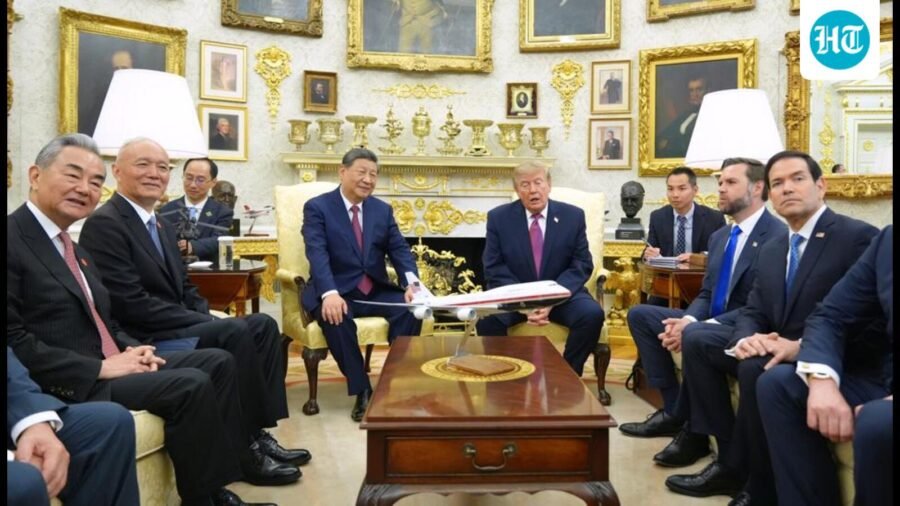
For over a month now, the world’s major powers have been busy reaching out to each other. In late August, Ajit Doval and Wang Yi, the Indian and Chinese Special Representatives on the border question, agreed in Beijing on an eight-point consensus to manage the border. On September 5, US President Donald Trump’s envoys Steve Witkoff and Jared Kushner met Russian President Vladimir Putin in Moscow. A week later Chinese President Xi Jinping was in New Delhi for the BRICS summit (as was Putin), his first visit to India in seven years. In the meanwhile, Trump’s secretary of State, Marco Rubio, met Russian foreign minister Sergei Lavrov in New York and invited Putin to the G20 summit in Miami in December. If Putin turns up in Miami, Europe is bound to lose sleep. Last week, Trump warmly received Xi at the White House, after threatening BRICS, of which Xi’s China is a member, and the two presidents extended their trade truce.
And amid all this, on September 18, Trump signed the Sanctioning Russia and Iran Act that allows him to impose tariffs of up to 100% on the largest buyers of Russian oil and gas. India is at the top of Trump’s target list.
If you analyse these events side by side, you will begin to see an interesting pattern. The key powers are bargaining directly with each other, and the consequences of such great power consensus are for the less powerful countries to bear. For India, a country whose foreign policy seeks to work the gaps among the great powers, this is not an encouraging sign.
In The India Way, foreign minister S Jaishankar argued that Indian strategy should advance its national interests “by identifying and exploiting opportunities created by global contradictions.” It is, no doubt, a sound principle for a rising major power, and for the most of the past decade, it worked for New Delhi. Washington wanted to enlist India against China. Moscow needed New Delhi to show it was not isolated from the mainstream of world politics. Beijing wanted India to keep out of the American camp which it believed was positioned against it. So, each of these rivalries gave New Delhi leverage.
But the doctrine of “exploiting contradictions” rests on the assumption that the contradictions will persist and will not disappear overnight. When the great powers are at odds, a lesser State has room to swing, hedge, and balance — i.e., exploit. When they begin dealing with one another directly, or their contradictions diminish, or both, that room shrinks.
Over the past two years, India’s material capabilities have stayed exactly where they were, but the country’s perceived value, in the eyes of the US, as a counterweight to China has dramatically diminished. If China doesn’t believe that the US is leading an anti-China gang-up with India (whether or not India actually is in it), then Beijing has no reason to view New Delhi as a near peer. If Washington is not putting pressure on Moscow, Moscow doesn’t need New Delhi to reduce its geopolitical isolation.
The US sanctions law over Russian oil shows how New Delhi’s bargaining power has indeed shrunk. While Washington wants to squeeze Moscow over the war with Ukraine, it does this by threatening Moscow’s customers (Beijing and New Delhi) because it has been unable to hurt Moscow directly, or it doesn’t want to. So instead of hurting Russia directly, Trump invites Putin to his golf resort in Miami. China, the biggest buyer of Russian energy, has been given a truce extension because China can hurt the US back. India has neither such leverage nor does it have the ability to absorb the 100% American tariffs. India has neither China’s usable leverage over the US nor Russia’sability to absorb sanctions.
At the BRICS summit, the BRICS + nations condemned the unilateral sanctions. And then the most powerful country that signed the declaration, China, went ahead and made a deal with the US. BRICS unity was forgotten within days of the grouping’s grand gathering.
What the warmth between Xi and Trump shows is not only the futility of grandstanding declarations but also the fact that on issues that are consequential, great powers are now negotiating and inking deals with each other directly. If so, grand multilateral forums are where the rhetoric happens, but bilateral forums are where the action happens. India’s own engagements say the same. The progress with China that made the Modi-Xi meeting possible came out of the Special Representatives’ talks and a long run of official meetings. BRICS had little to do with it. In fact, it is the bilateral progress that led to the show of BRICS unity.
We have seen this picture of great power consensus damaging our national interests before. In July 1971, Henry Kissinger flew secretly to Beijing via, reportedly, Pakistan. The American opening to China left India exposed months before the Bangladesh war, and New Delhi answered within weeks by signing a treaty of friendship with the Soviet Union. When the great powers realigned over India’s head, India rebalanced fast. It did so by depending on the weight of another great power that wanted New Delhi on its side.
That option doesn’t exist today. Russia today depends on China and could not balance Beijing on New Delhi’s behalf even if it wanted to. India’s strength and vulnerability have grown together. There is no great power to turn to — one that is trustworthy and useful at the same time. It will have to balance using its own power, which has grown remarkably, but is not enough.
While exploiting the world’s contradictions remains the right instinct, the harder task is to make sure India builds enough power to matter when there are fewer contradictions to exploit. Until it does, New Delhi can only hope that the present great power consensus proves short-lived.
Happymon Jacob is the author of India After Nonalignment (Penguin-Viking and Georgetown University Press, 2026). The views expressed are personal
Get Current Updates on India News, Elections 2024, Lok sabha election 2024 voting live , Karnataka election 2024 live in Bengaluru , Election 2024 Date along with Latest News and Top Headlines from India and around the world.
See Less
Between Trump’s US and Xi’s China, the trap India must avoid
By Sohail Khan · 28 Sep
Farmers need a share of the solar boom
By Sohail Khan · 28 Sep
Fraying exchange of ideas, and a world torn by conflict
By Sohail Khan · 28 Sep
Leave a Reply