India-Japan defence cooperation breaks new ground
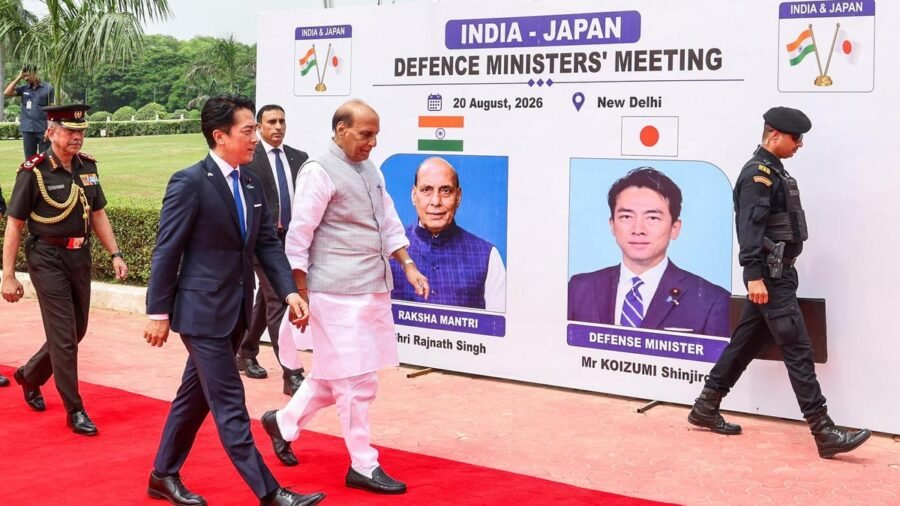
The August 2026 visit of Japan’s Defence Minister Shinjiro Koizumi to India marks an important moment in the evolution of a partnership that has often been more developed institutionally than operationally. The agreements that were announced suggest that New Delhi and Tokyo are now attempting to connect these disparate strands into a more coherent security relationship, having spent more than a decade building the institutional vocabulary of defence cooperation through annual dialogues, the 2+2 mechanism, exercises, logistics arrangements and defence technology discussions.
Convergence into operational capability
This matters because the India-Japan defence relationship has reached a stage where additional declarations of strategic convergence have diminishing returns. Both countries already share concerns about coercive attempts to alter the status quo, the security of maritime commons and the growing militarisation of the Indo-Pacific. The challenge has been translating these convergences into arrangements that improve their ability to operate together. The new maritime framework seeks to address this issue.
The emphasis on information sharing and Maritime Domain Awareness is significant as India and Japan occupy critical positions at opposite ends of the Indo-Pacific’s principal maritime theatre. Japan’s immediate security concerns are concentrated in the East China Sea and the waters surrounding Taiwan, while India’s geographical position gives it a central role in the Indian Ocean maritime space. A closer information-sharing architecture could gradually create a more continuous strategic picture across these interconnected maritime spaces. The objective is to develop greater awareness, interoperability, and operational familiarity between the two major maritime powers.
The discussions on naval shipbuilding may prove equally important with an exploration of joint development in naval shipbuilding and design by combining Japanese technological expertise with Indian production capabilities. There was also agreement to deepen discussions on Japan’s use of Indian production capabilities under the ‘Make in India’ framework and to move towards reciprocal arrangements for ship repair facilities. This could address a long-standing weakness in the bilateral relationship by giving a fillip to defence-industrial cooperation, which has consistently lagged behind strategic and political convergence.
The proposed transfer of Japan’s UNICORN integrated communications antenna system remains the most visible symbol of this effort. While the Japanese Ministry of Defence describes UNICORN as the first defence equipment transfer project between the two countries, the project itself is not new. A memorandum of understanding for the co-development of UNICORN masts, involving Bharat Electronics Limited, was signed in November 2024. The August meeting therefore represented a further step towards implementation rather than the initiation of a new project. New Delhi and Tokyo have struggled to convert their 2015 agreement on defence equipment and technology transfer into concrete outcomes. The commitment now to early implementation, alongside plans to deepen cooperation between India’s Defence Research and Development Organisation and Japan’s Acquisition, Technology and Logistics Agency, suggests a recognition that credibility today depends on delivering projects rather than solely identifying possibilities.
On exercises
Japan’s fighter aircraft are participating in the Veer Guardian exercise in India (September 9-22, 2026) for the first time. The two sides have agreed to increase the complexity of bilateral exercises, integrate unmanned systems and explore exercises organised at short notice. They also discussed cooperation between special operations forces and India’s future integrated theatre commands. These initiatives point towards a defence relationship increasingly concerned with operational preparedness.
Before travelling to New Delhi, Mr. Koizumi visited the Western Naval Command in Mumbai and INS Chennai. His visit thus extended beyond the familiar strategic geography of the Bay of Bengal and the Strait of Malacca. The western seaboard is central to India’s wider maritime interests, encompassing critical sea lanes, energy flows and India’s growing responsibilities in the western Indian Ocean.
The broader regional context is impossible to ignore. The joint statement reiterated opposition to unilateral actions that impede freedom of navigation or seek to alter the status quo through force or coercion. Neither country needed to name China for the strategic message to be clear. Yet, the significance of India-Japan cooperation lies precisely in its ability to move beyond a China-centric agenda. Maritime security, resilient supply chains, defence industrial capacity, logistics and third-country cooperation are all becoming components of a wider regional security architecture.
Building a more resilient partnership
The visit also plugs into a broader moment of impetus in India-Japan relations. Coming soon after the July 2026 Annual Summit, which expanded cooperation across economic security, critical technologies and resilient supply chains, the defence ministerial engagement demonstrates that security is increasingly intertwined with the wider strategic partnership. Defence cooperation can provide the connective tissue between these agendas, linking India’s industrial capabilities and Japan’s technological strengths while reinforcing their shared interest in shaping a more resilient Indo-Pacific. The real test will now be implementation. India and Japan are building the strategic foundations, with Mr. Koizumi’s visit suggesting that both are finally beginning to focus on the harder task, which is converting strategic convergence into usable capability.
Harsh V. Pant is Vice-President at the Observer Research Foundation; Pratnashree Basu is an Associate Fellow–Indo-Pacific at the Observer Research Foundation

Jyotika praises her mother-in-law, says ‘only a queen can raise a prince’
By Sohail Khan · 1 Oct
Can a police confession justify NSA detention? What Supreme Court said in Sambhal case
By Sohail Khan · 1 Oct
How is HbA1c calculated? Expert explains what your blood sugar test really means
By Sohail Khan · 1 Oct