In Haryana, villages are fighting back against drugs
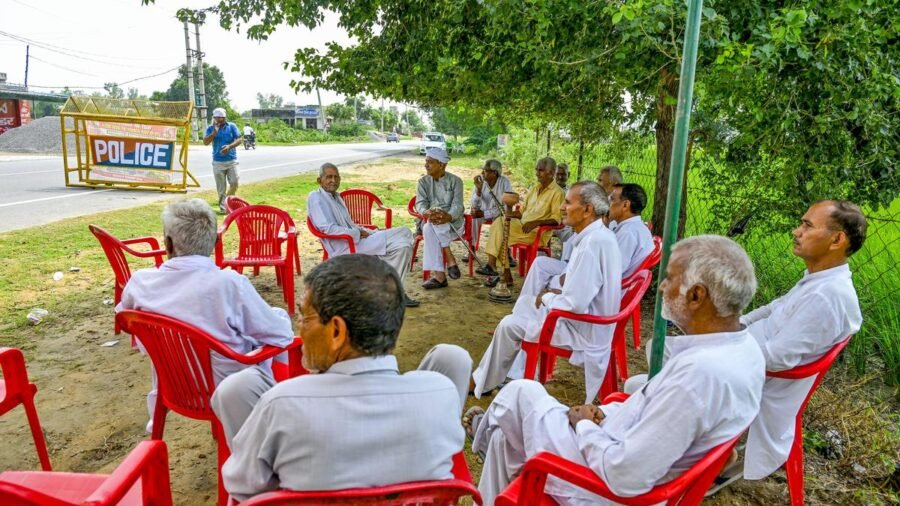
On the side of a busy road cutting through Rajthal village in Haryana’s Hansi district, around 150 kilometres north-west of Delhi, stands a bright red-and-white banner tied to a yellow police barricade. In bold letters in Hindi, it reads, “Nasha ke khilaf gram panchayat Rajthal ka sakht sandesh [The strict message from the Rajthal gram panchayat (village council) against drug/substance abuse].” The warning below says: sell drugs in the village and pay ₹1 lakh; help a drug peddler get bail and pay another ₹1 lakh.
A few steps behind the barricade, men wearing white kurtas and turbans sit on red plastic chairs in a circle in the shade of a roadside tree. They are Rajthal’s round-the-clock thekri pehra (community-led vigil). Their job is to guard their village and the entire stretch against drugs.
Satyawan Singh, 65, says, “We have taken it upon ourselves to not just rid our area but also the entire State of drugs. The Satrol khap, Naugama khap, and Bara khap [the names of various khaps active in Hisar and Hansi] have extended support to us, which has given our campaign new strength. Since then, we have become even more active and have started reaching out to every village grappling with the drug problem.”
According to the police and locals, the drug crisis first took hold in Haryana’s districts bordering Punjab and Rajasthan — Sirsa, Fatehabad, Jind, Kurukshetra, Kaithal, and Ambala — as heroin, locally known as chitta, poppy husk and pharmaceutical drugs made their way across porous State borders. From these entry points, local dealers and small-time peddlers gradually built their own networks, carrying the trade deeper into the State’s agricultural and semi-urban heartland, into districts such as Hisar, Hansi, Rohtak, Sonipat, and Panipat.
The trade has grown exponentially over the years. As per the Magnitude of Substance Use in India-2019 report, commissioned by the Ministry of Social Justice and Empowerment and conducted in collaboration with the National Drug Dependence Treatment Centre, AIIMS, New Delhi, 5.9 lakh people in Haryana need help for opioid-related problems. This is the third-highest number among States, after Uttar Pradesh (10.7 lakh) and Punjab (7.2 lakh). Haryana is also among the States with the highest proportion of its population affected by opioid use, along with Punjab, Delhi, and several northeastern States — Mizoram, Nagaland, Arunachal Pradesh, Sikkim, and Manipur. The report estimates that 1.2 lakh people in Haryana need help for sedative use, putting it among the six States with the highest usage. Another 55,000 people in the State inject drugs, the sixth highest in the country.
As addiction has spread and concerns have grown over the efficacy of police action, villages have begun looking beyond the State machinery for ways to contain the problem. Khaps, social organisations, and gram sabhas have formed committees to monitor suspected drug peddlers and even impose their own deterrents.
Keeping vigil
Residents say the drug problem in Rajthal, on the Jind-Hansi link road, has been around for nearly a decade, but it has worsened sharply over the past three years. They allege that the number of houses involved in selling drugs has increased from two or three to 25 to 26.
With the spread of drugs has come a rise in thefts, particularly from agricultural fields, say residents. They allege that to finance drug consumption, copper wires from submersible pumps, motorcycles, utensils, and other articles are stolen and sold as scrap.
“We had reached a point where drug users and sellers had turned the village into a marketplace,” says Anil Godara, 38, the brother-in-law of Sarpanch Renu Devi. “People would enter homes and stand in queues to buy smack, chitta, ganja and other drugs.”
According to Poonam Devi, 38, a yoga teacher working in the Haryana Kaushal Rozgar Nigam, a government department, the spread of drug use in Rajthal has changed the way women move through public spaces. “Those who use drugs stare at women in an improper manner. Sometimes they try to stop women riding scooters when they are returning from work,” she says.
Devi says the bus stand has, in particular, become a place of concern. Women who park their scooters or motorcycles there are often warned by shopkeepers that their vehicles could be stolen by drug users. She says a bicycle and a motorcycle have been stolen from the area.
For girls and women going to school or college, the fear extends beyond theft. “We do not even feel safe wearing bangles or chains,” she says. Women who once moved around the village freely in the mornings and evenings now often go out accompanied by men, she adds.
Alarmed by the spread and addiction to drugs, locally known as sukha nasha (dry intoxicant), as well as the spurt in thefts, the residents of Rajthal approached the district administration and the police to seek their support in launching their initiative. They also held a gram sabha meeting, where residents across age groups agreed to participate in the campaign. The village then formed the thekri pehra at two points to keep a watch on people and vehicles entering and leaving Rajthal.
The thekri pehra, launched on August 26, involves groups of young men keeping watch, with 15-20 people stationed at each point after 9 p.m. During the day, the number of villagers, including the elderly, can rise to 50-60 or more. Village youth also ride motorcycles to chase people suspected of entering the village to buy drugs.
This practice has a history. The Punjab Village and Small Towns Patrol Act, 1918, outlines “the performance of nightly patrol duty by the inhabitants of villages…in case of emergency.”
The poster in Rajthal warns that selling drugs in the village will attract a fine of ₹1 lakh; helping a drug peddler get bail will attract a fine of another ₹1 lakh.
Shiv Kumar Pushpakar
Residents say they have caught more than 400 people so far, including students, farmers, youth from well-off families, and a few girls aged 17-18. In several cases, parents have learned about their children’s drug use only after the villagers informed them, residents say.
Ankur Bisla, 30, who is part of the thekri pehra team, says most of those caught consuming drugs are from Haryana, including neighbouring villages and areas around Panipat, Sirsa, and Sonipat. “Some of them had travelled from Gurugram as well,” he says.
However, the job is not easy. After the vigil restricted the movement of outsiders into the village, drug sellers have become cleverer by taking supplies outside the village. Residents say they have noticed vehicles leaving the village in the wee hours, between 1 a.m. and 4 a.m.
Hansi Superintendent of Police Vinod Kumar says community participation has become an important part of the police campaign against drugs. In response to the villagers’ demands for greater police presence, the police deployed four personnel, including a woman constable, along with a police control room vehicle and a checkpoint, one month after the campaign was launched.
On September 23, around 150 police personnel and a canine squad conducted a three-hour house-to-house search operation in the village. “But such operations can be challenging, as people often get alerted by police activity and move or conceal contraband,” he says.
When the people take over
Independent journalist Vijender Kumar, who runs a YouTube Channel called NewsMike24, says there is a history of illicit liquor trade in some of these villages. He says what was once largely confined to liquor has evolved into a more dangerous drug market, increasingly involving women too, and affecting the youth from poor families. The survey highlights the vulnerability of children: Haryana has 35,000 children who need help for inhalant use, the fourth-highest number among the five States with the highest figures.
The emergence of heroin is particularly worrying, says Kumar. He points out that 5.7 kg of heroin was seized in Jind alone a month ago, valued at around ₹11 crore in the international market.
Kumar says the fight against drugs in Haryana’s villages is increasingly being led by residents. He recalls how Ashrafgarh-Dauri village in Jind, close to the Punjab border, confronted the problem about two years ago. “Villagers formed a 20-25-member team comprising the youth, government employees, retired people, and ex-servicemen to maintain round-the-clock vigil. They installed 25-26 CCTV cameras outside the houses of alleged drug sellers and imposed fines. The number of people coming into the village to buy drugs has reduced,” he says.
Lochab village, once a drug hotspot, also brought drug activity under control after the panchayat imposed fines and took strict action. “But new hotspots have emerged in Rajthal, Petwar, and Sulchani, where drug supply remains high,” says Kumar.
Rajthal resident Ratan Sharma says the police are reluctant to conduct searches in cases involving small quantities of drugs. “They say they cannot register a case over one or two packets. But if searches are not conducted, how will larger quantities be recovered,” he asks.
Sagar Preet Hooda, Director General of Police (DGP), Chandigarh, and a native of Haryana’s Rohtak, has conceptualised a village-based programme that brings local residents together to tackle the growing drug problem as a community-led social intervention. Called the Panchgama development model, the programme will be launched in Jind on October 11. In its first phase, it will cover nearly 300 villages, grouped into 60 clusters of five villages each.
“Through the Jind social forum, volunteers with roots in Haryana will share their experiences, expertise, and networks to support rural youth. They will work alongside existing community and government institutions,” he says.
Several khaps, too, have announced that they will impose fines on those indulging in drug-peddling in view of the growing problem.
Even as communities are taking matters into their own hands, Bisla questions the lack of political will in dealing with the growing menace. “On the one hand, the BJP has launched the Nasha Mukt Punjab Yatra [an anti-drug political campaign] in neighbouring Punjab. On the other, it has done precious little to contain the menace in the State that it has governed for the past 12 years,” he says.
State measures and hurdles
As part of its efforts to combat the drug menace, the State government constituted the Haryana State Narcotics Control Bureau (HSNCB) on August 25, 2020. So far, 2,353 FIRs involving commercial quantities of narcotics have been registered under the Narcotic Drugs and Psychotropic Substances Act, 1985, and 6,256 accused people have been arrested, according to a press conference held in June this year by the Additional Director General of Police, HSNCB.
In a parallel crackdown on drug-derived wealth, assets worth ₹72.70 crore have been seized, frozen, or attached to date. As part of the campaign against habitual and organised traffickers, preventive detention orders were issued against 156 accused under the Prevention of Illicit Traffic in Narcotic Drugs and Psychotropic Substances Act, 1988. In addition, property attachment proceedings were initiated against 432 individuals to target illegally acquired assets generated by the drug trade.
Rajendar Kumar Meena, Deputy Inspector General of Police, HSNCB, says that, going by drug seizures, heroin is the most prevalent in the districts bordering Delhi — Gurugram, Faridabad, Jhajjar — followed by cocaine, MDMA (a synthetic psychoactive drug), ganja, and poppy straw. “The police have a three-pronged strategy to combat the drug menace — enforcement, awareness, and de-addiction,” says Meena, conceding that supply cannot be totally curtailed till the time that there is demand.
“The police focus on curtailing the commercial supply of drugs, but the combination of the dark web, cryptocurrency, and courier services has changed the way drugs are trafficked,” adds Meena.
The gaps in rehabilitation
Vipin Sharma, the founder of Ankush Foundation, a drug rehabilitation centre in Hisar, says Haryana’s response to addiction remains heavily focused on de-addiction and regulatory compliance and gives little attention to long-term rehabilitation.
After more than two decades in the field, Sharma, a recovering addict himself, says the biggest problem is that policies are often framed without consulting those delivering services, such as rehabilitation and de-addiction programmes, on the ground.
Sharma argues that frequent inspections and increasingly prescriptive rules have made it harder for rehabilitation centres to function effectively. “Rules requiring clinical psychologists at every centre don’t take into account the limited availability of trained professionals. There is also excessive focus on specifications, such as the distance between beds. These requirements divert attention from the central problem of treating addiction,” he says.
For Sharma, the largest gap is the absence of sustained rehabilitation after medical treatment. “De-addiction is a medical treatment. It can address physical dependence on a substance, but it is not the complete solution,” he says. “Without long-term rehabilitation, a patient’s psychological dependence is not addressed.”
Sharma says Haryana lacks a rehabilitation centre run or supported entirely by the State government (there are eight centres in the State supported by the Union government). Private centres operate without government assistance, but face regulatory and licensing hurdles.
An inmate at the rehabilitation centre says, “For an addict, quitting drugs is only the beginning. The real battle is staying away from them — a struggle that can last a lifetime.” Recovery, he says, cannot end at the centre’s gates; it requires the continued support of family and society to help those battling addiction rebuild their lives and find their way back into the mainstream.
This story was edited by Radhika Santhanam
Rishi Sunak, Ro Khanna, Dinesh D’Souza: united by colour; divided among white nationalists
By Sohail Khan · 28 Sep
From Nepal to India, how AI is improving disaster management
By Sohail Khan · 28 Sep
40 years ago September 28, 1986: Relief for Haryana farmers
By Sohail Khan · 28 Sep
Leave a Reply