How tech firms hope to beat the backlash against “pervert glasses”

Creating a device for the AI era is hard
Published on: Sep 24, 2026, 14:30:38 IST
Prefer HTon Google
Share via
Copy link
A year ago your correspondent lost the charging case for his Ray-Ban Meta smart glasses and, with some relief, had to stop using their camera, audio and artificial-intelligence features. He still wore them as shades. But this summer, during an open-air performance of “A Midsummer Night’s Dream”, a parent of a member of the young cast accused him of covertly filming the event. Since then, he has felt creepy using them even in dumb mode.
He is not alone. In recent months, after videos emerged of men using the glasses to secretly record and harass women, some have referred to Ray-Ban Metas, sold by Mark Zuckerberg’s social-media giant in conjunction with EssilorLuxottica, a Franco-Italian eyewear maker, as “pervert glasses”. Luca Solca of Bernstein, an investment firm, said it reminded him of the “Glasshole” epithet tabloids slapped on users of Google’s short-lived smart glasses in 2014.
In response, developers have produced free apps such as Nearby Glasses and ZuckOff that use Bluetooth signals to help people detect the devices, even though only a few are known to misuse them. Those relishing the backlash may include investors, in both Meta and EssilorLuxottica, who hope it will derail what some see as a margin-shredding vanity project.
That is unlikely. In fact, while taking steps to repair the public-relations damage, Meta is doubling down on its eyewear. So is Snap, owner of Snapchat, a video and messaging app, which this month launched a swanky augmented-reality (AR) pair called SPECS. In the autumn Google and Samsung will unveil intelligent glasses powered by Google’s Android operating system. Omdia, a data gatherer, said global shipments of AI glasses more than doubled year on year in the six months to June to 4.2m units. Meta and a wave of new Chinese entrants led the way.
It is too soon to know how much the “pervert glasses” furore, which flared up after June, will dent sales. Meta belatedly took steps to halt covert abuse, such as disabling the camera when a wearer tries to tamper with the LED light that shines while filming. The firm said it had also removed content made by miscreants and suspended some of their social-media accounts. Insiders say shipments of its glasses doubled this summer from the previous summer, suggesting uptake is still strong.
Not a good look
But the incidents have had an impact. At its annual developers event, Meta Connect, on September 23rd, it introduced Ray-Ban Meta Audio, its first camera-less smart glasses, which the company hopes will take some of the sting out of privacy concerns. It is also counting on the bad optics being overshadowed by the incorporation of Muse, its personal AI agent, into the glasses; Muse has been such a hit since it was launched this month that it has sparked a rally in Meta’s share price (see Schumpeter). The firm appears to have no plans to backpedal on cameras; it says that by the end of the year it will have a line-up of 100 smart-glasses models. Still, the brouhaha emphasises how little can be taken for granted as companies strive to create devices that define the AI age in the same way the smartphone did the mobile era.
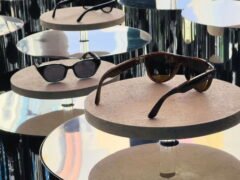
For now, what stands out is the plethora of alternatives. Functionally, Snap’s SPECS (pictured) are more like a wearable PC than a pair of glasses. As well as see-through lenses, cameras and earbuds, they have AR features that enable wearers to read maps, play dominoes and (with a keyboard) work on Google Docs. In an interview with The Economist Evan Spiegel, Snap’s boss, criticised Meta for “trying to create spy glasses”. No one would mistake SPECS, with their iridescent lenses, for covert surveillance devices, he said. Whether consumers will fork out for them is another matter. Their starting price of just below $2,200 is more than seven times that of Meta’s cheapest pair. At first, they are likelier to attract business users, from influencers to engineers doing fieldwork, than high-street shoppers, predicts Jitesh Ubrani of IDC, a market-research firm.
Meanwhile, Chinese upstarts are entering the field in force. According to Omdia, this year unit sales of smart glasses within China have grown much faster than in the rest of the world, if from a much lower base. Competition is also fiercer. Whereas Meta has an 81% global market share, in China Alibaba, Xiaomi and INMO, the three biggest producers, account for less than half of shipments. Firms are trying out numerous hardware configurations, Omdia notes.
A white-label market for smart glasses is also taking off. Qualcomm, designer of Snapdragon chips that power AI devices in America, China and elsewhere, produces miniature modules (including software) that fit into the rims of many types of eyewear. The firm hopes unbranded smart glasses will find their way into fashion, health care, education and industry, says Ziad Asghar, a Qualcomm executive.
He sees several ways in which smart glasses will connect with the outside world. For now, the default is to pair them with smartphones. They may become linked to smaller computational “pucks” worn by the user, or, once battery-life issues are resolved, have built-in cellular connectivity. But the AI-device market will not end with glasses, he believes. It is also likely to include pens, pendants, bags, rings and more. Unlike the smartphone, “the answer is not just one device,” he says.
Creepy or not, cameras are sure to stay integral to many AI devices because agents like Muse need eyes on the world to be effective. This is still the age of surveillance capitalism—just through a new lens.
See Less
Good to have camera on glasses, but must address privacy concerns: Qualcomm exec
By Sohail Khan · 24 Sep
Chinese carmakers keep gaining ground in Europe as monthly sales surge
By Sohail Khan · 24 Sep
The unspoken skill of the AI era: Clear & crisp writing
By Sohail Khan · 24 Sep
Leave a Reply