Hormuz crisis raises an unexpected marine risk
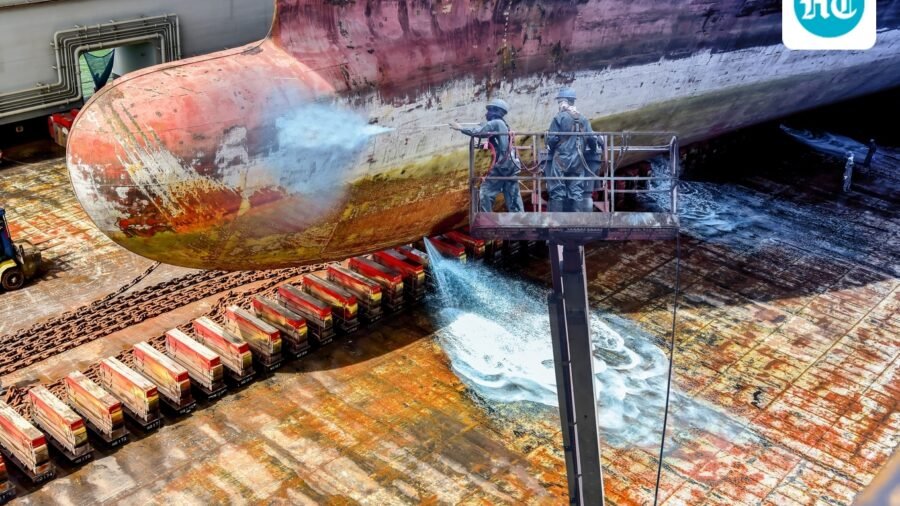
Biofouling on ships that have stalled because of disrupted passage can become a pathway for the spread of marine invasive species.
Published on: Sep 24, 2026, 06:50:10 IST
Prefer HTon Google
Share via
Copy link
The war in West Asia and the disruption of shipping through the Strait of Hormuz have left many commercial vessels stranded or severely delayed in the Persian Gulf and Gulf of Oman. Although many vessels resumed their journeys whenever transit became possible, some remained in the region for prolonged periods. This unusual situation has created a largely overlooked environmental concern: Biofouling on ships could become a pathway for the spread of marine invasive species across the world (Tamburri et al., 2026).
When a ship remains stationary for a long period, its submerged surfaces provide an excellent opportunity for marine organisms to settle and grow. Algae, micro-organisms, barnacles, mussels and many other marine lifeforms can colonise a vessel’s hull and other submerged parts. This process is known as biofouling. In normal course, ships spend relatively little time at anchor or in port before continuing their voyages. A prolonged lay-up is different. The longer a vessel remains stationary, the more time organisms have to settle, grow, and reproduce, particularly if the ship’s antifouling protection has deteriorated.
How Hormuz standoff is an ecological issue
The Strait of Hormuz is especially important in this context. Before the present crisis, roughly 130 commercial vessels passed through the Strait each day. Ships leaving the Gulf eventually reach ports across Asia, Europe and other parts of the world. A vessel that has accumulated a substantial community of marine organisms during months of inactivity may, therefore, carry an unintended biological cargo when it resumes its voyage.
Not all organisms transported in this way will survive or become established at their destination. Establishment depends on many factors, including environmental conditions, the organisms involved and the availability of suitable habitat. Nevertheless, the sheer number of vessels involved, and the prolonged duration of their stay make this a risk that should not be ignored. Ballast water — water pumped into specialised tanks to stabilise the ship and correct depth — is another recognised pathway for the movement of marine organisms. In the present situation, the additional risk created specifically by prolonged ship lay-up is likely to be more closely associated with biofouling, because the hull and other submerged surfaces remain exposed to seawater.
Disease threat
There could also be less obvious consequences. Fouling organisms may include parasites and organisms associated with disease-causing agents. Their introduction into new environments could create new host-parasite or host-pathogen relationships and, in some cases, affect economically important fish and shellfish. There is also a possibility of genetic exchange when organisms transported on ships encounter populations of the same or closely related species already established elsewhere. Such exchanges could, in some circumstances, increase genetic diversity and help established populations adapt to new environmental conditions. This is a potential risk rather than a predictable outcome, but it deserves attention where genetically distinct populations are brought into contact.
The risk is greatest when heavily fouled ships leave the Gulf and call at ports where the transported organisms can survive and reproduce. Major ports in the Indian Ocean and Asia — including Mumbai, Colombo, and Singapore — could, therefore, warrant particular attention. West Asian and European ports may also be exposed.
Risk from invasive species
This does not mean that these ports will necessarily experience biological invasions. Most organisms carried on ships will fail to establish. But invasive species are often introduced through repeated opportunities, and the unusually prolonged lay-up of many vessels increases those opportunities. The problem is particularly serious because marine invasions are difficult to reverse once they become established. The oceans are vast and highly connected, and eradication of a species that has spread over a large area is usually extremely difficult.
The Intergovernmental Science- Policy Platform on Biodiversity and Ecosystem Services (IPBES) assessment of invasive alien species emphasises that prevention and preparedness are the most cost-effective approaches to manage invasive alien species. This is especially important in marine environments, where opportunities for successful eradication or containment can disappear quickly. A rare example is the eradication of the Caribbean false mussel, Mytilopsis sallei, in Darwin, Australia, in 1999. The invasion was detected early and was confined to a small area, making eradication possible. So, the earlier an invasion is detected, the greater the chance of controlling it.
Way out of crisis
The immediate priority should be to assess vessels that have remained in the Gulf for unusually long periods and determine whether they have accumulated substantial biofouling. Where appropriate and permitted, heavily fouled vessels should be cleaned before they leave the region. Cleaning, however, must be carried out responsibly. Improper in-water cleaning can release living organisms, reproductive material and fragments of fouling communities into the sea and can, therefore, create another pathway for their spread. The International Maritime Organization (IMO) adopted revised 2023 Guidelines for the Control and Management of Ships’ Biofouling to Minimize the Transfer of Invasive Aquatic Species. These guidelines provide a globally consistent framework for managing biofouling, although compliance remains voluntary. The revamped 2025 guidelines include environmentally responsible in-water cleaning.
Where cleaning facilities are unavailable in the Gulf, receiving ports should be alerted to vessels considered to present elevated biosecurity risks. This would allow authorities to decide whether inspection, sampling, cleaning or other measures are necessary. Targeted surveillance should also be strengthened at ports likely to receive vessels from the affected region. Conventional inspection can be supplemented, where appropriate, by rapid diagnostic and molecular tools to identify unfamiliar organisms at an early stage.
Marine organisms introduced into one port can subsequently be transported to another through coastal and international shipping. Countries around the Indian Ocean and beyond, therefore, need to share information and coordinate surveillance and response.
This is not a prediction that a biological invasion will follow. It is a warning that an unusual situation has created an unusual opportunity for species to move. In a situation where prevention is possible, but eradication may not be, precaution is the wiser course.
KV Sankaran is former director, Kerala Forest Research Institute, and coordinating lead author, IPBES Thematic Assessment of Invasive Alien Species and Their Control. The views expressed are personal
Get Current Updates on India News, Elections 2024, Lok sabha election 2024 voting live , Karnataka election 2024 live in Bengaluru , Election 2024 Date along with Latest News and Top Headlines from India and around the world.
See Less

India should chase its own IP-led global standards
By Sohail Khan · 24 Sep
Germany’s political churn is about a shrinking centre
By Sohail Khan · 24 Sep
40 years ago September 24, 1986: Brig Puri’s ‘killer’ nabbed
By Sohail Khan · 24 Sep
Leave a Reply