High Commissioner Anil Sookal interview: ‘India now has acceptance with the Global North and the Global South’
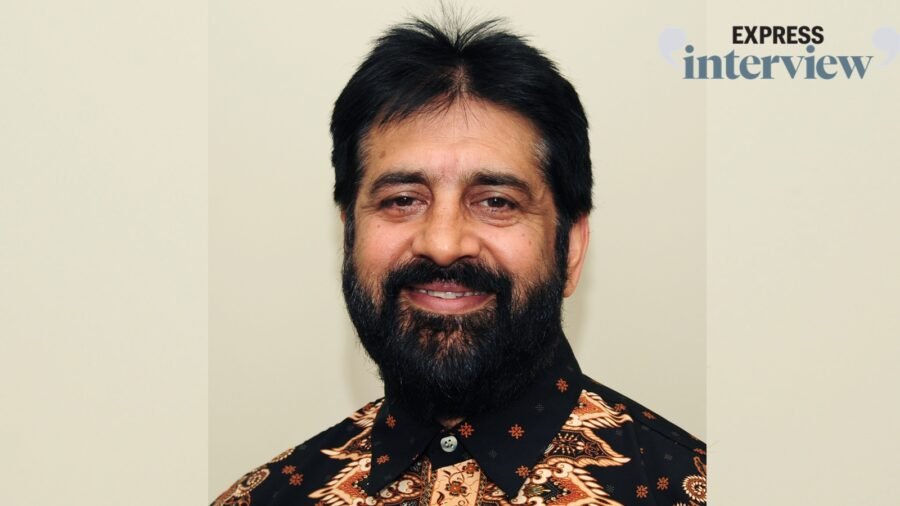
At the 18th BRICS Leaders’ Summit in New Delhi this weekend, member state South Africa will prevail on countries to find solutions to world conflicts, whilst also expecting some solid positions being taken on present challenges around food and energy security, High Commissioner Anil Sookal said.
In an interview with , Sookal also touched upon the significance of BRICS, the paralysis of global governance structures like the UN Security Council, the imperativeness of the Global South to have a voice, India’s standing in the world, South Africa’s exclusion from G20, and what the India-China thaw means for the region and beyond.
Excerpts:
Q: What do you think of the significance of BRICS as a grouping at this point in a conflict-ridden world?
A: At a time when the world needs leadership, the BRICS can provide it. We are increasingly seeing the world dividing into camps, with individual countries imposing their will on smaller countries. Despite the Global South accounting for 85 per cent of the global community, we don’t have a say on some of the most critical issues impacting us. It is important for countries of the Global South, especially under BRICS, to reflect on some of these issues and send out a very powerful yet positive message that the world wants peace, and an equitable and inclusive global community.
Q: What would be the most critical issues that the Global South should have a voice on in the present context?
A: We must have an inclusive global governance architecture. The UN was created as a forum where all countries, big or small, powerful or less powerful, could have an equal voice. Unfortunately, the UN of that vision has been eroded. We’d like to see it reformed, and BRICS has been constant about this.
Another one of the great tragedies is the paralysis of the UN Security Council. You can’t have a global platform with the entire African continent and the entire Latin America having no voice. India, Brazil and South Africa have been seeking membership in a reformed Security Council.
Story continues below this ad
Q: Are the BRICS leaders going to talk about these issues and send a message out?
A: One of the constants of BRICS has been the call for reform. Many want to actually make these global organisations obsolete and irrelevant. But if you take away these global governance structures, what do we have? A world of disorder and chaos. It suits some to have chaos. But for the global majority, we need a world underpinned by structures that have been playing a positive role throughout the years.
If you look at the conflict between the US and Iran, it is not just confined to West Asia, but impacts the global community. The surge in the price of energy has had an adverse effect on us low-income countries. The price of food, as a result of shortage of fertilisers, has gone up and our farmers are suffering. Food security is directly impacted. Poverty is exacerbated as a result of these factors.
Q: In this context, what would be South Africa’s expectations from India’s presidency?
Story continues below this ad
A: India has shown continuity, and the theme they have chosen — ‘Building resilience, inclusiveness, building for sustainability’ — these are all core principles of the BRICS. We’d like to see this consolidated. We’d like to see some solid positions being taken on how we can address the challenges around food and energy security, and in terms of prevailing on the countries to enter into dialogue and to find solutions to the conflict.
Recently, Prime Minister Narendra Modi spoke to President Putin about finding an end to this war, because it impacts all of us.
Q: During India’s G20 presidency, the African Union became a member of the G20. Does India, as a credible voice, amplify the concerns of the Global South to a larger world?
A: India has a trust factor on its side. Someone asked me if it was right for PM Modi to speak to President Putin and just tell him, ‘Look, you should find a way to end this war’. I said it’s the right thing to do. And that’s the level of trust that PM Modi enjoys with President Putin, that he can tell him that in a very frank manner. And President Putin appreciates it because he knows that it’s out of genuine concern that India is saying this, and not just for some dynamics or agenda. India now has acceptance with the Global North and the Global South.
Story continues below this ad
India had the G20 presidency under a difficult time, but New Delhi was able to bridge the differences between the North and the South. The world understands that India has no hidden agenda.
Q: After India, the BRICS presidency moves to China. What is your expectation of these two Asian powers, of balancing the Western world and amplifying the concerns of the region?
A: President Xi attending the Summit here is a positive statement to the world community. If you look at any projections of the world at the turn of the century, the two most powerful economies will be India and China. They will have to coexist, like they did for 2,000 years. For the major part until the Industrial Revolution, India and China were the two dominant global economies. And history moves in cycles. The world is going back to that period.
Also, if you look at projections of the world in 2050, it is expected that the three largest $50 trillion-plus economies will be India, China, and the US. So these three countries are going to shape the global geo-economic face for the next five decades.
Story continues below this ad
Q: How do you see the India-China thaw helps the region and the world in general?
A: It’s good for the region, but more importantly, it sends out a very powerful message to the global community. Especially some in the Global North who wouldn’t like to see a peaceful coexistence and cooperation between India and China.
I am positive that as India and China continue to grow, there will be, from time to time, disturbances and discomfort. When you have a dragon and an elephant living on the same mountain, you are going to have some rumbling from time to time. But eventually, as they did for the past two millennia, they will find a way to coexist and enrich each other.
And whether we like it or not, they will become the largest trading partner of each other and dominate global trade.
Story continues below this ad
Q: How do you think America’s tariff wars are playing out for the region?
A: It undermines the very principles of fair trade but it’s a short-lived process. The impact that they thought it would have has actually worked in our favour.
All of us, and within BRICS, have had to look more closely at how we conduct ourselves in terms of our domestic trade and with the international community, and are working towards greater self-reliance, deepening trade with the Global South. The trade in local currencies is moving at a fast pace. In a sense, the (US action) has caused pain, but pain is short-lived. Out of that pain comes strength. And you’re seeing the strength of BRICS countries reasserting their independence and resilience.
India is still expected to grow in the region of 6.5 per cent. That’s massive, as against what you are seeing in Europe — of around one per cent growth. So the center of growth is here and in Africa.
Story continues below this ad
Q: You spoke about trade in regional currencies. Is BRICS, in a way, moving towards de-dollarisation, not by creating a BRICS currency, but by using local currencies in a bigger way?
A: It’s a natural process. BRICS doesn’t have as its aim de-dollarisation. The dollar has been a dominant currency since the Second World War. It was nowhere to be seen during the colonial period. But the world is changing. The dollar at one stage occupied about 80 per cent of the IMF basket of currencies. In the latest reading, it’s 57 per cent. And that’s not because of BRICS. It’s a natural process. As the Global South rises, other currencies come to the fore. Today, over 50 per cent of global trade is in other currencies, and it’s going to be this way.
Q: President Cyril Ramaphosa will be here for the summit and will meet PM Modi. What are the likely key points of discussion between the two leaders?
A: Next year is a very important year in our bilateral relations as it marks the 30th anniversary of President Nelson Mandela’s visit to India – in March 1997. We want to celebrate the milestone on both sides, in India and South Africa, with a number of seminal events at the political, economic and people-to-people level. Further, this relationship must be constantly deepened and strengthened. President Ramaphosa being here gives us an opportunity to do that and to strengthen a very dynamic relationship.
Story continues below this ad
Q: South Africa has been excluded from the G20 Summit to be hosted by the US later this year. Do you expect other member states, especially your friendly countries, to broach this?
A: We have been excluded from all G20 proceedings since the US took the chairship in December 2025. And they have not invited us to any meetings, or the summit later this year. That’s a unilateral measure that undermines the values and principles upon which the G20 was founded. South Africa was a founding member of the G20 in 1997. Last year, we had the presidency and hosted a very successful summit.
Also, us being excluded by the US does not mean we are no more part of the G20. In December this year, when the UK takes up the presidency of the G20, South Africa will take up its chair again as a rightful member. No one country has the power to determine the makeup of the G20.
Many G20 countries, including India, have on many occasions broached on our exclusion. Canada has openly said that they don’t agree with the situation where South Africa has been excluded. The African Union, too, has pronounced on this. It’s an aberration that will be corrected.
‘They can beat us, but we’ll be at Jantar Mantar’: CJP sets stage for Oct 10 protest
By Sohail Khan · 6 Oct
Can Ladakh grow saffron? First-ever mass plantation drive begins in Leh
By Sohail Khan · 6 Oct
Tamil Nadu bypolls put Vijay’s young government to an early test as voting picks up
By Sohail Khan · 6 Oct