Can Ladakh grow saffron? First-ever mass plantation drive begins in Leh
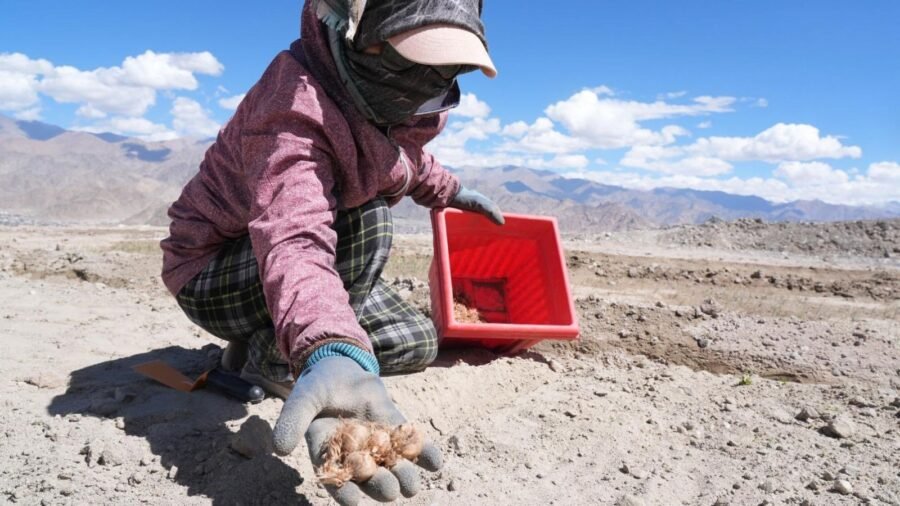
India’s saffron cultivation is set to expand beyond Kashmir, with a mass plantation drive underway in Ladakh’s Leh district as the Union Territory makes its first attempt to cultivate the high-value spice on a large scale.
Vinai Kumar Saxena, Governor, UT Ladakh, on Sunday announced the planting of 90,000 saffron corms, weighing 800kgs, in this region that has unique high-altitude agro-climatic conditions suitable for saffron.
“This pioneering project has immense potential to strengthen our local economy, creating lucrative and sustainable new livelihood opportunities for our hardworking farmers, youth, and self-help groups,” he said.
Story continues below.
Subscribe to see fewer ads.
The experiment, spread across 4,000 square metres area in Leh, is a part of Project Him Sarovar, a government initiative to reclaim lost agrarian land in Ladakh.
What’s needed to grow saffron
Saffron, the dried stigma of the flower, is often used in cooking, cosmetics, and for medicinal purposes. Pampore in Kashmir is well known for cultivating the finest saffron in India.
The plant can be cultivated between autumn and winter, with the ideal location having minimum temperatures ranging from 8°C to 10°C and benefitting from light to moderate snowfall.
Only corms weighing more than 10 grams bear saffron flowers, and the number of flowers depends on the size of the corm, directly affecting saffron production. On average, an acre of saffron cultivation in Pampore is known to yield a maximum of up to 2 kg of saffron.
Story continues below this ad
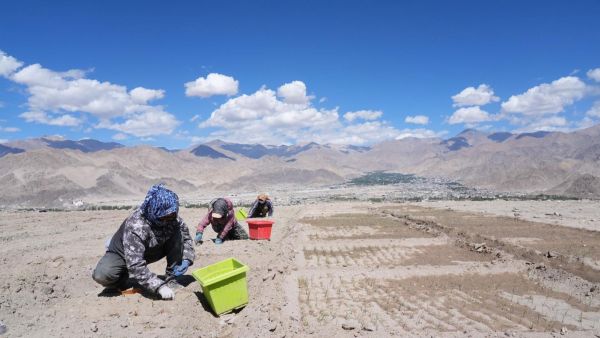 The present cultivation exercise in Leh comes in the wake of a successful attempt at growing saffron in Ladakh two years ago.
A 2024 success story
The present cultivation exercise in Leh comes in the wake of a successful experimental attempt at growing saffron in Ladakh two years ago, led by researchers at the CSIR-Indian Institute of Integrative Medicine (IIIM), Jammu. Botanically known as Crocus sativus, IIIM scientists had succeeded growing saffron in open fields in Leh.
In 2024, the institute inked an MoU with the Ladakh Autonomous Hill Development Council, Leh, towards setting up demonstration farms for the cultivation of medicinal, aromatic and flowering plants in Leh.
Since then, the institute has been developing protocols for cultivation, processing, and post-harvest management extendable to these crops to the farmer’s field and is planning to introduce more crops.
A welcome step
Speaking to , C K John, a scientist formerly with Pune-based National Chemical Laboratory, said that the Ladakh experiment is a welcome step. “If it is successful, this will help the farmers of the region and also contribute in increasing the country’s saffron production,” he said.
Story continues below this ad
John had led a team that succeeded in growing saffron under greenhouse conditions in the Pune lab and has worked with farmers across Jammu and Kashmir, Himachal Pradesh, Maharashtra, and Sikkim for experimenting and increasing the acreage of saffron cultivation in India.

Tamil Nadu bypolls put Vijay’s young government to an early test as voting picks up
By Sohail Khan · 6 Oct
Naveen Patnaik’s BJD joins Opposition’s Election Commission protest
By Sohail Khan · 6 Oct

Leave a Reply