Gurugram crash case reveals a legislative defect
Whether a crash victim survives or dies can radically alter how the law treats a driver who causes the collision and flees. Section 106(2) of the Bharatiya Nyaya Sanhita provides imprisonment of up to 10 years when negligent driving causes death, and the driver escapes without reporting the incident. The provision, however, was excluded when the other provisions of the BNS came into force and remains unenforced. If the victim survives with grievous injuries, no comparable offence exists even on paper.
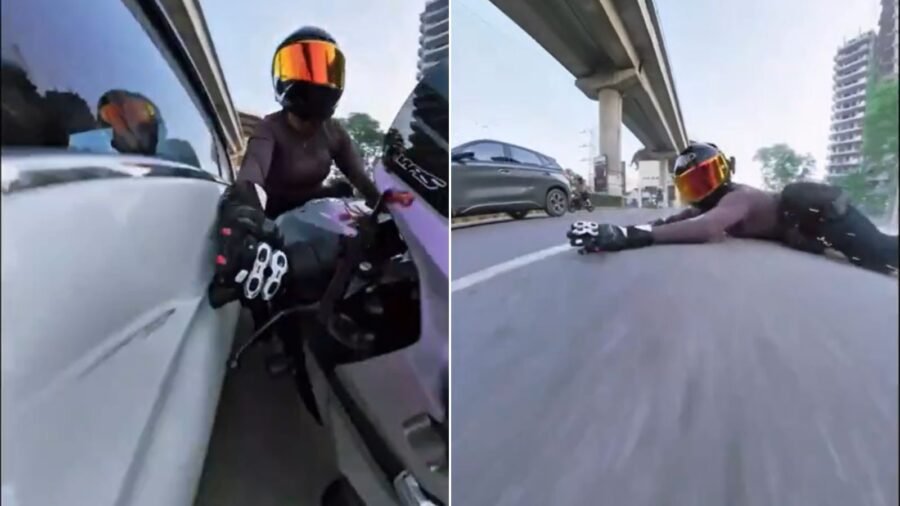
The problem has come into view after the recent crash on Gurugram’s Golf Course Road. A video reportedly shows a car striking a woman motorcyclist from behind after an alleged chase. The woman has alleged that the occupants made gestures at her before the collision, while the alleged driver has denied hitting her intentionally.
Advertisement
Gurugram Police took suo motu cognisance and initially registered an FIR under Sections 125 and 281 of the BNS. After examining the footage and recording the rider’s statement, the police added Sections 78 and 79, concerning stalking and gestures intended to insult a woman’s modesty, along with Section 109 on attempt to murder.
What the charges mean
Section 281 covers rash or negligent driving on a public road and carries up to six months’ imprisonment, a fine of Rs 1,000, or both. Where such conduct causes grievous hurt, Section 125(b) permits imprisonment of up to three years, a fine of Rs 10,000, or both. Both offences are bailable and treat the collision essentially as an act of dangerous or careless driving.
The addition of Section 109 changed the character of the case from an allegation of negligent driving to one of deliberate violence. A car may ordinarily be a means of transport, but when deliberately driven into someone, its use may support an allegation of intentional violence. Attempt to murder is non-bailable and carries imprisonment of up to ten years and a fine. Where the act causes hurt, the punishment may extend to imprisonment for life. The victim’s survival does not rule out the offence. What matters is whether the act was committed with the intention or knowledge required for murder, even if it did not ultimately prove fatal.
Advertisement
Sections 78 and 79 concern the alleged pursuit and gestures preceding the collision. Section 78 covers stalking, including repeatedly following or contacting a woman despite a clear indication of disinterest. A first conviction carries imprisonment of up to three years and a fine and is bailable; a subsequent conviction may attract up to five years and is non-bailable. Section 79 covers words, gestures or acts intended to insult a woman’s modesty or intrude upon her privacy. It carries imprisonment of up to three years and a fine and is bailable.
The offence that remains unavailable
Section 106(2) of the BNS applies when a person causes death through rash and negligent driving, where the act does not amount to culpable homicide, and escapes without reporting the incident to a police officer or magistrate soon afterwards. The punishment may extend to 10 years’ imprisonment and a fine.
However, Section 106(2) was excluded from the notification that brought most of the BNS into force on July 1, 2024. The provision therefore remains uncommenced and cannot presently be invoked.
Parliament has recognised that causing death negligently and then fleeing deserves a more serious response than negligent driving alone. The provision enacted to give effect to that principle, however, remains unavailable.
There is another gap within the provision itself. Even if Section 106(2) were brought into force, it would apply only when the victim dies. It creates no equivalent aggravated offence where a driver causes grievous injury and escapes without reporting the collision or helping the victim.
Consider two equally negligent drivers who make the same decision to flee. In one case, the victim dies. In the other, the victim survives with a permanent disability. Only the first driver would fall within Section 106(2). The resulting harm must affect punishment, but survival should not erase the separate culpability involved in abandoning a seriously injured person.
Not every fleeing vehicle is legally ‘hit and run’
In everyday conversation, “hit and run” describes almost any collision after which the driver leaves. Section 161 of the Motor Vehicles Act uses the expression more narrowly. It covers accidents in which the identity of the vehicle cannot be established despite reasonable efforts and provides a route to compensation for victims.
A driver may flee immediately after a collision but be identified later through CCTV footage, witnesses or registration records. Such a case would not necessarily qualify as a “hit and run motor accident” under this statutory definition.
Where the driver or vehicle is identified, Section 134 of the Motor Vehicles Act imposes duties following an accident. These include taking reasonable steps to secure medical attention for the injured person and reporting the accident to the police. Section 187 punishes a failure to comply with those duties.
These provisions make leaving the scene legally relevant, but they do not fill the gap in the BNS. A penalty for failing to assist or report does not fully capture the culpability of causing grievous injury and then escaping. Flight can delay medical treatment, impede identification and allow vital evidence to disappear.
The eventual charge in the Gurugram case will depend on whether the collision is found to have resulted from negligence or deliberate conduct. The larger legislative defect, however, exists regardless of how this particular case is ultimately classified.
Section 106(2) recognises that fleeing after negligently causing death can aggravate criminal responsibility. But the provision remains uncommenced and, even if enforced, would not cover a driver who grievously injures someone and escapes while the victim survives.
Parliament should address this gap through a carefully framed offence covering grievous injury followed by a knowing failure to stop, assist or report. The law must distinguish between a driver who leaves to obtain help and one who escapes to avoid responsibility. But it should not require a victim to die before the driver’s flight becomes part of the principal crime.
The writer is a constitutional lawyer and leads policy advocacy at Crashfree India


Bengali, Gujarati or Sindhi, let’s not reduce hilsa to its pedigree
By Sohail Khan · 16 Sep
5 heaviest birds in the world — and one weighs 156 Kg
By Sohail Khan · 16 Sep
Leave a Reply