Graphs, Data, Perspectives | Can the Chinese yuan displace the US dollar?
China’s rise over the past 20 years has not only been spectacular but has also been in sharp contrast to the economic stagnation in European economies.
Its growing dominance over the global order has led to a natural query: Can the Chinese currency, yuan, rival or even trump the US dollar as the global currency of choice?
This question assumes greater relevance as the US policy decisions become increasingly ad hoc, violating global norms and often weaponising the US dollar.
Story continues below this ad
The ‘privilege’ of the US dollar
To be sure, everyone on the planet (be it an individual or another country’s central bank) is happy to trust the US dollar. They would park their savings in US dollars (or in dollar-denominated assets) or settle trade amongst each other using that currency instead of their own currencies. This gives the US economy great power, allowing the country to live beyond its means.
Here’s how. When the US wants to buy more goods from the rest of the world, it can simply print more dollars to pay for it. The other party accepts these because it trusts the US economy and its governance system. What’s more, the other party uses these new dollars to buy US bonds, either issued by the government or other big US companies.
This way the lending party can make some profit on their dollars while being assured that it is the safest investment on the planet, because no one thinks the US will default on its debt.
Story continues below this ad
No other country enjoys this so-called “exorbitant privilege” that the dollar confers on the US.
If India prints more money to buy more goods from the rest of the world, all that excess money will stay in India since no one outside wants to hold Indian rupees.
In turn, all that excess printing of money will lead to a spike in prices within the country (domestic inflation) because everyone in India would have more money chasing the same amount of goods and services.
It is because the US dollar has become the trusted medium of exchange globally that the US economy has got this superpower.
Story continues below this ad
The Chinese challenge
The trust in the US dollar is, in essence, a trust in the continued strength of the US economy and the robustness of the rule of law in the country. But it is also true that for a while now — since World War II, in fact — there has been no single country that could rival the US in terms of economic might.
Over the past few years, the discourse has changed on both counts.
For one, US decision-making is increasingly at odds with the rules-based global order the country itself helped create. Trump’s punitive tariffs are but one example. One can also cite the removal of Russian banks from the SWIFT system — in response to its 2022 invasion of Ukraine — that was led by the US (under Joe Biden) and other Western countries.
Story continues below this ad
SWIFT is a global financial messaging service, dominated by the US, which is the cornerstone for money transfers across the world.
Amid these developments, trust in the usage of the US dollar has eroded on the margin.
This has happened at a time when China has not only grown big enough in economic might to rival the US but has also increasingly pitched its currency as an alternative to settle global transactions.
So, can yuan knock the dollar off its perch?
Given the overwhelming dominance of the US dollar in the global economy — more than 50% of all transactions are done in dollars and more than 50% of the global foreign exchange is stored in dollars, etc — knocking off the US dollar completely is a bridge too far for any currency.
Story continues below this ad
The yuan, however, did gain considerable ground among users in the wake of the Russia-Ukraine war.
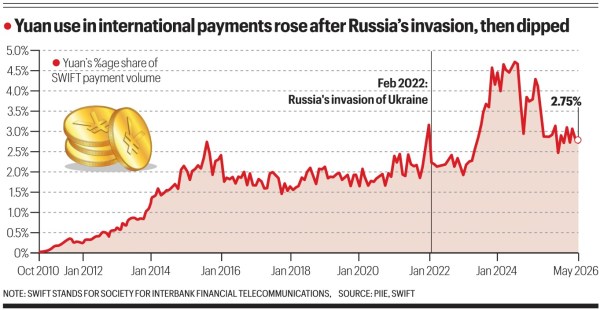
As a new research paper from the Peterson Institute for International Economics (PIIE) pointed out recently (see chart), yuan’s share in the SWIFT network, the global standard for payment messages between banks, “spiked after sanctions imposed by every major reserve currency issuer made Russia and other countries more willing to use the yuan”.
 The yuan’s performance
By July 2024, yuan’s share of global payments was at 4.7%, overtaking the Japanese yen and Canadian dollar to become the fourth most used currency in the world. The other two were the euro and the British pound.
Since then, however, its share has fallen back to 2.75%, leaving it the sixth most used currency. Dollar’s share is closer to 50% in SWIFT.
Story continues below this ad
Is the yuan challenge over?
There are two ways to look at yuan’s future prospects.
The first is to look at other sets of data to understand yuan’s attractiveness.
The PIIE paper by Martin Chorzempa points out that more and more banks globally are signing up for China’s Cross-Border Interbank Payment System (CIPS). CIPS settles payments in yuan instead of dollars. Data shows that more and more payments are being settled in yuan on CIPS over the past couple of years, even as the currency has lost ground on the SWIFT platform.
Story continues below this ad
In other words, CIPS’s trajectory suggests that an increasing share of payments using the yuan are bypassing the SWIFT network.
“It is a sign that China is prioritizing resilience to potential future sanctions and self-sufficiency, even at the risk of diverging from global payment standards,” writes Chorzempa.
The second way to look at this issue is to ask a more fundamental question: Can the world trust China?
The global trust in the US dollar is not just about the size of the US economy. What is equally, possibly more, important for the trust in the dollar is the way the US economy is run on the basis of clear-cut rules, well laid-out limitations on the arbitrary actions of the government, transparency of data, existence of a free media, as well as independent and fair courts of justice. All of these components come together over time, along with massive economic might, to afford the US the privilege of the dollar being the go-to currency for the planet.
Now, the US is struggling on many of these counts at present. It was quite symbolic that on a day when China’s President visited the White House, sections of the US media were refused entry thanks to an illegal and arbitrary ban by the US President.
But China cannot even pretend to have similar freedoms. Global trust requires China and its government to play fair and by the globally-accepted rules. In the absence of well-founded, independent and constitutionally-secured institutions in China, the yuan may never be able to become the global benchmark, regardless of what happens to the dollar.

‘Lust Stories’ offers what few other series do — a window into the world of women’s desires
By Sohail Khan · 25 Sep
An expert explains | As Xi-Trump meet, why an island 15,000 km away looms large
By Sohail Khan · 25 Sep
Leave a Reply