Ganpati’s noise battle puts DJs on the mute
For nine year old Vivek Kalse, it started with a pair of speakers.
He would experiment with them at home, fascinated by music and the way different sounds could change the mood of a room. By 18, that curiosity had become a profession. He became a disc jockey.
Now 24, Kalse is pursuing an audio engineering course in Ahmedabad, continuing to work as a DJ in Kalyan. But this Ganeshotsav, his attention is divided between learning new sounds and following a debate that could determine how much work comes his way.
Story continues below.
Subscribe to see fewer ads.
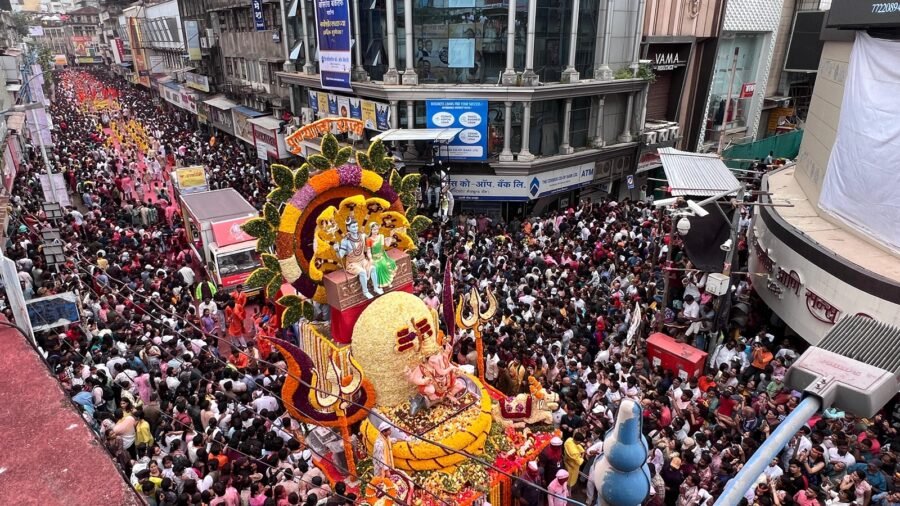
What began with a Pune resident’s demand for a ban on DJs during Ganeshotsav has grown into a wider debate over high decibel sound systems. The ruling Mahayuti is itself divided over how far restrictions should go, while the question of whether DJs should be banned or existing noise limits strictly enforced remains unresolved. For those who operate the systems, the uncertainty has already begun to affect bookings.
“Growing up, I observed that people loved to dance to remixes. These mixes had no limitations of religion, language or beats. I knew, early on, that I wanted to play music that entertains,” Kalse said.
For an estimated two lakh-plus DJs in Maharashtra, according to the Professional Audio and Lighting Association (PALA), the current controversy is not merely about music or noise. It is about a profession that supports sound rental companies, technicians and loaders, and requires investments running into lakhs of rupees.
The business behind the sound
The person standing behind the DJ console is only one piece of the operation.
Story continues below this ad
A large set up involves speakers, amplifiers and consoles, with a sound technician and loaders working behind the scenes to install, operate and move the equipment. The equipment used in a professional set up can cost between Rs 25 lakh and Rs 30 lakh.
For DJ and sound operator Sandeep Bhoir, who runs Ashok Pro Sound and Lights, the business has changed dramatically since he began.
“In the early 2000s, I started experimenting with two cassette players and did demos by blending music. The response from the public was amazing as they no longer had to wait for a new song to play. Gradually, the cassette was replaced with the CD player and later, ‘pendrives’,” Bhoir said.
Today, digital systems have replaced most of that equipment. But staying in business means continually investing in newer technology.
Story continues below this ad
“We have to keep purchasing new sound equipment, which are high-end and produce good, crisp sound. We are almost always facing financial hurdles as we have to constantly keep taking loans,” Bhoir said.
That investment is particularly difficult for an industry where work comes in cycles.
The festive calendar
The monsoon is traditionally a lean period for DJs. The season begins to pick up with Navratri, followed by weddings and events at schools and colleges. Demand rises again from April and continues through the wedding season until June.
Ganeshotsav falls at an important date in that calendar.
This year, however, the festival has arrived amid uncertainty over the use of high decibel sound systems.
Story continues below this ad
“During the monsoon period till September, we barely get any bookings. When we get a booking for an event, we hire speakers alongside loaders for lifting the heavy equipment and even sound technicians to maintain the systems. We pay them at a rate of Rs. 1,000 per day. When we lose our bookings, it is not only us but also our team who loses a source of earnings during this period,” said Mumbai based DJ Ganesh Sunariwal, who performs under the stage name Djgsonyyyyy.
A booking can mean a day’s work for a loader, an assignment for a sound technician and income for a rental company. PALA estimates that Maharashtra has over one lakh sound rental companies employing more than nine lakh service vendors.
The noise argument
The industry’s problem is not simply that there is a debate over noise. It is the ambiguity over what exactly is being restricted.
The Bombay High Court, in August 2016, directed implementation of the Noise Pollution (Regulation and Control) Rules, 2000 and asked Ganesh mandals to follow them along with Supreme Court guidelines. The sound limit was to be kept below 60 decibels in residential areas, while loudspeakers could be used with permission in silence zones.
Story continues below this ad
DJs and sound vendors say that over time, however, these directions have sometimes been treated as an effective ban, with fines imposed and equipment seized.
Manuel Dias, an administrator with PALA, says the distinction between a DJ and the equipment operated by a DJ has been lost in the debate.
“There is a lot of confusion over the norms and regulations of the Noise Pollution Act with authorities vaguely saying that a ban has been imposed on DJs. Firstly, a disc jockey is an artist who operates the sound apparatus. How can a disc jockey be banned? Second, there is no directive by the High Court which imposes a ban on the loudspeakers. There needs to be more clarity on understanding of a loudspeaker, before action is issued. Furthermore, why is the action only restricted to Ganesh Chaturthi?” Dias said.
Dias said authorities should sit with the industry to work out festival sound norms, pointing to the livelihoods dependent on the sector.
Loud does not always equal good
Story continues below this ad
Sound operators also object to the perception that their profession is simply about making music as loud as possible.
Bhoir argues that a good sound system is about the quality of the sound, not just its volume.
“A DJ set up is not just about loud sounds. A good sound system is one which is able to generate clean and crisp music. Today, the market is flooded with pressure-mid speakers which simply generate loud sounds and hurt one’s ears. These speakers are typically in road shows, simply to show-off and are very unpleasant,” he said.
For Kalse, DJing itself is a skill that requires years of learning.
Story continues below this ad
“In fact, the music industry is ever evolving and you have to keep up with every new technology and trend. A true artist has to train everyday to learn about new sounds, compile fresh mixes as well as keep experimenting with new experiences,” he said.
Yet the profession carries another kind of pressure, one that has little to do with equipment.
“Most people think that a DJ’s life is all about glamour. They presume that we simply stand behind a console and act cool. Sometimes, unruly clients often abuse us and even take to violence simply because we are unable to play their music or songs they want right away. People fail to respect us and see us for what we truly are, a professional artist,” Kalse said.
A changing Ganpati sound
The debate over DJs comes at a time when the soundscape of Ganeshotsav has already begun changing, at least in Mumbai.
Story continues below this ad
Naresh Dahibavkar, president of the BSGSS, which represents Mumbai’s Sarvajanik Ganpati mandals, said mandals have cut their use of DJs by nearly 85 per cent over the past decade.
“Since the High Court directives in 2016, most mandals now resort to more traditional music like dhol Tasha and Lezim. They have considerably reduced the usage of DJs during festivities. We continuously keep informing mandals to abide by the noise pollution norms,” Dahibavkar said.
But that shift has not eliminated the demand for DJs everywhere. In parts of Maharashtra, particularly during processions and immersion, large sound systems remain an important part of the festival economy.
There is a legitimate demand for regulation of excessive noise. There is also an industry that says it needs clear rules rather than an open ended threat of bans, fines or equipment seizures.
Kalse entered the profession because he wanted people to dance and enjoy music.
As Maharashtra argues over how loud Ganeshotsav should be, he is waiting for clarification on whether he will have a stage for festivities to perform at.

A wig, three identities and crores gone missing: Anatomy of a ‘share market’ con
By Sohail Khan · 14 Sep
81-yr-old schoolmate meets Modi over 15-year-old land dispute in Bhayander
By Sohail Khan · 14 Sep
Efforts underway to monetise land along Nashik ring road
By Sohail Khan · 14 Sep
Leave a Reply