Ganeshotsav 2026: Murtikars Struggle With The Rising Cost Of Going Green
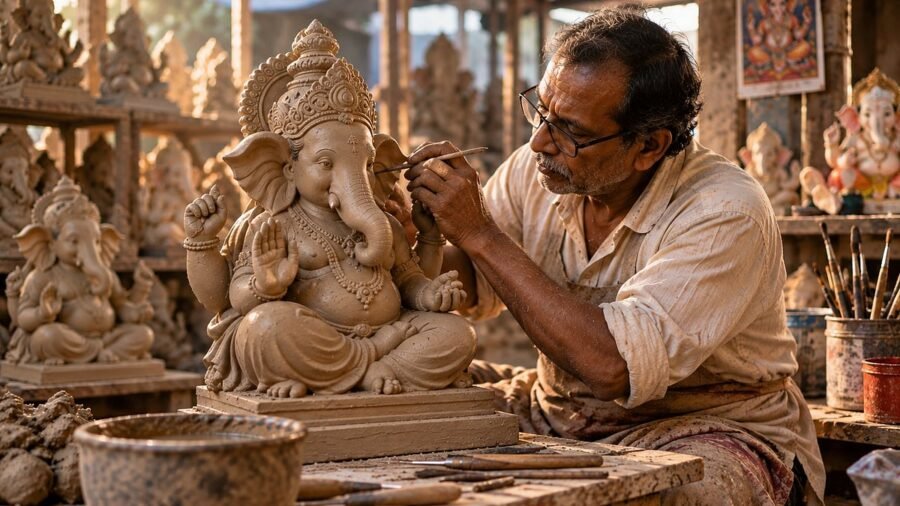
Clay idols take longer to make, require specialised skills and face higher labour and transport costs, putting the financial burden of the eco-friendly transition on artisans
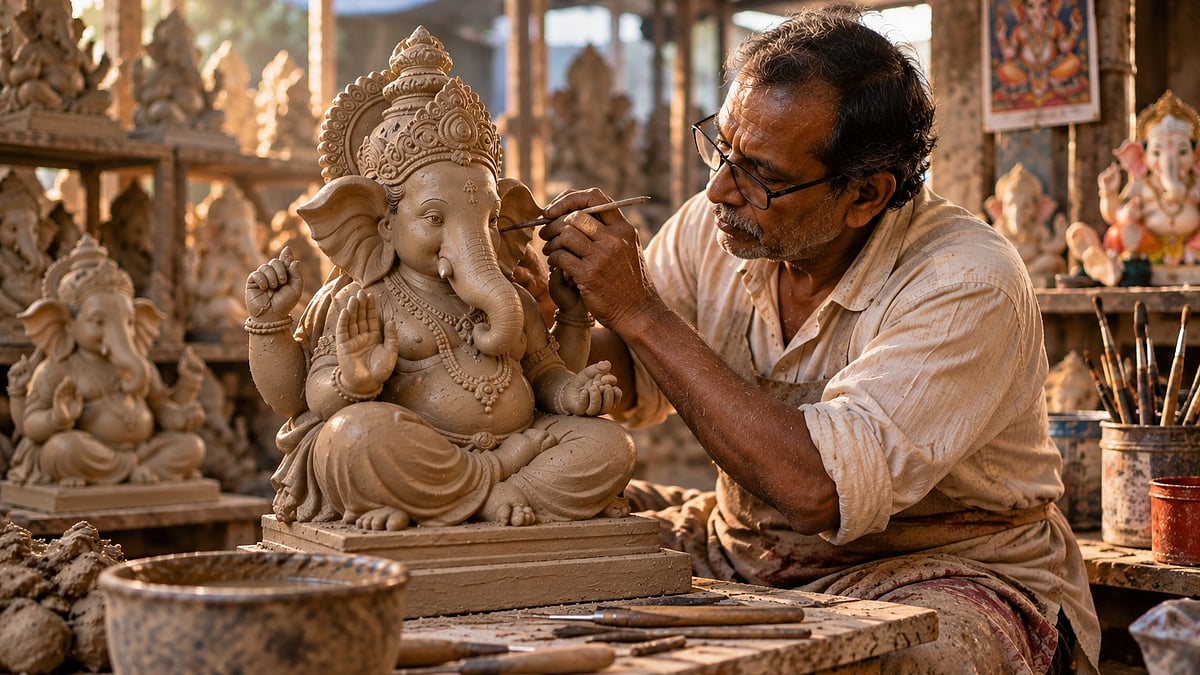
In a Girgaon workshop that has been turning out Ganpati idols since before Independence, Pradeep Ramkrishna Maduskar keeps returning to one sum. "If a PoP murti can be made twelve in a day, clay murtis are only two or three a day," says Maduskar, 73, who runs RV Maduskar Art, the business his father started 88 years ago. "That is why they are costly."
It is the clearest explanation of Mumbai's eco-friendly idol problem anyone has offered this season. The conversation around Ganeshotsav has been almost entirely environmental — what dissolves, what doesn't, which water body suffers. Far less has been said about who absorbs the cost of the switch, and whether the craft survives it.
Twelve a day, or three
Maduskar, a second-generation murtikar whose son is now the third, is careful not to overstate the difficulty. Humidity, the usual villain in the shadu story, is not really the problem, he says. Neither, in his experience, is civic enforcement; there is pressure from the BMC, but not as much as people assume.
`;
The real constraint is time. Plaster of Paris sets fast, takes paint evenly and is light enough to move cheaply. Shadu, by contrast, "requires skill, labour and time to work with", as the Pune-based eCoexist Foundation has put it and is markedly more prone to damage in transit. PoP's rise was never mysterious: cheaper in bulk, faster to produce, sellable at the same price or higher. A workshop running on clay runs at a fraction of its capacity, on the same rent, for the same season, against the same deadline.
Skill that went missing
The second constraint is rarer than clay: people who can work it. Not many murtikars are trained in it any more, Maduskar says, a scarcity that shows up directly in the price. A modest handcrafted shadu idol now realistically starts around ₹2,000, climbing steeply with size and detailing.
Those still entering the trade describe the same learning curve. Kartik Choudhary, an intern with a murtikar in Pune, took it on deliberately. "I have always wanted to create murtis, eco-friendly ones, and yes, I have faced difficulty learning it. PoP is easier," he says. "But given the demand, I had to learn it, and I am enjoying the process. I hope people understand the importance of it sooner."
Demand, not regulation, is what pulled him across. Whether it pulls enough others, fast enough, is the open question. Naresh Dahibavkar of the Brihanmumbai Sarvajanik Ganeshotsav Samanvay Samiti estimated last year that roughly 40 per cent of artisans had already shifted to shadu or other eco-friendly materials.
For Ashok Kadu, president of the Paramparik Murtikar Hastakala Karagir Sangh, who has made eco-friendly idols for five decades, the case is visible at the shoreline. "There are several ways to create eco-friendly idols," he has said, describing PoP idols left half-dissolved after immersion as distressing to see.
What neither figure settles is whether the remaining sixty per cent can follow or afford to.
What the science actually says
The case against PoP is not disputed. Laboratory work comparing identical painted idols in shadu, PoP and paper mache over 60 days found complete dissolution of clay idols, dissolving faster in marine water than fresh water, while PoP stayed insoluble and settled as sediment. CPCB studies have recorded total dissolved solids doubling after immersion, oxygen levels falling, and iron and copper rising up to tenfold.
The finer point, often lost, is that much of the toxicity comes from paint rather than the idol. PoP idols are typically finished with synthetic, oil-based paints containing heavy metals such as lead, mercury and cadmium, which leach out slowly as the idol breaks down over months. Clay pairs far more readily with water-based and vegetable dyes — which is precisely why the BMC hands out natural colours alongside the clay.
Where the clay comes from
Shadu's own supply chain complicates the green label. It is largely naturally occurring bentonite, mined in Gujarat and West Bengal and transported to Maharashtra, a non-renewable mineral in slowly shrinking supply, with its own environmental and miner-health costs.
Fuel has sharpened that. "Higher fuel prices have increased the transportation costs," says Mumbai sculptor Tejas Milind Kavitkar, for both shadu and PoP brought in from other states. Idol prices statewide have risen 20 to 30 per cent this season.
The Bombay High Court has noticed the asymmetry, asking the state why it was proposing recycling only for PoP idols and not for traditional shadu ones.
What free clay does not cover
The civic response has been material. The BMC has distributed 858 tonnes of clay and 25,400 litres of natural colours, with 1,136 murtikar mandaps set up in its jurisdiction and total distribution expected to reach around 1,000 tonnes, similar to last year. Clay goes out "on first-come-first basis at the ward level" to artisans applying online, a civic official has said.
That flatness is the finding. Despite the government's efforts, there has been no significant rise in clay collection for idols.
And raw material is not the chief complaint. In Uran, where families in Chirner, Kumbharpada and Jasai have made shadu idols for over a century, artisan Manohar Pawar said clay had risen by about ₹15 a unit, natural colours had grown costlier and labour had climbed by nearly ₹2,000, with no subsidy announced despite repeated demands.
Free clay does not buy covered drying space, three extra weeks of working capital, or cover against breakage.
Bill on the other side
The cost of not transitioning is larger, and lands on the public. After last year's visarjan the BMC moved roughly 2,500 metric tonnes of PoP remains but scientifically processed only 10 tonnes, at a cost of ₹20 lakh. A state expert committee found biological disintegration of PoP unfeasible, recommending only chemical disintegration and calcination.
A pilot is under way. "Idols of over six feet would be melted and processed," Advocate General Milind Sathe told the court, with results to be studied before wider use.
The ledger, as it stands: artisans carry the cost of going green, and the city carries the cost of not.
Three more years
The state has told the High Court it needs three more years to phase PoP out completely, and that it could not implement the Prime Minister's appeal for clay idols this season because most idols were already made. The court, having granted a one-year extension earlier, was unimpressed. "By the time you are given more time, natural resources will suffer immense damage," the bench observed. At a later hearing, it pressed harder still: "Show us any one of the scriptures which says that a PoP idol has to be immersed in water."
Rather than issue fresh interim orders each year, the bench has decided to hear all pending petitions together. Until that judgment lands, the existing arrangement holds: idols under six feet to artificial ponds, larger ones to natural water bodies under conditions.
For Maduskar, whose workshop has outlasted considerably more than a court calendar, the calculation stays simpler and slower than policy. Twelve, or three.

Add As a
Trusted Source 




Leave a Reply