From rooftop solar to household gold: 5 lesser-known changes in India’s new GDP series
Manufacturing or services?
A key change the new 2022-23 base year series makes from the old 2011-12 one is the classification of an enterprise in a sector.
Story continues below.
Subscribe to see fewer ads.
Imagine an enterprise called XYZ involved in multiple activities – it does some manufacturing and provides some services too – and with an annual turnover of Rs 100 and a GVA of Rs 50. Is XYZ part of the manufacturing or services sector?
In the old GDP series, this question would be answered by XYZ’s ‘major activity’. This means, if Rs 70 of XYZ’s Rs 100 turnover came from manufacturing, it was part of that sector and the entire GVA of Rs 50 was assigned to manufacturing even if some of it came from services sold.
In the new GDP series, XYZ’s GVA goes to both manufacturing and services depending on their shares – if Rs 20 of GVA came from service activities, that goes to the services sector and the remaining to manufacturing.
 MGT-7 form
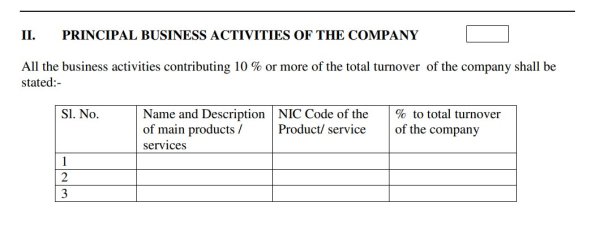
How is this distinction possible now? Because of two forms called MGT-7 and MGT-7A that companies have to fill with the Ministry of Corporate Affairs.
Story continues below this ad
MGT-7 is for public and private companies, while MGT-7A is for one-person and small companies. These forms must be submitted every financial year and require details regarding financial results, management structure, shareholding, and loans taken, among others.
These two forms also ask a company to list all those business activities it is involved in which contribute at least 10% of its turnover. In addition to listing the activity, the company must also mention what proportion of its turnover comes from each activity.
So, if 20% of XYZ’s turnover comes from service activities and 80% from manufacturing, this would be listed in its MGT-7/7A forms. MoSPI is now using that to compute how much of XYZ’s GVA is coming from which activity, ensuring each sector is more accurately measured.
Government housing
There are lakhs of government employees – some get accommodations and some get House Rent Allowance (HRA). While HRA reflects in the pay, the value of the housing service provided by the government to staff who get accommodations was previously not being accounted for.
Story continues below this ad
In the new GDP series, to value the housing services provided by the government, the cost of making these houses has been used after deducting the cost of repair, maintenance, and the annual consumption of this fixed capital.
Useful life of assets
The annual consumption of a house in the above section cannot be calculated without knowing how long it will last. And the new GDP series assumes a lower ‘average useful life’ for several types of assets. For example, the average useful life of dwellings is now assumed to be 60-75 years, down from 70-80 years in the old series.
The average life, the MoSPI said in its Sources and Methods document, is reviewed from time to time to account for technological changes, obsolescence, changes in operating environment, maintenance practices, and regulations, among other factors.
Household savings
MoSPI’s national accounts data is best known for the main GDP growth number. But it also contains other crucial pieces of information. One of them is on savings, including those of households, which are in the form of financial and physical assets, including valuables like gold.
Story continues below this ad
The new GDP series has made one major change in the compilation of household savings, with data on financial savings like shares, debentures, hybrid instruments, and mutual funds now taken from the Securities and Exchange Board of India (SEBI) instead of the Reserve Bank of India (RBI). This has allowed for the inclusion of new instruments like Real Estate Investment Trust (REIT), Investment Trust (InviT), and Alternate Investment Funds (AIFs).
To estimate household savings in the form of valuables, the results of the latest All India Debt and Investment Survey 2019 were used. This led to the nominal value of household savings in gold and silver ornaments in 2022-23 more than doubling to Rs 1.65 lakh crore in the new series from Rs 64,504 crore in the old series.
MoSPI began the new All India Debt and Investment Survey in July. It will end in June 2027.
Rooftop solar
The ‘electricity, gas, water supply & other utility services’ sub-sector produced a real GVA of Rs 1.92 lakh crore in April-June 2026, 8.9% higher than a year ago. And this now includes electricity produced by households for themselves through rooftop solar panels.
Story continues below this ad
Figures for 2022-23 and 2023-24 are calculated using the respective Household Consumption Expenditure Surveys and the health ministry’s population projections. Starting 2024-25, the value of electricity produced by households through rooftop solar is being estimated by extrapolating growth in installed capacity (available from the Ministry of New and Renewable Energy) and using the applicable per-unit price.

New vegetarian, non-veg labels for soaps, shampoos, toothpaste: What they mean for consumers
By Sohail Khan · 23 Sep
Why is the UK refuelling Saudi jets against the Houthis, and how involved is it?
By Sohail Khan · 23 Sep
Satire | My personal BRICS goodie bag
By Sohail Khan · 23 Sep
Leave a Reply