Flood-hit Nepal’s digital shift in philanthropy
Benchmarks
Nifty23,897.7024.25
Precious Metal
Gold (MCX) (Rs/10g.)152,815.00-2960.0
Enter search text:
Business News›News›International›World News›From bank queues to QR codes: Flood-hit Nepal's digital shift in philanthropy
Read Today's Paper
From bank queues to QR codes: Flood-hit Nepal's digital shift in philanthropy
Synopsis
Nepal's digital payment systems now facilitate swift disaster relief donations. QR codes and mobile banking enable direct person-to-government transactions easily. International donors contribute efficiently using digital payment networks and cards. This digital transformation simplifies contributions for citizens and overseas Nepalis. Technology has significantly streamlined the collection of relief funds for Nepal.
 PTI
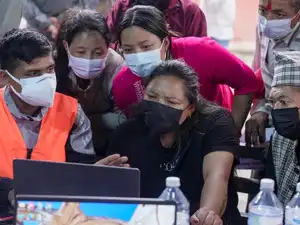
PTIKathmandu: Once, donating to government relief funds in Nepal meant carrying cash, finding a bank and standing in a queue. Now, for many, it takes just a phone, a few taps and a QR code scan.
For guitarist Bobby Lama of the band Mongolian Heart, the change was personal.
During the 2015 earthquake and the COVID-19 pandemic, Lama joined rescue and relief efforts, carrying cash himself to communities in need. The hassle of going to a bank meant he never considered donating to a government relief fund.
This time, after devastating floods hit the Himalayan nation, he simply scanned a QR code and sent money directly to the Prime Minister's Disaster Relief Fund through mobile banking, according to The Kathmandu Post newspaper.
Lama's experience reflects a broader shift in the way Nepal is responding to disasters, with the country's rapidly expanding digital payments infrastructure connecting ordinary citizens, businesses and overseas donors directly with a government relief fund.
You Might Also Like:
Nepal’s request for flood payout tests new climate-aid system
By the 11th day after the devastating August 26 Bhotekoshi floods, more than NPR 10 billion had been collected in the relief fund, the Post report said.
The contributions have ranged from schoolchildren to global tech giant Nvidia.
The campaign marks the first time in Nepal that individuals have been able to make direct person-to-government transactions on such a large scale, sending money digitally straight into a government account.
During the 2015 earthquake, there was no similarly convenient digital channel for individuals in Nepal or abroad to transfer money directly to a government relief fund.
You Might Also Like:
Global warming: From Nepal to Assam to Kerala, nature’s fury is colliding with unchecked development
Finance Minister Swarnim Wagle said digital payments and technology had made it considerably easier to collect relief funds.
"For donors living abroad, we arranged for direct payments using dollar-denominated cards such as Visa and Mastercard. They no longer have to visit a bank or go through cumbersome international bank transfers," Wagle was quoted as saying in the Post report.
Data from the Finance Ministry, digital payments company Fonepay and Nepal Clearing House Ltd (NCHL) show that electronic payments have emerged as a major channel for disaster donations.
Of the 8,89,145 transactions processed through Fonepay's network, 8,15,219 were domestic QR payments made by people in Nepal, generating NPR 2.095 billion for the relief fund.
Through NCHL's network, 2,46,614 transactions had been recorded by Saturday afternoon.
Domestic QR payments accounted for the largest number, with 1,12,932 transactions generating NPR 390.5 million.
Nepal's electronic payment systems are also connected to international networks, allowing Nepalis living abroad and international donors to contribute without traditional bank transfers.
More than NPR 1.4 billion has been deposited directly into the relief fund through 93,850 transactions using international cards such as Visa and Mastercard, authenticated through the 3D Secure system.
"In previous disasters, people had to go to banks and queue up to make donations," said Santosh Koirala, president of the Nepal Bankers' Association.
"The digital transformation of banks and financial institutions now means anyone can easily send relief money through a mobile banking app," he said.
The strengthening of Nepal's digital financial infrastructure has connected donors at home and abroad directly to the government relief fund.
Contributions have also arrived through international payment systems, including India's Unified Payments Interface (UPI), China's Alipay, Visa, Mastercard and UnionPay.
By Saturday, UPI had generated NPR 4.854 crore for the relief fund, while Alipay had contributed NPR 1.797 crore.
According to news portal ekantipur.com, Nepal's software and information technology (IT) companies have also stepped forward to provide financial assistance and relief materials for those affected by the devastating floods.
NAS-IT, the umbrella organisation of Nepal's software and information technology service providers, and the Computer Association Nepal (CAN) Federation said they are trying to help with rescue and reconstruction by using technology along with financial assistance.
While IT company Cedar Gate contributed relief materials worth NPR 130,000 for the flood victims, F1 Soft Group donated NPR 13.5 million to the Prime Minister's Disaster Relief Fund.
Add 

(You can now subscribe to our WhatsApp channel)
(You can now subscribe to our WhatsApp channel)
Read More News on
digital payments in NepalNepal flood relief donationsQR code donationsPrime Minister's Disaster Relief Fundelectronic payment systems in Nepalnepal floodsnepal flash floodsnepal flood newsNepal news


Enter search text:
Stories you might be interested in
Bank blocked access to matured FDs, ordered to pay
By Sohail Khan · 3 Oct
RBI hike unlikely to hurt NBFC asset quality
By Sohail Khan · 3 Oct
‘Economic resilience cannot mean global insulation’
By Sohail Khan · 3 Oct