Five moves of mayhem: How Nihal Sarin turned certain defeat into victory
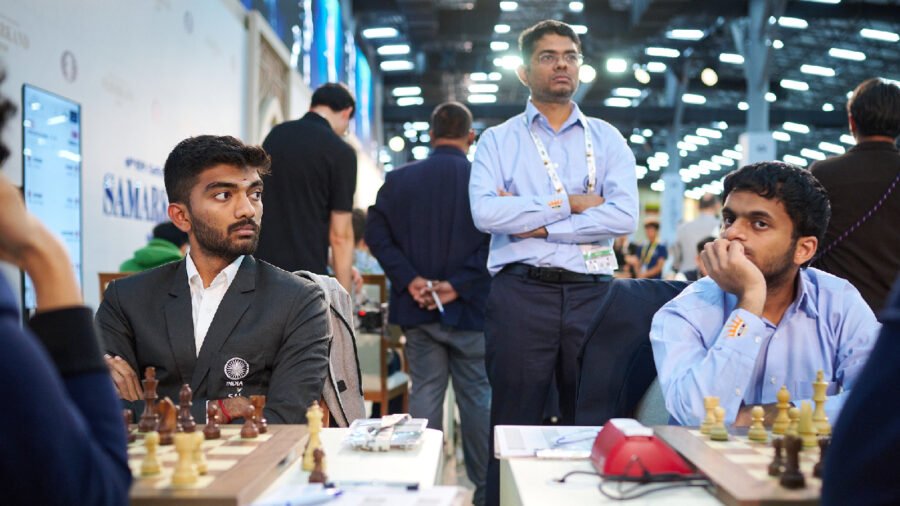
Nihal Sarin managed to grab victory from the jaws of almost-certain defeat in a game that ended up handing the Indian team a victory over Indonesia in round 2 of the Chess Olympiad in Samarkand. Nihal’s game was the only decisive result across four boards in the defending champions’ clash with Indonesia, who with an average team rating of 2436 are only the 52nd strongest team among the 206 participating nations. India, meanwhile, are the second strongest team with an average rating of 2735.
The Indian women’s team, meanwhile, claimed a near-perfect victory over Finland in the second round, with Divya Deshmukh, Vantika Agrawal and Savitha Shri winning their games while Vaishali ending up with a draw. Divya was the only player in trouble in the round, with her form from the recent Global Chess League still to be shrugged off. But FIDE master Johanna Paasikangas was overpowered in the middle game by Divya before she claimed a win.
Nihal was in a losing position when his opponent Arif Abdul Hafiz handed him a get-out-of-jail-free card, one that he gladly accepted before turning around the fate of the match and the India-Indonesia tie. Rated 2428, Hafiz is 290 Elo points behind the 2718-rated Nihal, but if you had glanced at the position on the board when Nihal played his 21st move with white pieces, you would have thought that the ratings were a hoax.
Story continues below.
Subscribe to see fewer ads.
Both players exchanged blunders over a series of consecutive moves— Nihal abandoning his pawn on c2 and Hafiz refusing to take it, Hafiz castling queenside before rashly pushing his king forwards a square to try and threaten Nihal’s rook, a move which swung the balance in the India’s favour—as the evaluation bar dropped and rose like it was hopping on the trampoline. At one point when these blunders were being made, with all the other three games not having too much fight, the eyes of all three Indonesian players and Vidit Gujrathi and Praggnanandhaa were trained at Nihal’s game. Only Gukesh managed to focus on his own game without getting distracted by the harakiri on the board to his left. Nihal was two pawns down at this stage, and it looked like another defeat for India was imminent after Arjun Erigaisi had lost in round 1.
Such was the rollercoaster that in the space of five moves — from 21 to 26 — Nihal had gone from a dead lost position to a winning position.
The game proved to be decisive for India’s fortunes, because all the other games had ended in draws, so had Nihal lost, India would have found their title defence crumbling in the second round of the Olympiad.
“The Nihal board could have gone either way. For example, if Nihal was playing the same position against someone who was a 2600 or a 2700-rated player, would this game still have ended this way? I’m not sure. Nihal was in objective trouble in that game. He kept his chances going and when he got the opportunity he found the best moves and won. That could have been anyone’s game,” said Tania Sachdev, who was part of the Indian women’s team at the last Olympiad, on the Chess.com India commentary.
Story continues below this ad
Creeping cracks
The worrying part for captain Srinath Narananan is that while India have managed to win both their ties in the first two rounds, cracks have been apparent. At the 2024 Olympiad in Budapest, the Indians had lost one game in the 44 games they played over 11 rounds. At Samarkand, thanks to Arjun’s defeat in the first round, the Indians have already equalled that.
To make matters worse, the hosts Uzbekistan, who are expected to be the strongest contenders to snatch away India’s gold at the ongoing Olympiad have won seven of the eight games so far, drawing the final game. They had an imperious victory over Peru on Thursday, winning 3.5 to 0.5.
The other contenders for the open section crown, Team USA, suffered a defeat on one board (Awonder Liang to Khuyagtsogt Itgelt) but managed to prevail in the overall tie.

Fide Chess Olympiad: Gukesh drops below 2700 as India defeat Indonesia
By Sohail Khan · 17 Sep
Abhishek Sharma hits fastest T20I century: 100 off 30 balls vs Afghanistan
By Sohail Khan · 17 Sep

Leave a Reply