Explained: When should mutual fund investors use CAGR, XIRR or IRR to calculate returns?
Benchmarks
Nifty23,346.4075.81
FEATURED FUNDS★★★★★
Motilal Oswal Midcap Fund Direct-Growth
5Y Return
22 %
Invest Now
Enter search text:
Business News›Mutual Funds›Analysis›Explained: When should mutual fund investors use CAGR, XIRR or IRR to calculate returns?
Read Today's Paper
Explained: When should mutual fund investors use CAGR, XIRR or IRR to calculate returns?
Synopsis
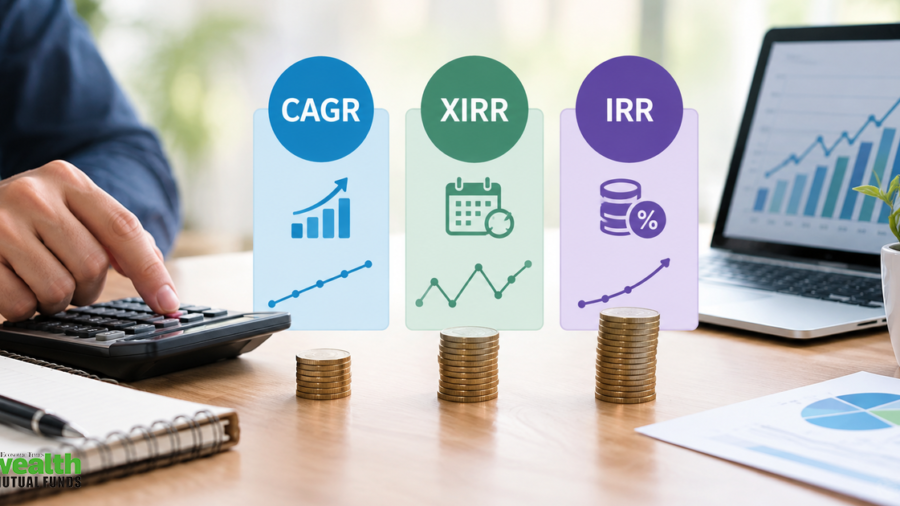
CAGR, XIRR and IRR are commonly used to measure mutual fund returns, but each serves a different purpose. While CAGR is suited to lumpsum investments, XIRR helps calculate returns from irregular cash flows such as SIPs. IRR can be used to assess returns from investments involving multiple cash flows over time.

Before choosing a mutual fund scheme, investors often look at its past performance. But have you ever wondered why mutual fund returns are expressed using different terms such as CAGR, IRR and XIRR? ET Mutual Funds explains these commonly used return measures in simple terms and shows first-time investors when and how each one should be calculated.
Compounded Annual Growth Rate (CAGR)
CAGR calculates the annual growth rate of an investment over a particular period of time. This measure is the most common tool used to measure/calculate returns generated by a mutual fund scheme. It shows the average annual return delivered by a fund over a specific period of time, assuming that the returns are compounded every year.
For example, if you invest in a mutual fund scheme for five years, the CAGR would depict the average rate of return that the scheme has yielded every year for the past five years. With the help of a CAGR, one will be able to find out the compounded annual growth or decline of the mutual fund investments.
Best MF to invest
Looking for the best mutual funds to invest? Here are our recommendations.
View Details »
Number of years is the total number of years that have passed
Suppose an investor invested Rs 1.20 lakh in a mutual fund scheme. The investment grows to Rs 1.80 lakh after five years. CAGR will be = {(1,80,000 / 1,20,000) ^ (1 / 5)} -1 = 8.45%
The CAGR will be 8.45%, which means a lumpsum investment of Rs 1.20 lakh needs to grow at a rate of 8.45% every year for a period of five years to grow to Rs 1.80 lakh in the end.
Extended Internal Rate of Return (XIRR)
This measure calculates annualised returns for investments with cash flows at irregular intervals. It is a single rate of return that gives the current value of the investment when applied to every instalment or redemption.
If you are investing through SIP mode, calculating XIRR will be the best way. This method is useful with different purchase prices and instalment periods. This method takes into account the timing of cash flows (inflows/outflows).
Here is how to calculate XIRR for your SIP portfolio/ investments.
Step 1: In first column add your date of investment

Step 2: In next column enter all your investment transactions
In this step, add all your investment transactions. Each transaction will be denoted with a minus sign (-); i.e. all outflows like investments and purchases will be marked negative. All inflows like withdrawals and redemptions will be marked positive.
Step 3: In this step mention the current value of your investment and the date of redemption.
Step 4: In this step use the XIRR function in excel. XIRR = (investment amount, date)
Internal rate of Return
This metric is used to assess investment profitability. This method considers the changing value of money over time and acts as a special discount rate. In this method, cash flows are discounted at a certain rate based on when the cash flows happen to know the present value of investment.
An investor can use IRR to calculate returns of their SIP, SWP, lumpsum investments with multiple cash flows.
Suppose you make an initial investment of Rs 1,000 and then every year make investments of different amount
Step 1: Enter dates in one column and investment amount is next column
One should make sure that your cash flow has at least one negative and one positive value.
Step 2: Use the IRR formula to calculate the internal rate of return for a series of cash flows that occur at irregular intervals
(Disclaimer: Recommendations, suggestions, views and opinions given by the experts are their own. These do not represent the views of The )
If you have any mutual fund queries, message ET Mutual Funds on Facebook/Twitter. We will get them answered by our panel of experts. Do share your questions at ETMFqueries@timesinternet.in along with your age, risk profile, and Twitter handle.
Add 

(Catch all the Mutual Fund News, Breaking News, Budget 2024 Events and Latest News Updates on The .)
…moreless
Read More News on
SIPXIRRCAGRmutual fund investmentsIRRportfolio returnredemptionSWPmutual fundsmutual fund news
(Catch all the Mutual Fund News, Breaking News, Budget 2024 Events and Latest News Updates on The .)
…moreless


Enter search text:
BrowseMutual Funds:
ABCDEFGHIJKLMNOPQRSTUVWXYZ
123456789
Continue reading with one of these options:
Limited Access
Free
Login to get access to some exclusive stories
& personalised newsletters
Login Now
Unlimited Access
Starting @ Rs120/month
Get access to exclusive stories, expert opinions &
in-depth stock reports
Subscribe Now
ET
Unlock Access to All Exclusives with ETPrime FREE TRIAL
15 Days Free: Unlock All ETPrime Exclusives, Market Tools & ePapers
Trial offer expiring in00 : 05 : 00
I'd rather pay ₹2599 now


Uh-oh! This is an exclusive story available for selected readers only.
Worry not. You’re just a step away.

Prime Account Detected!
It seems like you're already an ETPrime member with
Login using your ET Prime credentials to enjoy all member benefits
Log out of your current logged-in account and log in again using your ET Prime credentials to enjoy all member benefits.
Unlock ETPrime's Exclusive Stories Today!
Subscribe to gain powerful insights on business, stock market and industry trends.
Big Price Drop! Flat 40% Off
Student Only Offer
Already a Member? Sign In now
Already a Member? Sign In now
Already a Member? Sign In now
Offer Exclusively For You
Save up to Rs. 700/-
ON ET PRIME MEMBERSHIP
Avail Offer
Offer Exclusively For You
Get 1 Year Free
With 1 and 2-Year ET prime membership
Avail Offer
Offer Exclusively For You
Get 1 Year Free
With 1 and 2-Year ET prime membership
Avail Offer
Offer Exclusively For You
Get Flat 40% Off
Then ₹ 1749 for 1 year
Avail Offer
Offer Exclusively For You
ET Prime at ₹ 49 for 1 month
Then ₹ 1749 for 1 year
Avail Offer
Special Offer
Get flat 40% off on ETPrime
Avail Offer
Avail Offer
Claim NowAlready a Member? Sign In now
Need Assistance?
Connect with an ETPrime expert for personalized support and guidance
+91 9484700004
' + h3 + '
' + h4 + '
- ' + listing + '
What’s Included with

1Exclusive Insights That Matter
Uncover the truth with our investigative stories
Make strategic moves using the real-world case studies
Read industry-specific stories to identify emerging trends
Spot opportunities with in-depth insights that matter

Trump temper on H-1B visas is forcing Indians to do these things to stay put in US

What Adani’s US indictment means for India Inc’s overseas fundraising

Why veterans like Reliance, L&T are on acquisition spree? Aswath Damodaran has an answer.

Will China’s dollar bond sale in Saudi Arabia trump the US in financial world?

Huawei launches its own OS to compete with Google and Apple. But can it win beyond China?

The problem with lab grown diamonds

Why a falling rupee is a better option for the economy

A list of top 20 momentum stocks that have delivered massive returns in one year
2Invest Wisely With Smart Market Tools & Investment Ideas
Alpha Trade

Get daily trade ideas from SEBI-registered research analysts.
Investment Ideas

Grow your wealth with stock ideas & sectoral trends.
Stock Reports Plus

All-in-one stock research with Stock Score, peer comparison & key signals.
BigBull Portfolio

Get to know where the market bulls are investing to identify the right stocks.
Stock Analyzer
Check the score based on the company's fundamentals, solvency, growth, risk & ownership to decide the right stocks.
Market Mood

Analyze the market sentiments & identify the trend reversal for strategic decisions.
Stock Talk Live at 9 AM Daily

Ask your stock queries & get assured replies by ET appointed, SEBI registered experts.
3Stay informed anytime, anywhere with ET ePaper
ePaper – Print View

Read the PDF version of ET newspaper. Download & access it offline anytime.
ePaper – Digital View

Read your daily newspaper in Digital View & get it delivered to your inbox everyday.
Wealth Edition

Manage your money efficiently with this weekly money management guide.
4Times Of India Subscription (1 Year)
ePaper

Read the PDF version of newspaper. Download & access it offline anytime.
Deep Explainers

Explore the In-depth explanation of complex topics for everyday life decisions.
Health+ Stories

Get fitter with daily health insights committed to your well-being.
Personal Finance+ Stories

Manage your wealth better with in-depth insights & updates on finance.
New York Times Exclusives

Stay globally informed with exclusive story from New York Times.
5Enjoy Complimentary Subscriptions From Top Brands
Docubay Subscription

Stream new documentaries from all across the world every day.
Stories you might be interested in


Atta, dal, oil & a ‘shattered’ kitchen budget: Cong
By Sohail Khan · 19 Sep

Leave a Reply