Expert Explains | How floods triggered Nepal’s demand for compensation
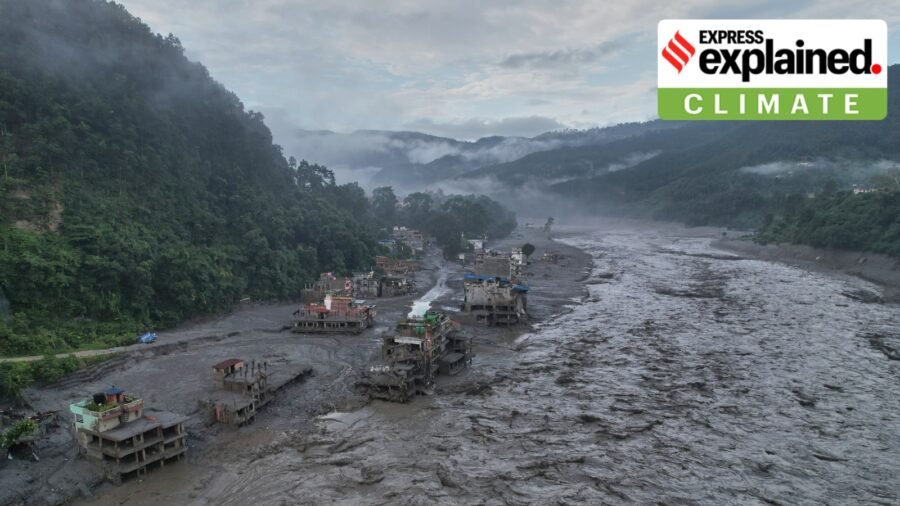
Nepal has suffered a catastrophic flash flood, with more than 1,000 dead, thousands still missing nearly 10 days later, and whole villages, bridges and roads swept away. The impact appears to have been heightened as the Himalayas now stand much impacted by heavy infrastructure development by the Chinese in Tibet.
And then there is climate change.
The big emitters
The Himalayas are referred to as the third pole given their huge reservoirs of ice and water. For years, melting of their glaciers has been noticed, with climatologists warning of severe consequences.
The US is the leading contributor, at 25%, to the key cause of climate change, CO2 accumulated in the atmosphere. Europe is next at around 20% with the Chinese now fast catching up at15% of the global stock. India’s contribution, on the other hand is under 4%. Moreover, India’s per-capita CO2 emissions at around 2 tonnes per year are half of the global average of 4.5 tonnes.
After the floods, Nepal, whose own emissions are very little, said it is bearing the consequences of a problem it did not create.
Aid and compensation
Nepal’s foreign minister, Shishir Khanal, said the country has written to the UN’s fund for responding to loss and damage. This fund was set up in 2022 to help countries respond to economic hits from extreme events, in addition to financing mitigation and adaptation. Contributions to it are voluntary.
Khanal had earlier said that the Himalayan country had decided to shift its diplomatic position to claim ‘compensation’ for natural disasters instead of aid.
“Nepal’s greenhouse gas emissions are virtually negligible. Yet, we are paying the ultimate price for a global crisis we did not create. The rapid melting of glaciers and these catastrophic mountain tsunamis are direct consequences of global climate change… This is not a matter of charity; it is a matter of legal and moral liability,” Khanal had said.
Story continues below this ad
He had also named India. “The major industrial emitters – such as China, which is the world’s top emitter, the United States at number two, and India at number three – have a historical responsibility to compensate vulnerable nations like Nepal,” he had said in an interview with The Kathmandu Post.
After Khanal’s remarks, Nepal’s Prime Minister, Balen Shah, quickly thanked India and China for their assistance in the aftermath of the floods. Khanal also walked back, later saying the issue was not about “shifting the blame to one or the other country” but about “working together”.
The enormity of the rehabilitation task makes it imperative for Nepal to access international funding. An approach of eschewing ‘aid’, the go-to of previous times, and instead seeking international solidarity fits in with the new Nepal with a young and globally aware government.
The US and China, as the largest emitters, seemed obvious inclusions in the compensation demand, but why India? To many, this appeared to follow the usual Nepali quest of balancing its two neighbours, India and China — although the clever minds of European NGOs, busy for long in Nepal, cannot be dismissed placing such hints. Europe, an emitter of much bigger consequence than India, was not mentioned in these reports.
Story continues below this ad
Status of the loss and damage fund
Around $822 million has been pledged to the UN’s loss and damage fund, but around $350 million is allotted for disbursement.
The UAE has provided $100 million. Much of the other contribution has come from Europe.
The US, which had pledged around $17 million, has now pulled out of this funding mechanism, with climate change itself being referred to as a ‘hoax’ by President Donald Trump.
The author was ambassador of India to Nepal.

Jyotika praises her mother-in-law, says ‘only a queen can raise a prince’
By Sohail Khan · 1 Oct
Can a police confession justify NSA detention? What Supreme Court said in Sambhal case
By Sohail Khan · 1 Oct
How is HbA1c calculated? Expert explains what your blood sugar test really means
By Sohail Khan · 1 Oct