Election Commission’s nine new decisions: What changes and what doesn’t
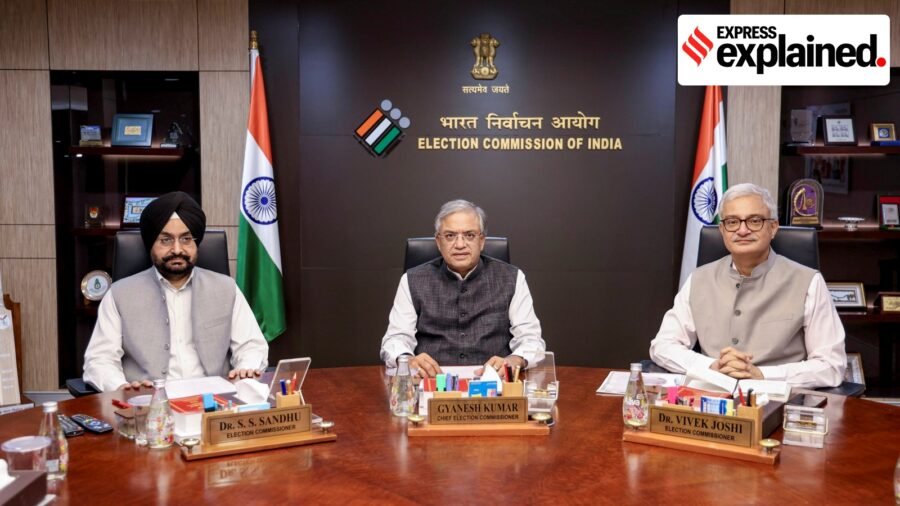
On Saturday, the Commission met again. What followed was striking. In a four-page note issued after the meeting, it announced nine decisions that addressed, point by point, several of the concerns recorded by the two Commissioners, Sukhbir Singh Sandhu and Vivek Joshi.
What are the Election Commission’s new decisions?
Agendas will now be circulated before every Commission meeting and minutes issued afterwards. Officers’ foreign trips will need Commission approval. New IT modules and portals will go through a committee of officers before being placed before the Commission. The ECINet will be reviewed by a committee headed by a senior Deputy Election Commissioner and will include an independent expert from an IIT or IIIT. If field officers need more flexibility in the system, it will be provided. And directions issued by Commissioners to officers will be “meticulously complied with”.
These decisions map, almost item for item, onto the concerns the two Commissioners had put on file over 10 months: that agendas were not circulated and minutes not issued, that officers went abroad without the Commission’s approval, that new IT modules were built without its knowledge, that the electoral-roll database needed an audit by an independent expert, that field officers lacked “proper and complete access” to ERONet, and that an administrative order had altered the allocation of work around the IT division without them.
Story continues below this ad
In Goa, where found 97 voters cleared by local officers still missing from the final roll, the Commission says 81 have now filled Form 6 and the CEO has been directed to facilitate their inclusion.
This sharp turn signals how deep the disquiet inside the Commission had become, and how far it had travelled outside, with Opposition parties by Friday demanding that polls on SIR rolls be cancelled.
What happens to Form 6?
But the concessions have limits, and Form 6 is where they show. The note reads like a concession there and isn’t one. It says the form prescribed under the Registration of Electors Rules will apply outside the SIR period, which was the substance of Joshi’s May objection.
Story continues below this ad
But the objection was about the online form on ECINet, where a question on the applicant’s parents was inserted between sections J and K, and which would not let an applicant proceed without answering it. The note does not mention the online form, or the question, or say whether it has been removed.
It says the Supreme Court “upheld” the declaration, which the court’s May 27 order on the SIR does not appear to do in terms. And it does not say who put the question there in July, or why it stayed after Sandhu called it “unauthorised/illegal” on August 13.
Other unanswered questions
Other questions go unanswered too.
The note says nothing about the central one from West Bengal: Who authorised the appeals filed against voters whose inclusion had been ordered by judicial officers, were they filed on behalf of ECI, and if yes, who was it authorised by?
It does not explain why Goa’s requested software facility to restore voter names was never enabled.
Story continues below this ad
And it does not say whether DG (IT) Seema Khanna, whose functioning was a point of contention and Senior Deputy Election Commissioner Maneesh Garg, against whom both Commissioners sought action, stay.
And it leaves the biggest question open: what the new normal inside the Commission looks like. Whether Gyanesh Kumar now takes Sandhu and Joshi along before decisions are made, and whether the two, having put their objections on record, will have more say at the table, remains to be seen.

The paradox of de-Sinification in global production
By Sohail Khan · 28 Sep
Letters to The Editor — September 28, 2026
By Sohail Khan · 28 Sep
Kashmir as India’s gateway to Eurasian opportunity
By Sohail Khan · 28 Sep
Leave a Reply