Don’t count out corporate bonds just because the Fed is raising rates
A healthy economy and reduced issuance by tech companies could support corporate debt.
Published on: Sep 19, 2026, 17:00:21 IST
Prefer HTon Google
Share via
Copy link
The last time the Federal Reserve was hiking rates, corporate bonds got slammed. They might fare much better this time around.
Back in 2022, when the Fed raised its interest-rate target by more than 4 percentage points over the course of that year, top-rated corporate bonds overall generated about a negative 15% return, according to the ICE BofA U.S. Corporate index. Corporate bonds fared even worse than ICE BofA’s index of Treasury bonds, which lost about 13%.
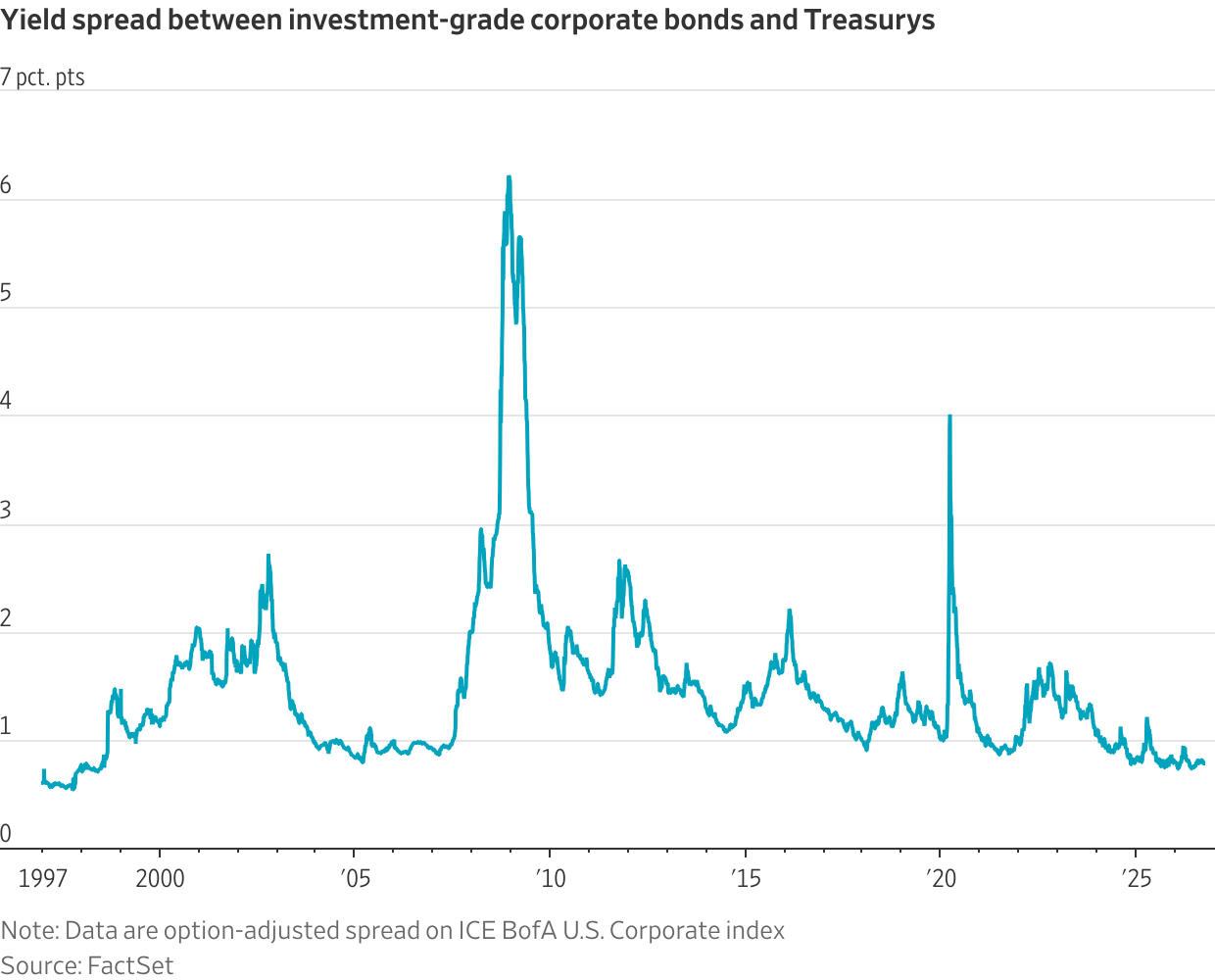
All fixed-rate bonds can suffer losses in value when rates go higher, because they are paying out increasingly less than the new prevailing rates. But corporate bonds can suffer an additional hit if credit spreads—or how much compensation investors demand for default risk over government bonds—also get wider. That is what happened in 2022, with the spread on ICE BofA’s corporate bond index going from about 1 percentage point at the end of 2021 to a high of about 1.7 points in 2022.
Corporate bonds look vulnerable to this widening again, having narrowed their spread to Treasurys since 2022 to below where they began that cycle. But there are several things that can help keep spreads grounded this time.
For one, the sheer speed and magnitude of the Fed’s tightening from here will likely be far less than the move that began in 2022. What is more, companies at that point had grown accustomed to borrowing for nearly nothing. Now that they have been living in a higher-rate world for a few years, an increase won’t be as painful. Many companies have issued new bonds at yields closer to today’s prevailing rates.
In fact, corporate bonds have historically traded at tighter spreads during other periods of high yields. The Fed raised rates in the late 1990s from levels that were even higher than today. In 1997, spreads on the ICE BofA high-grade corporate index fell to under 0.6 percentage point. That year, the Fed raised its rate target from 5.25% to 5.5%.
“The current backdrop of very tight corporate bond spreads is not all that abnormal in the context of the higher level of yields,” says Nathaniel Rosenbaum, head of U.S. high-grade credit strategy at JPMorgan Chase.
The market might also get a break from another corner: reduced issuance of bonds by so-called hyperscaler AI companies such as Alphabet, Amazon.com, Meta Platforms, Microsoft and Oracle. Spreads on investment-grade hyperscaler bonds, as tracked by strategists at JPMorgan, have widened by more than a quarter percentage point this year through mid-September.
One part of that was because investors weren’t expecting just how gigantic issuance would be. Back in May, only 9% of respondents in a Bank of America investor survey expected hyperscaler high-grade bond issuance to top $250 billion in 2026. BofA strategists now forecast well over $300 billion in total debt issuance this year from Amazon, Alphabet, Meta and Microsoft.
From here, though, BofA strategists forecast that issuance from the hyperscalers they track is going to decline for the next two years. The need for debt could be lessened as these firms start to generate more cash flow from their nascent artificial-intelligence businesses. But a slowdown in demand for hyperscalers’ computing services could have a similar effect, too.
If AI companies struggle to show a return on their AI capital expenditures, that also could “paradoxically” boost their bonds, according to a recent note from Lotfi Karoui, multi-asset credit strategist at Pimco.
“Capex falls, free cash flow recovers, and the issuance pipeline shrinks,” Karoui wrote in a note this past week. “The same shock that undermines the AI investment case could improve hyperscaler credit metrics.” The note added that this dynamic could hold if there was “capital discipline” among hyperscalers.
Of course, much depends on how aggressively the Fed moves. If it goes sharply beyond the forecast of several Fed officials of one more quarter-point rate increase this year, or the market’s expectation of hikes next year, that could push spreads out wider again. Companies might feel the pinch of sharply higher funding costs, and bond prices would likely react more to bigger, faster hikes.
So nothing is set in stone. But investors shouldn’t throw out corporate bonds just because rates are rising.
Write to Telis Demos at Telis.Demos@wsj.com
See Less

Mumbai-Goa Highway cost jumps 48% to Rs 16,909cr
By Sohail Khan · 19 Sep
Assam RRTS: New high-speed rail in the works?
By Sohail Khan · 19 Sep
Agarkar exit: Rohit future, Laxman rift
By Sohail Khan · 19 Sep
Leave a Reply