Delhi building collapse: Why Delhi University has few hostels, and what can be done
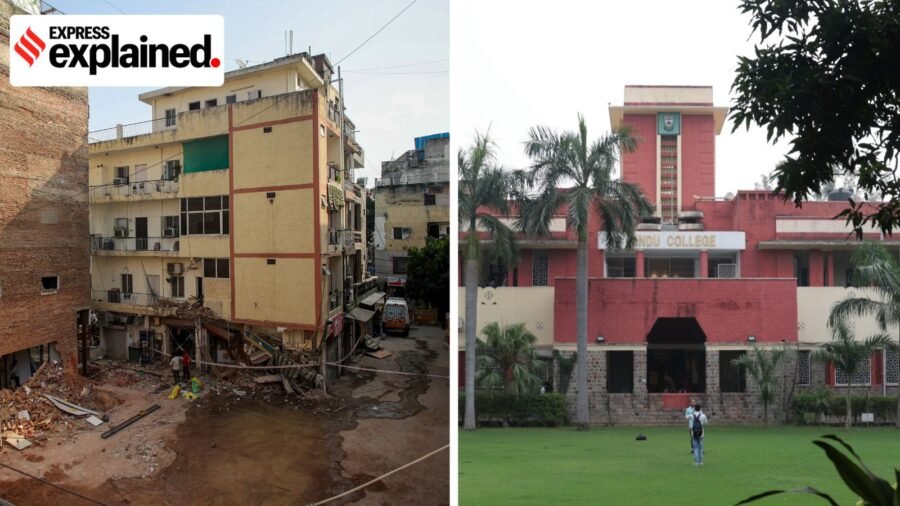
The collapse of a Paying Guest (PG) accommodation building in South Delhi’s Satya Niketan on Sunday (September 6), which led to the deaths of at least seven people, including students, has spotlighted the lack of hostels in Delhi University (DU) colleges.
In relation to a PIL on auditing such buildings, the Delhi High Court on Monday flagged “the absolutely inadequate number of hostels available to students.”
Satya Niketan is one of the many localities that have emerged as hubs of private student housing over the decades, partly because of their proximity to DU colleges. But what such areas offer in terms of commuting convenience is often offset by shabby living conditions — badly constructed buildings, windowless rooms, poor quality of food and water, and several students crammed into a limited space.
The gap
Story continues below.
Subscribe to see fewer ads.
The Delhi University Act of 1922 led to the establishment of one of India’s premier central universities. Section 33 states that “Every student of the University (other than a student who pursues a course of study by correspondence) shall reside in a College a Hall, or under such conditions as may be prescribed by the Ordinances.” “Hall” refers to student residence that the university provided, maintained or recognised.
Over a century later, however, the university has significantly expanded in scale. DU’s Annual Report for 2024-25 notes that from three colleges and 750 students in North Campus, it spans 90 colleges, 20 standalone hostels and over 6 lakh students (those enrolled in person and distance learning) today.
Around 2.5 lakh come under the conventional mode, and more than half of the students come from regions other than Delhi, the report said.
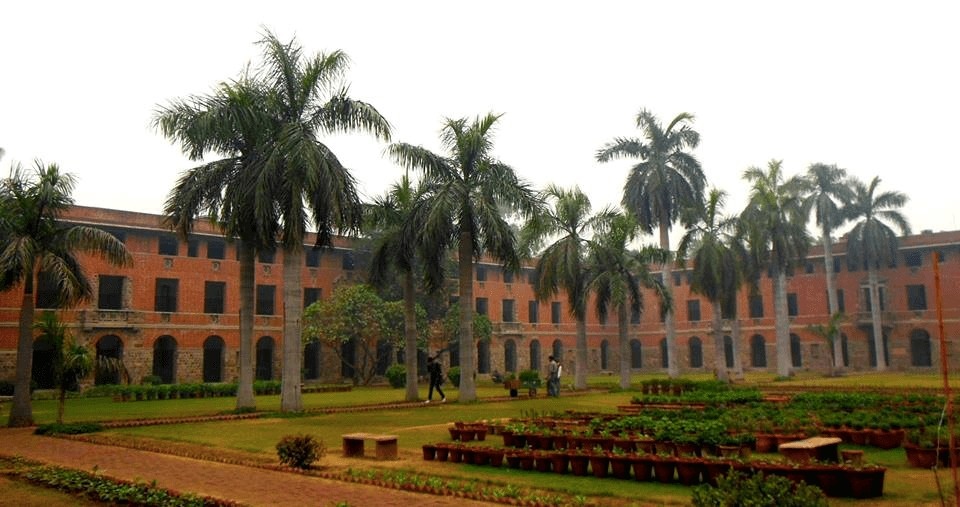 The Miranda House hostel. (website photo)
Not all 90 colleges offer on-campus residence, and the university does not offer consolidated data on the total number of hostel seats. Around 2015, it was reported that against an estimated 1.8 lakh students enrolled with DU at the time, only about 9,000 seats were available in its hostels for both undergraduate and postgraduate students.
Story continues below this ad
Many colleges coming under the South Campus, which was established in 1973 to cater to growing demand, continue to lack hostels or have only recently constructed them. Even then, the supply of college hostels has not kept pace with the rising demand. For example, South Campus’s Maitreyi College for women inaugurated its hostel in 2022, and has a capacity of 103 students against a total college student body of over 4,000. In most colleges, hostels can only cater to less than 10% of the total student population.
The roadblocks
The demand for increasing the number of hostel seats has been raised repeatedly over the years. Haritma Chopra, principal at Maitreyi College, told that the share of outstation students has grown with deepening access to technology and the university’s admissions process shifting online about a decade ago.
VS Negi, the President of the Delhi University Teachers’ Association (DUTA), said that the organisation has raised the issue in the past, but colleges have cited constraints at their level. “Very little has been seriously done to provide hostel facilities to all students. Students travel from every corner of India to the national capital… Providing adequate on-campus housing is essential so that they are not forced to hunt for shelter and settle for unsafe living conditions,” Negi told .
Sooraj Elamon, the Secretary of Students Federation of India (SFI), the student wing of Communist Party of India (Marxist), said, “The responses (from the administration) have generally been that there is not enough space, which is a flawed argument. DU has a lot of space, there are vacant properties, it’s just that there is no initiative because of the large inflow of money that comes in from the PGs to various stakeholders… it is one of the biggest economies in DU.”
Story continues below this ad
Those within the administration, however, say that even with expansions, reliance on external accommodation will remain due to the sheer number of outstation students.
Bijayalaxmi Nanda, principal of North Campus’s Miranda House, said their limitations range from space constraints to specific regulations that govern construction and expansion: “Every college has a particular capacity, based on its landholding size. Then say a building like ours, established in 1948; that is a heritage building, in a sense.”
Some expansion has happened with new hostel blocks constructed around 2012, and another 120-bed building is being explored with funding sources such as Corporate Social Responsibility (CSR). “Many colleges are doing similar things, but a 100% residential campus in a public university is not possible with the kind of land holdings we have,” she added.
Other hurdles can include the long process of receiving clearances and permits from civic bodies like the Municipal Corporation of Delhi (MCD), and obtaining administrative approvals based on meeting certain criteria, such as creating new green spaces alongside or preserving historical buildings.
Story continues below this ad
Securing funding also matters. Chopra said one major funding source is the Higher Education Financing Agency (HEFA). It is a joint venture of the Ministry of Education and Canara Bank “for financing creation of capital assets in premier educational institutions in India”, its website says. “In certain colleges, the alumni also support in the renovation or in the maintenance of structures. There are many means, but whatever they might be, we have to follow all processes,” Chopra said.
“When you are constructing a building, so many compliances have to be looked into because you have to present the exact details; you have to undertake mapping and reach out to several agencies. An architect has to be involved, and the funding requirement runs into crores,” she added. For instance, with her college building located in the diplomatic enclave of Chanakyapuri, there were restrictions on the number of floors that could be built for the hostel, affecting capacity.
The alternative
With limited hostels, PGs have proliferated, charging monthly rent ranging from Rs 11,000 to as high as Rs 25,000 per person, which can be higher than the annual fees of some college courses. Their limited regulation means that students not hailing from Delhi are often in the dark about the options available to them and what they can demand of PGs.
Earlier this week, DU Vice-Chancellor Yogesh Singh held a meeting on the condition of student residence. Negi said that many colleges have now issued directives to students to provide information about their accommodations and PGs.
Story continues below this ad
Nanda said that going forward, colleges could be more “actively involved as stakeholders” in the process of students finding accommodation. She said that Miranda House’s Women’s Development Cell (WDC) had drafted a report in 2024-25 based on student teams auditing nearby accommodations. The report lists factors affecting the cost of PGs, the average cost in particular areas of North Campus, as well as precautions to consider while flat-hunting. These include checking the presence and functionality of secure entry systems, including cameras and intercoms, and checking for potential safety hazards.
With limited official compliance required of many such buildings, these features may not be available in the first place, but a law may soon attempt to make certain requirements mandatory. As reported, a new draft Bill proposed by the Delhi government says of PG accommodations, “The absence of a formal integrated regulatory framework has led to… arbitrary rent practices, substandard living conditions, inadequate safety provisions, and… lack of an effective grievance redressal mechanism for students.”
Chopra said that Maitreyi College has asked faculty, retired professors and others in its network within the city for suggestions for potential renters, and many have even offered to rent out rooms in their homes at cheaper rates.
“It has to be more of a community approach. Parents, Resident Welfare Associations (RWAs), and colleges can all come together and, in the interest and welfare of students in nearby areas, we should develop a certain quality of support,” said Nanda. She also gave the example of buddy systems in colleges abroad, where new entrants are paired up with senior students to guide them on accommodation and other areas.

10 weekend getaways from Delhi within 300 km that are perfect for a bike ride
By Sohail Khan · 2 Oct
Flydubai flight: How tighter post-9/11 rules could have impacted cockpit access
By Sohail Khan · 2 Oct
From Varanasi to Tashkent, how Mahatma Gandhi influenced Lal Bahadur Shastri
By Sohail Khan · 2 Oct