Column | Elephants always have right of way
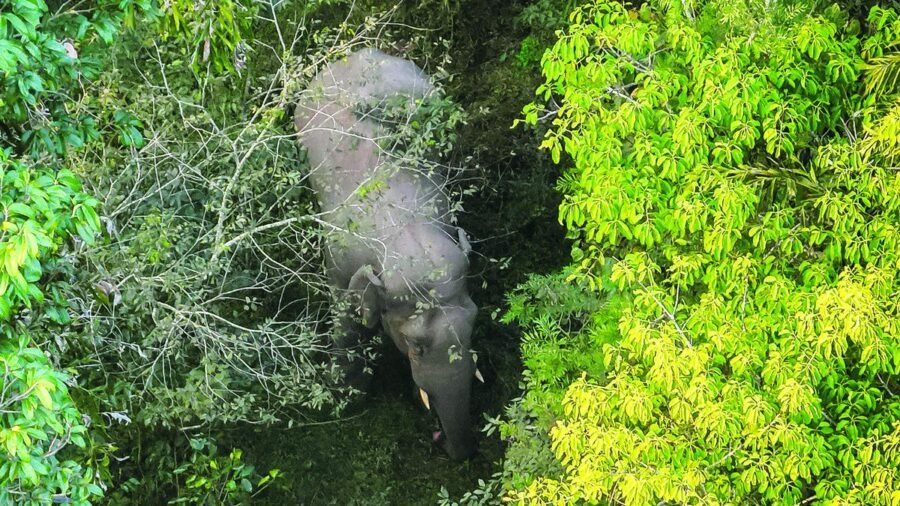
A few months ago, Kumar, who lives on my farm in Kodaikanal, shared a piece of news that I have held close to my heart, letting it warm me every time I needed it. A mother and her baby elephant walked onto the farm in the middle of the day, where she fed her infant till the child fell asleep.
A beautiful little story that casually assumes the many years it took to gain the trust of a mother elephant to allow her child to fall asleep in human-occupied land. She was teaching her baby that the farm was a safe space. In a fast-changing world, where elephants are being forced to change their ancient migratory routes because of human development, it felt like a milestone.
Elephants in Kerala
K.K.NAJEEB
When I first bought the farm, wide-eyed and ruthlessly optimistic, I thought sharing the border with Tamil Nadu’s Anamalai Reserve Forest, home to the Bengal tiger, Indian elephant, gaur, leopard and several other endangered species, was hugely romantic. I relished my self-proclaimed title as ‘Guardian of the Forest’, and barred local poachers and the timber mafia from entering the forest. It was only later, when I had to plan what I wanted to grow on my farm, that I realised how difficult farming with wild animals was, and how expensive it is to keep them out.
It was, of course, already too late to separate from the land.
The original encroachers
After having finished my Permaculture Design course (in Thailand, under professor John Champagne), I learnt that it might make more sense to simply farm side by side with these large animals, without bothering to keep them out. It felt counterintuitive, and I was forced to rethink everything.
In truth, being introduced to the very colonialised idea of ‘ownership’, and particularly the ownership of property, was very uncomfortable. Whose land is it, really? Mine, with my money and property papers? Or the wild, which has an obvious first claim to the land, having been there for generations? Who moved into whose territory?
Elephants grazing in the grasslands of Cherankodu Tantea Estate near Gudalur
M. Sathyamoorthy
The harsh reality that agriculture was the first cause of habitat loss and degradation, and the original encroachment into wild ecosystems, became glaringly real to me. But, with a young child who climbed every tree she saw and roamed for hours with her dog, I did come to integrate the truth that humans, too, have a right to this wildlife, that we too are a part of this delicate ecosystem and as much a part of Nature as the elephant. The difference being, the elephants were responsible for the forest that the farm was in, and I was literally beholden to them.
Bona fide ecosystem engineers
Elephants move in matrilineal tribes following migratory routes believed to be thousands of years old. Passed down through generations, matriarchs lead the herd through hundreds of kilometres through the country, following the seasons and remembering where to find water. Migration is necessary because they require enormous amounts of food, but the whole time they are walking on these routes, they are creating highly biodiverse forests. Seeds swallowed with fruit are carried across long distances and deposited through dung, helping new plants grow away from the parent tree, supporting genetic diversity through movement.
In the summer, their large bodies move through thick vegetation, acting as natural pruning agents, bringing in sunlight and air, even creating grasslands for other animals. They are considered keystone species that support other wildlife and are bona fide ecosystem engineers.
Imagine knowing all that and stopping elephants from entering your ‘regenerative organic farm’. Things like fences and property papers, even money, feel meaningless in the intensity of eye contact with a wild elephant; you simply make way.
A herd in Gudalur
M. Sathyamoorthy
‘Owning’ the planet
I have always been a firm believer in the Natural Commons, that every human being has the nature-given right to air, water, forests and wildlife simply by being born on this planet. In reality, most of these have now been packaged and sold to the rich in their most pristine form. But land and a space to live must surely be a part of these commons as well.
The first human communities understood this, and land was shared within the tribe. Plato, the first Western philosopher to write on private land ownership, was vehemently against it. He argued it would lead to corruption and greed, and proposed communal property for the ruling class in his ideal republic. Eventually, obviously, capitalism won, and private property, defined as property owned by commercial entities, emerged with the great European trading companies of the 17th century — the beginning of colonialism.
An elephant herd, including calves, in Palappilly, Kerala
Najeeb K.K.
Luckily, there are still intellectuals who ruminate on this concept of ‘owning’ a part of this planet, especially in today’s post-capitalist, degraded landscape. In his groundbreaking book Sacred Economics, American activist Charles Eisenstein circumscribes the private right to “use and abuse” private property by proposing a penalty on socially and environmentally harmful activities. It separates, as much as possible, the “enjoyment” (i.e. the fruits) of ownership from the fruits of the labour and creativity added to the thing owned. Permaculture also integrates community-based land stewardship with ecological design to create and maintain natural commons, where land is held in trust for shared ecological and community benefit rather than private ownership.
So, how does one think about the land they own? Putting a fence on a man-made boundary doesn’t separate it from the rest of the planet. I suppose it is a lot like having a child. You are the protector, guardian, and steward of the child — but you could never claim to own them. It feels like that is the part that we have forgotten, that the land can never be really yours.
A series written through the lens of someone who works the land. Let’s make thinking about the ecology feel like Second Nature.
Punjab is among India’s top grain producers. So why is it unable to store it?
By Sohail Khan · 6 Oct
Ashok Lavasa: Can the Election Commission untie knots of its own making?
By Sohail Khan · 6 Oct