Punjab is among India’s top grain producers. So why is it unable to store it?
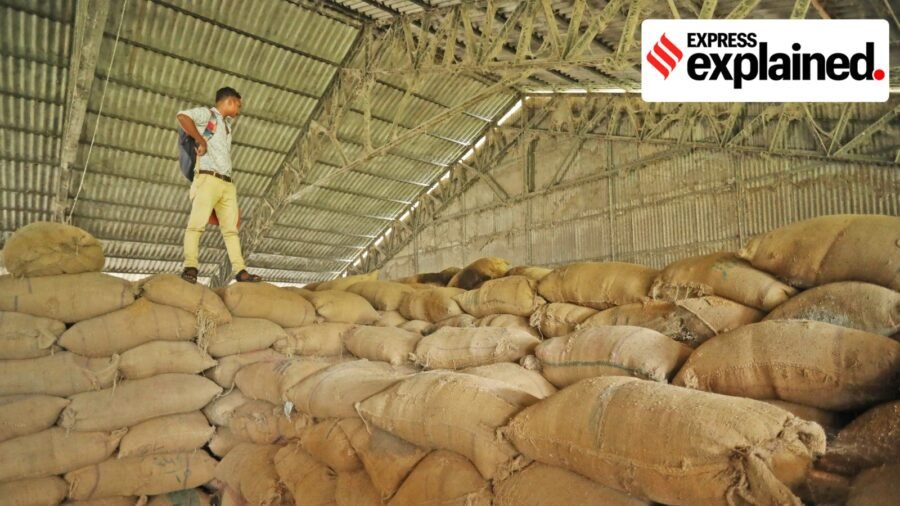
Recently, Punjab Chief Minister Bhagwant Mann sought transportation of grain out of Punjab to create storage space, warning of possible law and order issues. The problem could worsen as Punjab targets 180 LT of paddy procurement, against 156 LT last year. So, why does the crisis persist, why might it worsen, and what is the solution? We explain.
Why is grain storage in Punjab under pressure?
Essentially, a mismatch exists between grain supply and space. Punjab has around 175 LT of covered storage capacity, including what is available with the Food Corporation of India (FCI), state procurement agencies and private facilities, besides 75 LT of plinth storage (an open-air storage platform primarily used for wheat, where rice cannot be stored similarly).
However, rice from previous kharif cycles (June to October) occupies most covered space. Consequently, 17 LT of wheat from the previous rabi season (October to March) remains in rice mills and mandi yards due to a lack of storage. Around 6 LT of previous-cycle rice is also pending for delivery by mills. Punjab handles 300–320 LT of paddy and wheat annually, making regular movement to other states essential to create space for the next procurement cycle.
Story continues below this ad
How much grain needs to move out of Punjab — and how much is actually moving?
Rice millers and state procurement agencies traditionally prefer paddy milling to be completed by March 31, as prolonged summer and monsoon storage increase infestation and deterioration risks. The Centre’s prescribed milling period generally runs from December 1 to June 30, though extensions are given when stocks remain pending.
Even by June 30, Punjab would need to deliver about 120.6 LT of rice if it procures the targeted 180 LT of paddy. Over seven months, that means clearing around 17 LT a month. Against this target, officials say that current grain movement out of Punjab averages 11–12 LT a month, comprising rice and wheat. The proportion varies, sometimes roughly 50:50, while at other times one-third is rice.
Could the problem worsen in the coming years?
The immediate concern is that the backlog is carrying forward: old stocks are not moving out while new paddy continues arriving. Last year, milling went on until September; this year, the problem is more visible, with around 6 LT of previous-season rice pending for delivery, while 17 LT of wheat still occupies rice mills and mandi yards. With this trend of no movement, the overlap could double or triple in the coming years.
Story continues below this ad
What could be the solution?
Both storage capacity and slow movement of grain are to be blamed, according to FCI and state procurement officials.
Officials say constructing additional storage in Punjab is expensive because land rates are high. Punjab already has a substantial storage network, but it is not enough to handle the volume of grain procured in the state without regular emptying.
“When both the Centre and state governments are aware of the amount of grain procured from Punjab, why not create additional storage capacity — if not in Punjab, then outside Punjab?” said a senior FCI official. “Even if storage capacity is available in any part of the country, wheat can be transported directly from mandis to those locations. In the case of paddy, which is entirely housed by rice mills, the rice can be transported directly from mills to storage facilities elsewhere after milling.”
Story continues below this ad
Officials point to Uttar Pradesh and Bihar, where land rates are comparatively lower and many storage facilities can be built. They argue that Punjab produces for the nation: around 80% of the wheat produced and almost the entire paddy in Punjab goes to the central pool.
Therefore, officials say, the storage burden need not be concentrated in Punjab, and suggest faster movement of grain to additional storage capacity outside Punjab.

‘You are licking an ice cube’: Vijay Deverakonda recalls cutting water intake for Liger
By Sohail Khan · 6 Oct
Ashok Lavasa: Can the Election Commission untie knots of its own making?
By Sohail Khan · 6 Oct
Leave a Reply