China space surge: 4 orbital rockets launched within 45 hours in satellite blitz
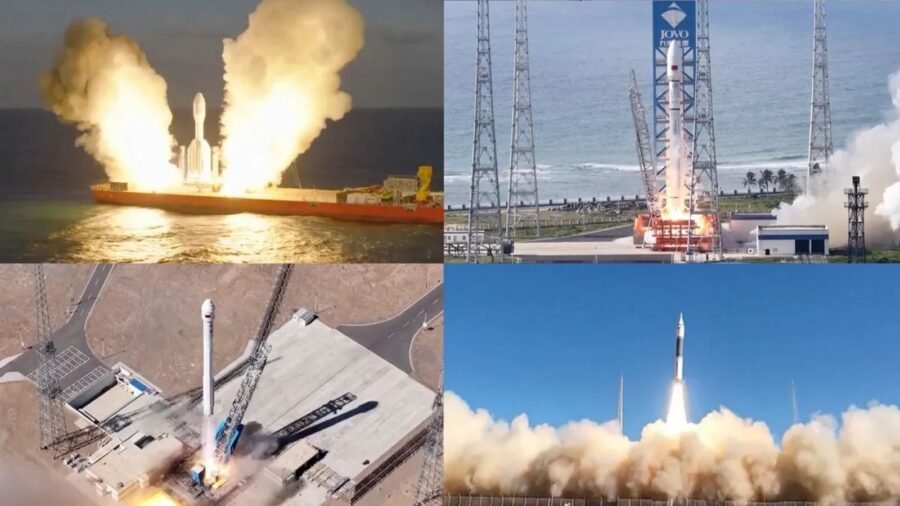
China successfully launched four different orbital rockets from three separate launch sites within roughly 45 hours between September 15 and 16. The rapid launch sequence highlights the rapid expansion of China’s space sector, driven by a growing mix of state-owned aerospace organisations and private commercial launch providers.
All four missions were successful and carried satellites designed for Earth observation as well as major Chinese broadband megaconstellations, according to Space.com.
LandSpace and Orienspace lead commercial launches
The launch sequence began at 2.26 am Eastern Daylight Time (EDT) (11.56 am IST) on September 15, when LandSpace launched its Zhuque-2E rocket from the Jiuquan Satellite Launch Center in northwest China.
The methane- and liquid-oxygen-powered rocket carried 10 satellites into low Earth orbit for Qianfan, or “Thousand Sails”, a Chinese broadband megaconstellation. If the programme proceeds as planned, Qianfan is expected to have around 15,000 active satellites eventually.
Story continues below.
Subscribe to see fewer ads.
Later that day, at 6 pm EDT (3.30 am IST the next day), Orienspace launched its Gravity-1 rocket from a sea-based platform off the coast of Shanghai. Gravity-1 carried another nine Qianfan satellites into orbit. The rocket is notable for its powerful solid-fuel propulsion and distinctive short, wide design.
Two state-linked rockets complete the sequence
The third launch came on September 16, when a Long March 12 rocket operated by the state-owned China Aerospace Science and Technology Corporation (CASC) lifted off from the Wenchang Space Launch Site on Hainan Island.
The rocket launched at 8.32 pm EDT (6.02 am IST on September 17), carrying nine spacecraft for SatNet, another Chinese low Earth orbit broadband megaconstellation. The network is planned to comprise around 13,000 satellites eventually.
About two hours later, a Kuaizhou-11 rocket completed the four-launch sequence. It lifted off from Jiuquan at 10:40 pm EDT ( 7:40 am IST on September 17), carrying two Earth-observing radar satellites for Chinese company Spacety.
Story continues below this ad
A subsidiary of the state-run China Aerospace Science and Industry Corporation operates the Kuaizhou-11.
China continues work on reusable rockets
While the four launches demonstrated the country’s ability to conduct multiple orbital missions in a short period, none of the rockets attempted to land their first stages.
China is nevertheless making progress on reusable rocket technology. Over the previous two and a half months, two different vehicles, LandSpace’s Zhuque-3 and CASC’s Long March 10B, successfully landed their first stages during orbital missions. However, no Chinese first stage has yet completed multiple orbital missions.
The four-launch sequence instead highlighted the growing variety within China’s launch sector. The missions involved a methane-fuelled commercial rocket, a solid-fuel rocket launched from a sea platform, a state-operated Long March vehicle and a Kuaizhou rocket carrying radar satellites.
Story continues below this ad
The activity also showed how China’s launch sector is being used to deploy large satellite constellations, with Qianfan and SatNet together representing plans for tens of thousands of spacecraft in low Earth orbit.

Apple Pay could finally enter India in October after 12 years: What to expect
By Sohail Khan · 21 Sep
Apple Pay could launch in India next month: 5 things to know
By Sohail Khan · 21 Sep

Leave a Reply