Can you open an Airbnb in a residential flat?
Synopsis
If someone is found running a homestay or Airbnb-like service in your society, what can you do? Legally, the society’s first step should be a written notice to the owner, pointing to the specific byelaw being broken and backed by evidence. If the owner still doesn't stop, the RWA's real recourse is a civil suit for an injunction.
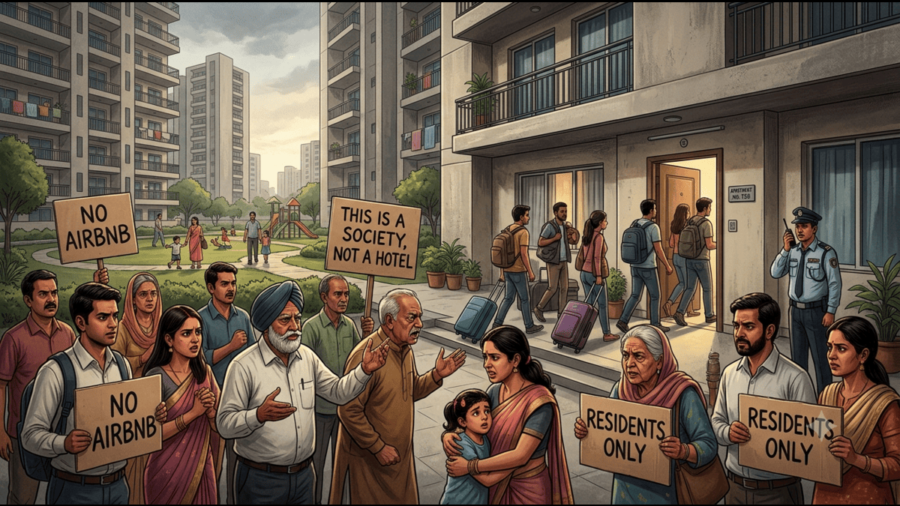
What happens if someone in your housing society starts a homestay or Airbnb service, even though it's a residential property? Residents of Vaibhav Khand Windsor Park Society in Ghaziabad recently protested about something similar, claiming that the flats were being offered to outsiders on a short-term or daily basis.
“This is a society, not a hotel” and “No Airbnb” read some of the posters that the residents were seen holding. They claim that constant movement of outsiders has affected the atmosphere and raised security concerns for families.
According to a report, the protestors voiced concerns around this practice of giving flats for rent on such a temporary basis, particularly in the studio apartments in Towers A and B.
Ghaziabad’s Vaibhav Khand Windsor Park Society protests: What happened?
Residents claim that many flats are being given to people on daily or short-term rentals. To raise their voice against this practice, many staged a peaceful protest on Sunday (September 20), held posters and raised slogans against the RWA.
As per the report, they have filed a joint complaint with the District Magistrate, Police Commissioner, GDA, Nagar Nigam and Tourism Department. While some people are occupying the flats daily, in some cases, they were staying without police verification and necessary registration.
You Might Also Like:
Can a resident open a homestay or Airbnb in a residential flat?
Sahil Sethi, Partner, Saikrishna & Associates, told ET Wealth Online that a homestay where the owner actually lives on the premises and rents out a room or two can be registered under the state's new homestay policy. But that policy is explicit that it's meant for homeowners, not commercial operators.
It doesn't cover someone letting out an entire flat on a daily basis while living elsewhere.
All properties are governed by respective municipal laws regarding usage as residential, commercial, etc., which depends on how such properties are held, used and taxed. Explaining this, Basudeb Biswas, Advocate & Real Estate Lawyer, stated that if the property is entirely/ substantially used as a B&B, the usage is to be reclassified as commercial.
Failing this, demolition, substantial penalties and legal proceedings, etc. can be initiated against the owner.
Kshitij Bishnoi, Partner at CMS Induslaw, also added that the permissibility would depend on the title documents and society bye-laws, the applicable State homestay framework, municipal and land-use regulations, and tax requirements.
“Airbnb’s own India guidance also advises hosts to check applicable permits, zoning, safety and health requirements,” he said.
The residential vs commercial dilemma
Classifying this might sometimes seem complicated. So, the first distinction is between a genuine homestay and an Airbnb-style commercial accommodation operation, Kunal Sharma, Managing Partner, TARAksh Lawyers and Consultants, told ET Wealth Online.
"A homestay generally operates within a State-recognised tourism framework and is ordinarily subject to conditions concerning registration, the number of rooms and beds, the nature of accommodation and, in some States, the owner's residence at the property.”
By contrast, repeatedly giving an entire flat to different guests for one or a few nights, with continuous check-ins/outs and hotel-like services, can be treated as a lodging or commercial activity rather than ordinary residential letting.
Sharma highlighted that in Kamaldeep Singh v. Shivam Satellite Cooperative Housing Society Ltd., the Gujarat HC dealt specifically with a member who wanted to use a room in his flat for a homestay through Airbnb. The Court noted that the society's general body had resolved to prohibit homestays or other stays and held that, so long as those resolutions remained in force, they bound the member.
ALSO READ | Paid Rs 14.51 lakh for a home in Gurugram, buyer finds no progress at construction site as builder lost registration; HRERA directs refund with 10.80% interest
How risky is it to run a homestay or Airbnb-like service in your apartment?
A resident can’t assume that they are legally entitled to operate an Airbnb or homestay from a residential flat merely because they own the flat. “Where the society bye-laws or applicable property documents prohibit commercial use or short-term letting, operating an Airbnb would be a violation of those restrictions and the resident could be restrained from continuing the activity,” said Bishnoi.
Therefore, operating an Airbnb or homestay without the requisite society approval and applicable registrations or permissions would carry a legal risk.
Conversely, where such activity is not prohibited by the governing documents and the applicable regulatory requirements are duly complied with, the activity may be permissible.
Sharma added that the legal risk becomes materially higher where:
- the State requires registration or licensing, and the owner has not obtained it;
- the flat is approved only for residential use;
- the apartment declaration, lease deed or society byelaws restrict commercial use;
- the society has validly adopted a restriction on paying guests accommodation;
- local fire, municipal, police, tax or other requirements are not met; or
- the activity is effectively a guest-house business being run from a residential unit.
Accordingly, an owner who is running an Airbnb-type operation without the requisite registration is exposing himself to meaningful legal risk. “The risk is not that every Airbnb listing is automatically illegal; rather, the risk increases substantially where the property is not registered under the applicable framework,” he suggested.
Someone running a homestay/Airbnb in your society? Here’s what you can do
Sethi shared that society’s first step should be a written notice to the owner, pointing to the specific byelaw being broken and backed by evidence. If the owner still doesn't stop, the RWA's real recourse is a civil suit for an injunction.
“Residents must, however, not act on their own by cutting water or power, or stopping guests at the gate as it can expose the RWA itself to a claim,” Sethi noted.
Moreover, society members can raise the issue with the association and seek action against the homeowner in accordance with the applicable byelaws and governing documents, added Bishnoi. “Where the activity also involves a breach of applicable municipal, zoning, tourism or other regulatory requirements, a complaint may also be made to the relevant authority.”
Where the society’s bye-laws or other governing documents clearly prohibit such use, the association or affected members may also seek an injunction from the civil court to restrain the homeowner from continuing the activity.
Society owners, as owners of adjacent properties, whose ‘beneficial enjoyment’ is being hampered, have the legal right to enforce through private litigation (since these conditions are usually part of the sale-purchase deed executed between developer and owners) under the Transfer of Property Act, according to Biswas.
They can also raise the complaints in writing to the RWA to maintain records and pave the way for action. "The RWA is also legally empowered to take necessary action against such owners, which shall depend upon facts of each case, and as per applicable law and each such Society’s byelaws.”
To sum it up, a society member can:
- Document the activity: listing screenshots, booking information, repeated guest turnover, advertisements and other objectively verifiable material.
- Check the registered byelaws and declaration to determine whether short-term letting, paying guests, and commercial activity are restricted.
- Ask the association committee to issue a formal notice seeking an explanation and relevant permissions.
- Verify compliance with the State/UT tourism regime where registration is mandatory.
- Approach the municipal/planning/fire/tourism authority where there is evidence of a statutory breach.
- Approach the police where there is an independent criminal, public-order or security issue.
- Seek civil/co-operative/apartment-law remedies, including injunctions, where the applicable legislation permits them.
Planning to start a homestay-like service in your apartment? Key things you must know
Regulations like the UP B&B Policy 2025, NCTD B&B Establishments Act, 2007 (now repealed, with a new law awaited), and other similar regulations/statutes require necessary NOCs to be obtained from respective local bodies. Even so, the responsibility falls only on the owner.
Biswas shared that even platforms like Airbnb themselves say that the owner needs to check if the requirement of permits, licenses and/or registrations to offer hotel, homestay, guest house, lodging houses, residential hostels, and/or bed & breakfast, etc. is listed on Airbnb.
You must know that registration under the applicable State homestay framework does not, by itself, permit a resident to operate a homestay in breach of the society’s byelaws or other restrictions applicable to the property, Bishnoi explained. Similarly, compliance with the society’s byelaws does not exempt you from obtaining the registrations.
“Both the society’s byelaws and the State’s rules operate at different levels, and compliance with one does not override or cure a breach of the other,” he said, adding that both sets of requirements need to be satisfied.
Sharma underlined that the regulatory framework generally consists of the following layers:
First, State and UT tourism law and policy: Homestays and Bundefined others follow their own accommodation or tourism policies.
Second, apartment or society law: Depending on the State and nature of the housing entity, this may be governed by an Apartment Ownership Act, Cooperative Societies Act, society byelaws, condominium declaration, lease conditions or a combination of these.
For example, the UP Apartment (Promotion of Construction, Ownership and Maintenance) Act, 2010, expressly provides for an Association of Apartment Owners and model byelaws concerning administration and restrictions on the use and maintenance of apartments and common areas.
Third, local and central laws and permissions: Depending on the property and the services being offered, issues concerning sanctioned building use, fire safety, municipal requirements, food services, taxation and other local permissions may arise.
Can the RWA take action, or remove the owner from the flat?
“No, an RWA cannot evict anyone or physically remove them from their own flat. Its only real weapon is a civil suit for an injunction. Noida and Greater Noida are the exception, because those flats are leasehold. There, on a complaint by RWA, the Authority can issue a show-cause notice and, if the owner doesn't comply, take punitive actions under the lease conditions,” Sethi detailed.
However, the RWA can act against an owner who is using the flat in violation of the applicable bye-laws or other governing documents. Its powers, however, are generally limited to enforcing those rules and do not extend to taking away the owner’s property rights, explained Bishnoi.
ALSO READ | Man booked 11 shops for Rs 25 lakh in Mumbai in 1995 but didn't get possession even after 30 years; he fights back and wins full refund with 12% interest
So, what can the RWA do?
It may issue notices, levy penalties if permitted under the byelaws, regulate guest and visitor access in accordance with applicable security rules, and approach the relevant authorities. Where the byelaws or other governing documents prohibit the use, the RWA may also seek an injunction from the civil court.
But the RWA cannot evict or dispossess an owner from their own flat or terminate their ownership rights merely by passing a resolution.
While there is no nationwide blanket prohibition on using a residential property for short-term accommodation, there isn’t even a blanket right to do so. "The legality turns on the applicable State or UT tourism regime, sanctioned land/building use, local regulatory requirements and critically for apartments, the governing declaration, byelaws and housing-society rules," said Sharma.
(Join our ETWealth WhatsApp channel for all the latest updates)
Add 

(Catch all the Personal Finance News, Breaking News, Budget 2025 Events and Latest News Updates on The .)
…more

OECD lifts India FY27 growth forecast to 7.1%
By Sohail Khan · 23 Sep
Raymond moves into fighter aircraft assembly
By Sohail Khan · 23 Sep
Leave a Reply