Faceless People: The documentary asking why Sri Lankan Tamil refugees still are not Indian citizens
In the two decades of reporting on Sri Lankan Tamil refugees in India, senior journalist RK Radhakrishnan has come to a pivotal realisation. “They do not want sympathy, they want to be seen,” he writes in his director’s statement for Faceless People — The Journey of Sri Lankan Tamil Refugees in India, his debut documentary on an oppressed community that he tracked long before picking up the camera to call ‘action’ and ‘cut’.
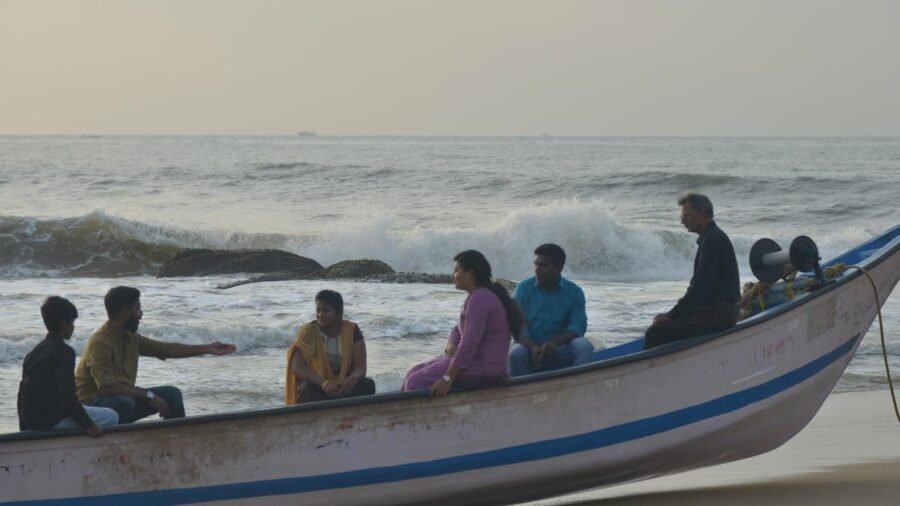
This documentary which has been selected as a finalist in the SHORTS! European Short Film Festival in Oslo (December 14) follows the lives of six refugees. Among them is a school boy, a housewife, a young woman with academic dreams, and the community’s first PhD scholar.
All of them barring two of the youngest, arrived at the Indian shore on boats, undergoing adverse, inhumane conditions, to escape the brutal killings of Sri Lankan Tamils in northern Sri Lanka. Radhakrishnan, who donned the hat of a director after nearly four decades of being a print journalist, says that the project grew out of his years spent reporting at camps across Tamil Nadu, including those in Thanjavur, Mannar, and Tiruchi.
A still from Faceless People directed by RK Radhakrishan
M Vedan
“My first visit to a camp was in 2006. That was when Tamil Nadu had a cholera outbreak in the camps. About nine groups of Ministers were set up by [late Chief Minister] Karunanidhi’s government to visit the camps and find out what people needed. That was the first time a full-scale investigation into camp conditions was carried out. I thought that if the affected people spoke for themselves.. if they could articulate what they want.. it would carry more weight than me saying it on their behalf,” he says.
This instinct seems to have come through in the form of the director’s cautious and deliberate restraint. Although the film holds within its bones, deep and raw emotions, it instead turns to speak about the subjects and the status of their Indian citizenship. Radhakrishnan says that most people in camp who have lived in India for a greater part of their lives, are yet to get their citizenship in the country. They are hence not able to progress with their lives. The residents of these camps lack voting rights, job access, and legal protection from exploitation.
Radhakrishnan asks what moral right India has to deny them citizenship especially when nearly 98% of the 89,830 refugees live peacefully. “This is a solvable problem stalled only by the absence of political will in New Delhi,” he says. Much of it is inertia rather than being an actual security threat, he adds.
“As a director, it was tempting for me to focus on the immediate physical and emotional condition of Sri Lankan Tamil refugees in India. The texture of their hopelessness, the quiet but steady erosion of hope, and the palpable fatigue induced by the waiting. I had to fight off that temptation and stay focussed on the larger question of their uncertain legal status, which is ultimately the reason their lives remain in limbo,” he says.
Radhakrishnan says that the focus on the status nearly cost the film its rating. Even after two-and-a-half months of reviewing the film which focusses a great deal on the life and memory of a young child, the Central Board of Film Certification (CBFC) found it to be suitable for viewing only for those over 16.
Supriya Sule, Kanimozhi, Thamizhachi Thangapandian and Jothimani Sennimalai.
M Vedan
In some ways, Faceless People attempts to dismantle the link between the refugees and their perception of being ‘threats’, especially post the 1991 assasination of former Prime Minister Rajiv Gandhi. It is evident in the way the filmmaker centres his subjects, but most lucid in the way he tells the story of the youngest in the group. There is Negha, a scholar who aims to study abroad but is still compromising on her dreams but finding a way to work. Then there is Abhinesh, a child whose complete and total resignation of a future where he says that he might have no choice but to be a carpenter, breaks your heart and has you shed a tear.
RK Radhakrishnan with some people featured in the documentary
M Vedan
Radhakrishnan asks you to instead take solace in AS Vijedharan’s story, a young scholar, who just received his PhD degree in Political Science and Public Administration from Annamalai University. “It is just as remarkable as it is sad. So many more scholars could’ve had bright futures. For now, there is one,” he says, resignedly.
The documentary is a 2026 official selection at the International Film Festival The Hague (IFFH 2026), has won the best Migration and Refugee Documentary at the Los Angeles Film and Documentary Awards 2026, and won the short documentary award (Special Jury) at the Roshani International Film Festival in Aurangabad in September 2026.
The intention is to take the film to as many festivals, administrators, people who can facilitate change. After all, all one can do is hope and in its process, be faceless no more.

Leave a Reply