As Trump rejects Iran peace proposal, what does each side want?
Story continues below.
Subscribe to see fewer ads.
If these sound familiar, that’s because they are. These terms are straight out of the June peace framework (Memorandum of Agreement), only with a faster proposed pace of implementation.
Iran issued the proposal after the US imposed sanctions on its air transport and tightened its economic sanctions (since August).
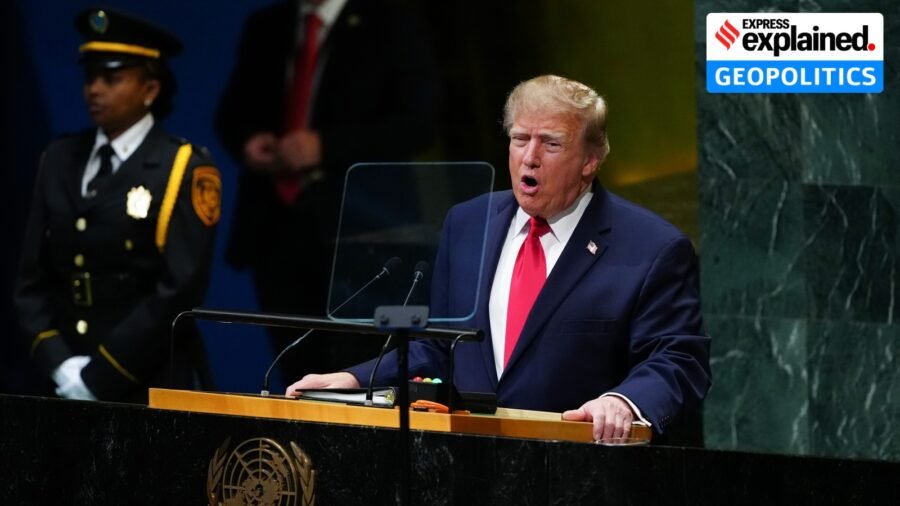
Both countries conducted indirect negotiations on the sidelines of the UNGA — despite Trump threatening to “annihilate” Iran during the same session and Iranian President Masoud Pezeshkian vowing to fight “until our last breath”.
The US President also claimed during his speech that the looming Congressional midterm elections would have no bearing on his Iran strategy. Remember that the war he started along with Israel late in February has spiked oil prices and dragged down his approval ratings. Araghchi, meanwhile, said that “while it would be better” for an agreement before the midterms, Iran was “not in a hurry”.
Story continues below this ad
On Saturday, Trump rejected the proposal and suggested that the US could resume bombing Iran following the midterm polls.
Amid the sabre-rattling, where does each side stand? What are they looking to achieve? And does an end to the war look likely?
Iran’s position
At the UNGA, Pezeshkian reiterated Tehran’s position that it wants both parties to return to the June Memorandum of Understanding (MoU).
One of the main reasons for the MoU’s collapse in July lay in one of its provisions. Article 5 gave Iran and Oman the long-term power to jointly control transit through the Strait of Hormuz.
Story continues below this ad
The US, in Iran’s view, undermined this by attempting to force a new corridor through the Strait’s southern waters in early July. Tehran’s broader approach to Washington has centered around the primary aim to enforce Article 5. So, alongside negotiations with Oman for a transit framework, it has attacked tankers that allegedly violated its conditions.
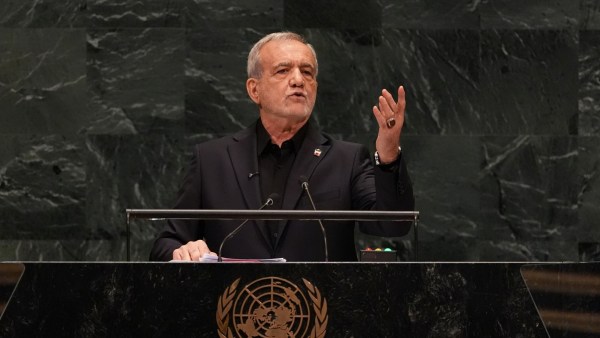 Iran President Masoud Pezeshkian at the UNGA on September.
Iran would feel that a “win” on this specific issue would reflect its ability to force US compliance with the June MoU, ensure a better negotiation position for long-term nuclear talks and, ultimately, curb American “arrogance” (a long-running goal).
This rationale is the reason why Iran’s strategic community is not exactly debating how new or old the terms of its latest proposal are — the MoU, which it mirrors, is already seen globally as a strategic win.
For Iran, the focus is to ensure that the US doesn’t repeatedly repudiate agreements it commits to (be it the 2015 nuclear pact or the June 2026 MoU).
Story continues below this ad
So, to ensure that the core character of the MoU is retained, Iran has shown that it is willing to bear the mercurial positions of the US President — including the rejection of the latest plan — the continuing US blockade and a fresh tightening of sanctions that it has already lived with across this century.
There are, arguably, very few variables within Iran which suggest a change in this position.
The US position (through Iran’s lens)
The current American position continues to be determined by the Trump White House’s need to undercut the strength of the Iranian bargaining position, regardless of the objective of such a position (a return to the June MoU or otherwise).
Story continues below this ad
The US says its navy has helped more than 2,000 tankers transport more than one billion barrels of crude since May — which translates to seven million barrels per day.
But this is still much lower than the pre-war flows of 20-21 million barrels per day, revealing the limits of the US’s approach in the long run.
For Iran, it is this latter statistic as well as the cost of keeping up the blockade that must be driven home to Washington.
Story continues below this ad
Tehran has arguably already driven such lessons home to its Arab neighbors across the Persian Gulf, which continue to struggle with the March war’s fallout.
International Energy Agency estimates suggest costs upwards of $50 billion to repair over 80 damaged energy facilities, while the International Monetary Fund estimates a cumulative output loss over the next five years (all of which assumes no future damage from Iranian/other strikes).
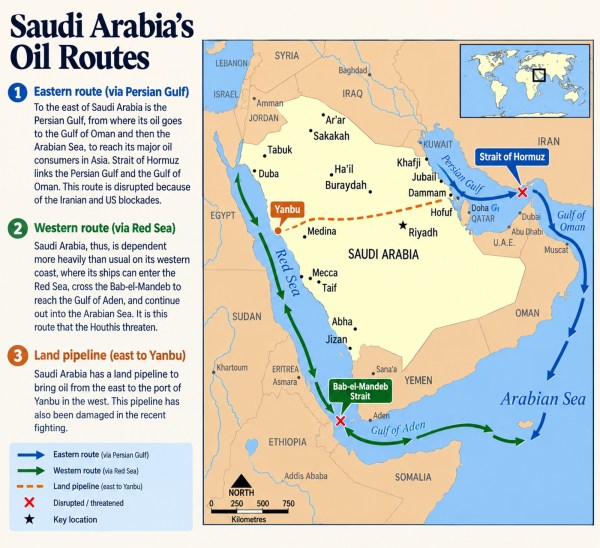 Map: Wikimedia Commons
This was behind Arab leaders’ reported frustration with President Trump in August, since he could not “manage the diplomacy necessary to secure peace with Iran”.
That month, the US had also proposed a $10-billion fund with Gulf Arab states to rebuild war-damaged energy infrastructure in West Asia and reduce regional reliance on the Strait of Hormuz.
Story continues below this ad
But Iran has proven that there are few viable alternatives to the Strait, especially for Saudi Arabia (see map above). The Kingdom’s shipping has been blockaded in the Bab-el Mandeb strait by the Houthis and its key overland oil transport route (the East-West pipeline) has also come under drone attacks from Iraqi militias.
Moreover, any reconstruction can take place only once there is an end in sight to the conflict. This is not the case in the Gulf, especially because of Washington’s own ambiguity over whether and when it will resume bombing Iran.
Tehran’s clarity in strategy, by contrast, enhances this threat.
Story continues below this ad
In any case, both Iranian and American strikes on oil tankers which either refuse to coordinate with the Islamic Revolutionary Guard Corps or breach the US naval blockade, respectively, continue in Hormuz.
It is this specific ability which informs how much Iran can continue seeking to force US compliance with core terms of the June MoU.
But what about the crippling, and worsening, economic crisis within its borders? The Islamic Republic has long shown an ability to tolerate the cost of deteriorating living conditions to sustain its foreign policy posture. Popular expressions of dissent and resistance, which created occasional pressures on the state, have both failed to manifest since January thanks to the unifying effect created by the war and President Trump’s annihilation threats.
Collectively, this reduces the degree to which the US midterm polls affect at least the Iranian position in the long term. Tehran’s articulations linking the polls to negotiations are likely aimed more at Trump’s own immediate electoral compulsions, to test the degree to which Iranian aims can be achieved in the short term through such a linkage.
The writer is Senior Research Associate at Council for Strategic and Defense Research, New Delhi.

The paradox of de-Sinification in global production
By Sohail Khan · 28 Sep
Letters to The Editor — September 28, 2026
By Sohail Khan · 28 Sep
Kashmir as India’s gateway to Eurasian opportunity
By Sohail Khan · 28 Sep
Leave a Reply