A red carpet, a fragile truce & US-China stability
Synopsis
During Xi Jinping's state visit to Washington, leaders announced modest tariff cuts and a new dialogue on AI safety. The ongoing US-Iran war significantly affects the strategic relationship between the two powers. A report highlights the US's dependence on Chinese rare earths for military needs amid supply challenges. Strategic stability efforts were explored but ultimately did not yield significant progress toward a lasting agreement.
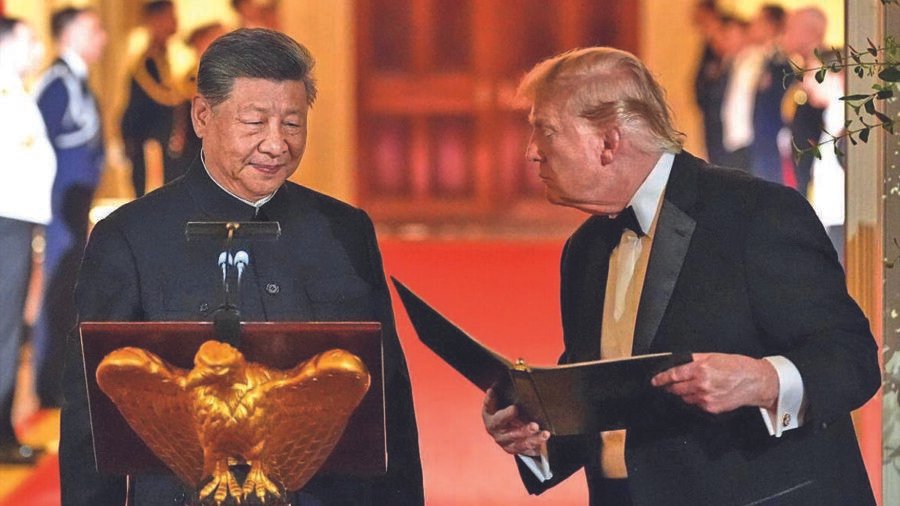
Beijing: At the end of a long red carpet, the two presidents and their wives stood before a 21-member honour guard as the national flags of both countries waved. They looked like two powers of equal stature, at ease with each other. Is this what strategic stability looks like?
The opening ceremony was the biggest takeaway from Xi Jinping's state visit to Washington last week. Announcements at the close on Friday were modest: tariff cuts on $30 bn of 'non-sensitive' goods in each direction, a new dialogue on AI safety and a 2-month extension of the trade truce due to expire on November 10. That truce, struck in Busan last October, ended a year of duelling tariffs, export controls and rare-earth restrictions.
Also Read: 'Busan Agreement' explained: What the US-China trade truce means for world trade
Little was said about US war on Iran. Yet, no current event matters more to the relationship, even as its weight has grown since Trump's state visit to Beijing in May, which was postponed from April when the US and Israel began their bombing campaign. The exchange of blows is now intermittent. But it hasn't stopped.
Refilling America's arsenal requires a continued flow of rare earths from China, and US air defence is where the shortage is most critical. Center for Strategic and International Studies (CSIS) estimates that the US began the war with more than 2,300 Patriot interceptors and now has significantly fewer than 1,000.
CSIS expects Patriot stocks to take 3 years or more to recover, even if no more are fired. Yet, they keep being fired. When Iranian missiles struck Muwaffaq Salti Air Base in Jordan earlier this month, US forces launched more than 30 Patriots in a single night.
By starting the war, the US and Israel gave Iran a compelling reason to dash for a nuclear weapon, a move that would all but guarantee a third all-out round of fighting. The first came in June 2025, when the US struck Iranian nuclear sites of Fordow, Natanz, and Isfahan, with Trump then claiming that the US had 'completely and totally obliterated' them.
US dependence on China was illustrated in April 2025 when Chinese exports of rare earths and magnets were suspended 2 days after Trump's 'Liberation Day' tariffs were announced on April 2. By late May, a Ford assembly line in Chicago had stopped for want of magnets.
A September 2026 Council on Foreign Relations (CFR) report, 'Dismantling China's Supply-Chain Weapon: A Transatlantic Strategy for Critical Minerals,' concedes that Beijing can cut off western firms at its discretion, and that without critical materials the US 'would fail to replenish the ammunition used during the US-Iran war'. Without missiles, the US cannot fight Iran through another intense round, or serve what Washington has made its paramount foreign policy interest: protecting Israel.
To give strategic stability real meaning, it should rest on 2 things: permanence over time and distance between two powers. In China, the outcome sought is a US that stays on its side of the Pacific. For all the pageantry, nothing at the summit hinted at such a permanent shift. The continued freeze on a $14 bn arms package for Taiwan, in place since May, is a pause rather than a cancellation.
Also Read: Trump-Xi summit heavy on symbolism, light on economic breakthroughs for US and China
Washington's current position was set out by undersecretary of war for policy Elbridge Colby during his visit to the Philippines in August. He avoided commenting on China, signalling that the US means to keep quiet, at least for now. But he made clear that the first island chain, running from Japan through Taiwan to the Philippines, would not be given up.
A rival vision arrived a month later, now hotly debated in strategic circles, in the Defense Priorities report, 'A Second Island Chain Strategy for Asia'. It argues that the first island chain is too vulnerable to defend, and US defence treaties with Japan, South Korea, the Philippines and Australia should be ended and non-intervention over Taiwan be declared. (India, treated as another theatre entirely, finds no mention.)
Those 2 positions, charted out in CFR and Defense Priorities reports, will define the US' debate over what strategic stability means. Pressures on Washington point toward the second. National debt has passed $40 tn and the 10-year treasury yield has crossed 5%, making it hard to fund the Trump regime's $1.5 tn defence request for fiscal 2027, an over-40% increase over spending in FY2026.
More important than the fiscal strain is the social one. Majority of Americans under 50, regardless of party affiliation, no longer share Washington's pro-Israel posture, feeding a weariness with maintaining bases around the world.
Strategic stability was not achieved at this summit. It's, however, something to expect in the Pacific.
The writer is a Beijing-based corporate lawyer
(Disclaimer: The opinions expressed in this column are that of the writer. The facts and opinions expressed here do not reflect the views of www.economictimes.com.)
Add 

(Catch all the Business News, Breaking News, and Latest News Updates on The .)
…more
Elevate your knowledge and leadership skills at a cost cheaper than your daily tea.
-
Everyone asks who will fund AI. Few ask who pays if it burns -
Smugglonomics: Geckos, dry dates, human hair – what makes something worth smuggling? -
Building recycling plants is fine. Will they get enough scrap? -
Biogas found its ethanol moment this month. Can it now find scale? -
Gold prices: Caught in a three-way tug-of-war -
Nobody's money? The fortune Indian families forgot they had -
Forget the UPI fee fight. Do we know how India pays today? -
Has the US Fed and AI created a costlier world? And has the queue got longer for India? -
Gold rush on Dalal St as regional jewellers bid to be the next Tanishq -
A different kind of buyback. Is this the beginning of these kinds of buybacks?

Time is on India’s side: Baume & Mercier CEO
By Sohail Khan · 28 Sep
The next big streaming IP may be a creator
By Sohail Khan · 28 Sep
TV is fading, but the rulebook refuses to change
By Sohail Khan · 28 Sep
Leave a Reply