79 Congestion Hotspots, Rising Enforcement: Why Pimpri-Chinchwad Residents Remain Stuck In Traffic
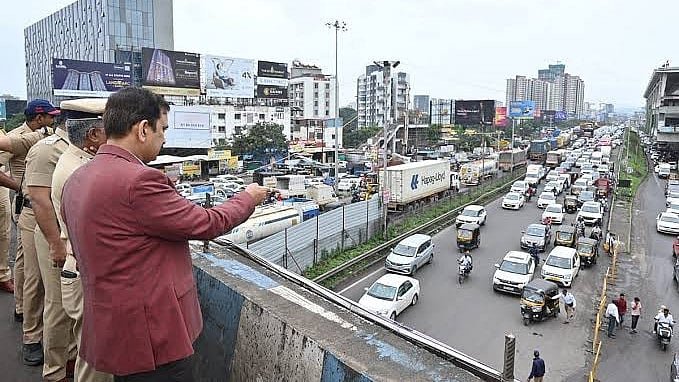
The Pimpri-Chinchwad Traffic Police have identified 79 major congestion spots across the commissionerate. Officials said engineering flaws, bottlenecks, delayed road widening, faulty signals and sudden increases in vehicle volume during peak hours are among the main reasons for traffic jams
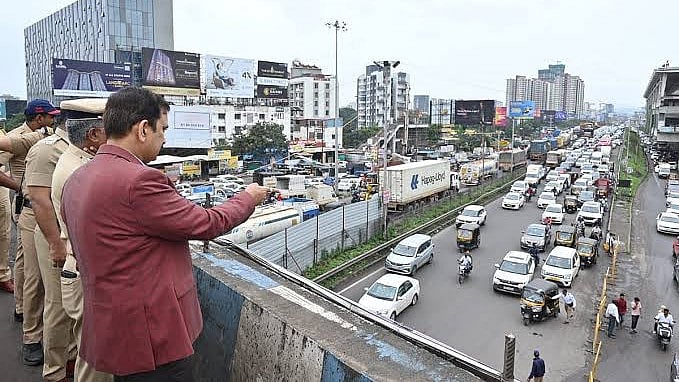
Pimpri-Chinchwad Police Chief's on-ground inspection of the traffic situation in the Wakad and Hinjawadi areas | File Photo
Pimpri-Chinchwad: Traffic enforcement has intensified across Pimpri-Chinchwad, but residents continue to face congestion at major junctions and corridors, exposing a wider problem that policing alone cannot solve.
The Pimpri-Chinchwad Traffic Police have identified 79 major congestion spots across the commissionerate. Officials said engineering flaws, bottlenecks, delayed road widening, faulty signals and sudden increases in vehicle volume during peak hours are among the main reasons for traffic jams.
The problem is spread across a city that has expanded rapidly over the past few years. Residential projects, industrial areas, IT hubs and regional highways now share the same road network. This has increased pressure on roads that were not designed to handle the current volume and mix of traffic.
Pimpri-Chinchwad Deputy Commissioner of Police (Traffic) Vikrant Deshmukh said the police are regulating traffic at key locations while seeking infrastructure improvements from other departments.
`;
“We have identified key traffic congestion locations. The issues stem from engineering flaws, bottlenecks, road widening delays and sudden spikes in vehicle volume during peak hours,” Deshmukh told The .
Let us know! 👂
What type of content would you like to see from us this year?— HubSpot (@HubSpot)
Let us know! 👂
What type of content would you like to see from us this year?— HubSpot (@HubSpot)
Police action is extensive
The traffic police have continued large-scale enforcement against violations that affect road movement and safety.
According to enforcement data for January to August 2026, more than 1.52 lakh cases of obstruction to traffic were recorded. There were also 70,741 heavy and large vehicle cases, 70,190 signal-jumping cases and 53,663 triple-riding cases.
Police also recorded 51,415 helmet violations, 49,693 cases involving defective or improper number plates, 24,624 tinted-glass cases and 15,907 seatbelt violations.
Deshmukh said rule breakers are being penalised regularly to prevent violations from affecting traffic movement.
Towing cases also continue to occur from time to time, and the police continue to take action against them regularly. The traffic police recorded a total of 522,165 enforcement cases between January and August 2026, according to the data provided.
Let us know! 👂
What type of content would you like to see from us this year?— HubSpot (@HubSpot)
Let us know! 👂
What type of content would you like to see from us this year?— HubSpot (@HubSpot)
Congestion remains despite enforcement
For residents, the problem is not only about traffic violations.
The western belt, including Hinjawadi, Wakad, Tathawade, Punawale, Ravet and Kiwale, has seen rapid housing growth. The NH-48 corridor also carries regional traffic and heavy vehicles.
Bhumkar Chowk, Mukai Chowk and the Punawale underpass have emerged as major pressure points. Residents have previously reported that short journeys in the area can take several times longer during peak hours.
The northern belt faces a different pressure where areas like Talegaon and Dehu Road continue to face issues. Eastern areas including Moshi, Chikhali, Talawade and Bhosari are connected to industrial areas and routes towards Chakan. The movement of goods vehicles adds to traffic on roads also used by residential communities.
This has created a recurring cycle. Police regulate traffic, clear obstructions and impose penalties, but congestion returns when the underlying bottleneck remains.
Let us know! 👂
What type of content would you like to see from us this year?— HubSpot (@HubSpot)
Let us know! 👂
What type of content would you like to see from us this year?— HubSpot (@HubSpot)
Police face manpower and infrastructure limits
The Traffic Police also face a manpower challenge as the city and its vehicle population continue to grow.
Deshmukh said the department is deploying available personnel and has sought additional support from local police stations. Traffic wardens are also being used, with their numbers expected to increase.
“To handle this, we are deploying adequate manpower and have initiated requests for overall infrastructure development with multiple departments,” he said.
However, experts say that additional personnel can regulate traffic only to a point. They cannot widen a road, redesign a junction or permanently fix an engineering problem. This is why the traffic issue persists across the Police Commissionerate.
Several agencies control the traffic network
Traffic management in Pimpri-Chinchwad Commissionerate involves the police as well as agencies such as the PCMC, NHAI, PWD, PMRDA and Maha Metro.
Road work, Metro construction, encroachments, damaged roads, drainage problems and changes in road layouts can all affect traffic movement. Coordinating these agencies can therefore be as important as enforcement.
Deshmukh said the police have sought infrastructure development and coordination with other departments.
Signal failures are another concern. The commissionerate covers a large area stretching from Talegaon to Sangvi and from Hinjawadi towards Chakan. Faulty signals at busy junctions can quickly create long queues.
“We have officially communicated with the concerned authorities regarding signal system repairs. Urgent fixes are being carried out, and major technical faults are being addressed,” Deshmukh said.
The bigger question for residents
The traffic problem is therefore becoming less about whether the police are taking action and more about whether the city is creating enough road and transport capacity to match its growth.
Police enforcement can address illegal parking, obstruction, signal jumping and other violations. But congestion caused by inadequate road width, poor junction design, regional traffic and delayed infrastructure requires action from multiple agencies.
For residents, the daily question remains simple: if traffic enforcement is increasing, why are the same roads still getting jammed?
Deshmukh acknowledged that conditions are not yet optimal everywhere.
“Improvements are required, and our efforts are continuously underway,” he said.
The 79 identified congestion spots now provide a clear measure of the scale of the problem. The bigger challenge will be whether these locations receive permanent engineering and infrastructure solutions, rather than repeated traffic regulation after congestion has already begun.

Add As a
Trusted Source 
Mumbai surpasses annual monsoon quota as rain returns: More showers expected?
By Sohail Khan · 15 Sep

Leave a Reply