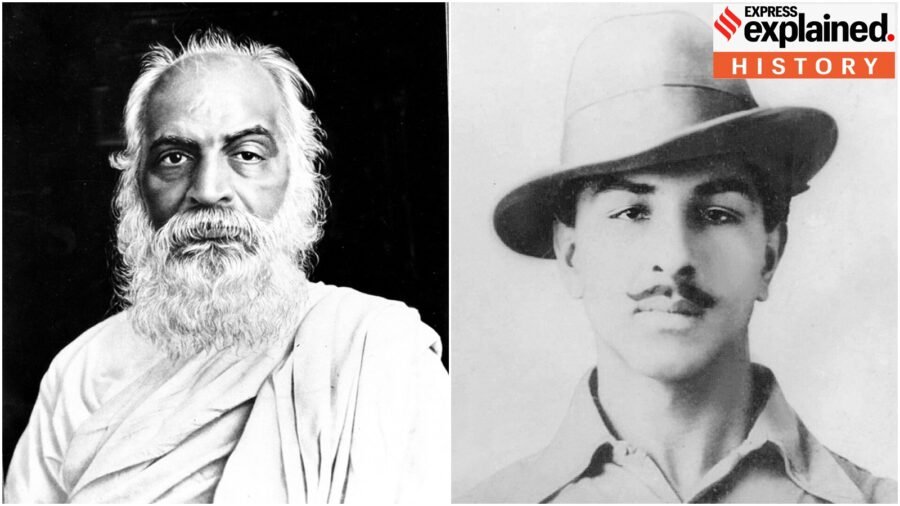
2 men, 2 bombs, one fateful day: When Bhagat Singh and Vallabhbhai’s brother crossed paths
Story continues below.
Subscribe to see fewer ads.
Who was Vithalbhai Patel?
Vithalbhai was the third of five brothers. Like his more famous younger brother Vallabhbhai, he studied law in England before returning to Bombay to practise.
In 1924, he was elected to the Central Legislative Assembly (precursor of today’s Parliament) from Bombay city. On August 22, 1925, he became its first Indian President.
The position gave Vithalbhai an opportunity to establish practices that would outlast British rule. Among them was an important principle concerning the security of the legislature: the ward and watch system under the authority of the President of the Assembly.
This arrangement would remain in place long after Independence, till the CISF took over Parliament’s security in 2024, even though the British tried to change it after Bhagat Singh and Batukeshwar Dutt’s bold move.
Story continues below this ad
‘It takes a loud voice to make the deaf hear’
Bhagat Singh and Batukeshwar Dutt, members of the Hindustan Socialist Republican Association (HSRA), shared the anger many countrymen felt at how little power Indians had despite being in the Assembly as part of the Montague-Chelmsford Reforms.
On April 8, 1929, when the Central Legislative Assembly was set to enact the Public Safety and Trade Disputes Bills despite stiff opposition, the two young HSRA activists made their protests heard.
Seated in the visitors’ gallery, they threw bombs and pamphlets in the Assembly. Bhagat Singh also fired two shots from a pistol. The bombs were not lethal, not intended to harm anyone. As they went off and the House fell into confusion, Singh and Dutt made no attempt to run away, shouting slogans like “Inquilab Zindabad” and “Down with British Imperialism.”
They were arrested at the spot.
The pamphlet explained their actions. “It takes a loud voice to make the deaf hear, with these immortal words uttered on a similar occasion by Valiant, a French anarchist martyr, do we strongly justify this action of ours,” it read.
Story continues below this ad
Auguste Vaillant was a French anarchist who used non-lethal bombs to attack the French Chamber of Deputies on December 9, 1893 as a mark of protest.
Criticising the imperial government, the pamphlet further said that the HSRA, “in all seriousness, realising their full responsibility, had decided and ordered its army to do this particular action, so that a stop be put to this humiliating farce and to let the alien bureaucratic exploiters do what they wish, but they must be made to come before the public eve in their naked form.”
“Let the representatives of the people return to their constituencies and prepare the masses for the coming revolution, and let the Government know that while protesting against the Public Safety and Trade Disputes Bills and the callous murder of Lala Lajpat Rai, on behalf of the helpless Indian masses, we want to emphasize the lesson often repeated by history, that it is easy to kill individuals but you cannot kill the ideas. Great empires crumbled while the ideas survived…,” it continued.
The aftermath
Singh and Dutt were tried for the Assembly bombing and sentenced to life imprisonment on June 12, 1929. But Bhagat Singh was also facing trial in the Lahore case relating to the killing of British police officer John Saunders in 1928. He was sentenced to death and hanged at Lahore Central Jail on March 23, 1931. He was 23.
Story continues below this ad
His execution provoked widespread mourning and anger. Jawaharlal Nehru wrote that there would be hartals and mourning processions everywhere. “There will be sorrow in the land at our utter helplessness but there will also be pride in him who is no more, and when England speaks to us and talks of a settlement there will be the corpse of Bhagat Singh between us, lest we forget,” he wrote a day after the execution.
Vithalbhai’s brother, Vallabhbhai Patel, speaking at the Karachi Congress session in April 1931, said: “I bow my head before the patriotism, bravery and the spirit of sacrifice which animated Bhagat Singh and his comrades.”
In Vithalbhai’s career, this bomb-hurling led to a standoff — the government wanted to take over the Assembly’s security. But Vithalbhai remained firm, and eventually, the responsibility rested with the president (Speaker), with the aid of other officials.

The paradox of de-Sinification in global production
By Sohail Khan · 28 Sep
Letters to The Editor — September 28, 2026
By Sohail Khan · 28 Sep
Kashmir as India’s gateway to Eurasian opportunity
By Sohail Khan · 28 Sep
Leave a Reply