₹3.5L motor insurance claim despite invalid licence
Synopsis
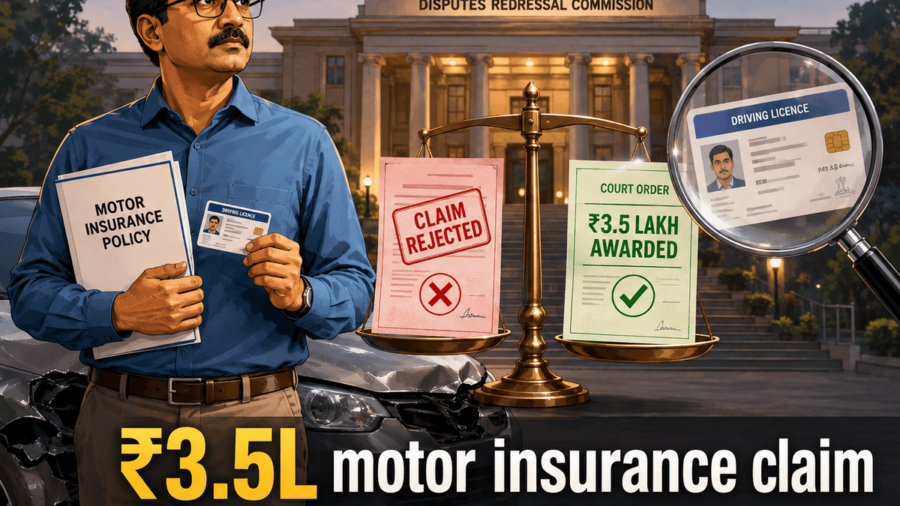
A motor insurance claim was rejected by HDFC General Insurance over driver's license concerns. The West Bengal Consumer Commission found insufficient evidence of deliberate policy violation. The insurer was directed to pay Rs 3.5 lakh with interest and Rs 1 lakh compensation. The commission emphasized that a fake license does not automatically absolve insurers of liability. Policyholders must exercise reasonable care when hiring drivers for their vehicles.
A motor insurance claim was rejected after the insurer raised doubts about the validity of the driver's licence and claimed that the driver had another licence. The West Bengal State Consumer Disputes Redressal Commission, however, found that the insurer had not produced sufficient evidence to prove a deliberate violation of the policy terms.
In its July 8, 2026 order, the Commission directed HDFC General Insurance Company to pay Rs 3.5 lakh with interest to the policyholder, along with Rs 1 lakh as compensation for mental harassment. The insurer's appeal against the earlier Consumer Commission order was dismissed.
What happened to the car and why was the insurance claim rejected?
The case involved a policyholder who owned a Skoda New Laura Ambiente 1.8 TSI. The vehicle was insured with HDFC General Insurance Company for an insured declared value (IDV) of Rs 6.95 lakh. The policy was valid from March 9, 2014 to March 9, 2015 and the premium paid was Rs 11,233.
The car met with an accident on October 12, 2014. It was taken to an authorised Skoda service centre, which estimated the repair cost at about Rs 5.28 lakh. The policyholder subsequently sought settlement of the claim.
The insurer rejected the claim, questioning the validity of the driving licence held by the driver at the time of the accident.
“The insurance company declined the claim on the ground that the policyholder at the time of the accident was not in possession of a valid licence, but had a fake licence issued in Nagaland during the accident and was holding two licences, which was a clear violation of Section 6 of the Motor Vehicle Act,” says Advocate B. Shravanth Shanker, Managing Partner, B Shanker Advocates LLP.
The insurer maintained that this amounted to a breach of the policy conditions and justified repudiation of the claim.
Did holding two driving licences automatically absolve the insurer of its liability?
“According to the Commission, Section 6 of the Motor Vehicle Act put restrictions on a person from holding two licences at the same time and punishment for violating the provisions of Section 6 has been provided under Section 182 of the Act itself which calls for simple imprisonment extendable up to 3 months or a fine of Rs. 10,000 or both,” says Shanker.
The Commission also distinguished between a driver's violation of the Motor Vehicles Act and a breach of the insurance policy by the vehicle owner. It held that even if the driver violated Section 6 by holding two licences, that violation by itself could not be used to avoid the insurer's liability under the policy.
“So, when a person is guilty of violating Section 6, he shall be given appropriate punishment as per the act by the prescribed competent authority but it will not absolve insurance companies from their liability towards the insured as per the insurance policy,” says Shanker.
Does a fake or invalid driving licence automatically allow an insurer to reject a claim?
The Commission relied on several Supreme Court judgments dealing with cases involving fake or invalid driving licences.
“However, adverting to the facts of the case, the Commission drew an important distinction between a defective or fake driving licence and a breach of the insurance policy by the insured himself. Relying on settled Supreme Court jurisprudence, particularly National Insurance Co. Ltd. v. Swaran Singh and Nirmala Kothari v. United India Insurance Co. Ltd., the Commission held that an insurer cannot avoid liability merely by showing that the driver's licence was subsequently found to be fake or invalid,” says Advocate Mayank Arora, Partner, The Chambers of Bharat Chugh.
The commission reiterated that in such cases the insurer company must additionally establish that the vehicle owner was negligent, knew about the defect in the licence, or had failed to exercise reasonable care while employing the driver. The burden of proving such a breach lies on the insurer, he adds.
When employing a driver, an owner is expected to check that the person has a driving licence and is competent to drive. However, if the licence appears genuine on its face, the owner is generally not expected to independently verify it with the issuing transport authority unless there is a reason to suspect its authenticity, explains Arora.
The Supreme Court has specifically observed that it would be unreasonable to expect vehicle owners to make enquiries with transport authorities across the country to verify every driving licence.
What did the consumer commission find in this case?
The West Bengal State Consumer Commission noted that the insurer had to establish a breach on the part of the insured and could not rely merely on the existence of an invalid or allegedly fake licence. It therefore rejected the insurer's appeal.
The Commission also considered the surveyor's assessment of the vehicle damage. The surveyor assessed the loss at a lower amount than the policyholder's claim. The Commission noted that the insurer had not adequately explained the depreciation applied to some parts or the formula used for calculating labour charges.
“Further, the surveyor recorded that the tyre got stuck in a tram line and the car hit a road divider, an intervening cause with no nexus to the driver's licence class. A merely technical breach could not defeat the indemnity,” says Vishal Jain, Founder and Senior Partner at Ayaam Legal.
The Commission relied on the Supreme Court's ruling in Swaran Singh, which says that even when a breach concerning the driver's licence is established, the insurer cannot avoid liability towards the insured unless the breach is sufficiently fundamental and is found to have contributed to the cause of the accident. The Commission applied this principle while examining the facts of the case.
ET Wealth Online has also approached HDFC General Insurance Company for its response and inputs on the matter. The insurer's response was awaited at the time of publication.
How much did the insurer have to pay?
The Commission modified the earlier District Commission order and directed the insurer to pay:
- Rs 3.5 lakh to the policyholder, with interest at 6% per annum from September 7, 2016, payable within 45 days.
- If the amount was not paid within the prescribed period, interest would continue at 6% until the date of the order and thereafter at 9% per annum until final payment.
- Rs 1 lakh as compensation for mental harassment.
The Commission did not, however, award the full Rs 6.95 lakh IDV claimed by the policyholder.
What does the ruling mean for motor insurance policyholders?
The key takeaway is that a fake or invalid driving licence does not automatically mean that a motor insurance claim can be rejected.
“While not all policyholders can verify the genuineness of a driving license, they are duty-bound to take reasonable care that the vehicle is not handed over to someone who does not hold a valid driving license,” says Jain.
Exercising reasonable care while hiring a driver will help at the time of any claim. The Swaran Singh and Nirmala Kothari judgments establish that the insurer must affirmatively prove the insured's wilful breach or want of reasonable care. Policyholders should not accept the inverted framing that they must prove the driver's licence was genuine, he adds.
“The connection between the cause of action and the reason for repudiation is very important, and a claim cannot be defeated on a ground that does not establish any causal connection between that ground and the actual accident,” explains Jain.
For policyholders, it is also important to examine the surveyor's report and the basis on which the claim has been reduced or rejected. In this case, the Commission specifically questioned aspects of the surveyor's assessment, including the depreciation applied to certain parts and the calculation of labour charges.
(Join our ETWealth WhatsApp channel for all the latest updates)
Add 

(Catch all the Personal Finance News, Breaking News, Budget 2025 Events and Latest News Updates on The .)
…more
Tata Motors commercial vehicle sales up 49%
By Sohail Khan · 1 Sep
Railways approves Rs 170 crore for Kavach 4.0
By Sohail Khan · 1 Sep
IRDAI plans one-stop registry for insurance
By Sohail Khan · 1 Sep
Leave a Reply