Yayoi Kusama’s art of self-obliteration, in the age of the selfie
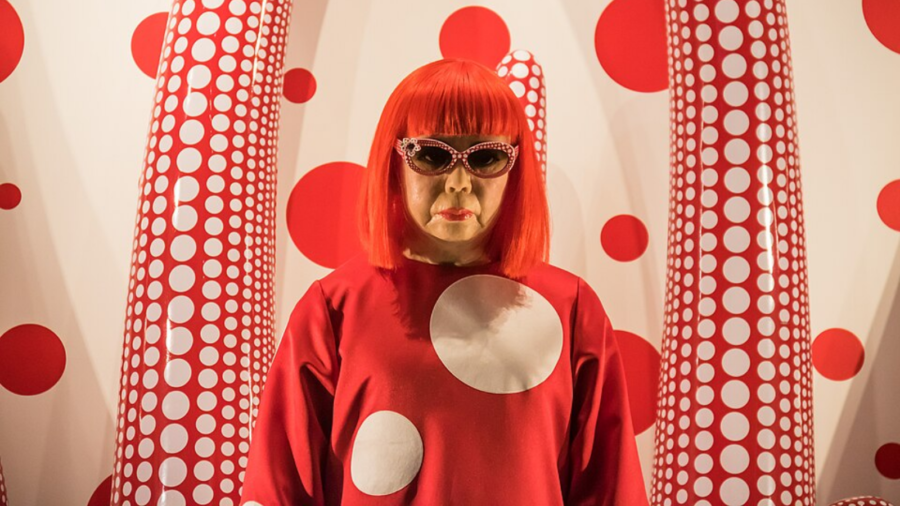
I first encountered Yayoi Kusama‘s famous yellow, polka-dotted pumpkin in 2018 in Hong Kong. Installed at the Harbour Arts Sculpture Park, it overlooked the still waters of the Victoria Harbour. It was a windy afternoon and I remember wondering: If a freak tide were to sweep the area, would Kusama’s pumpkin sink or float?
A few years later in 2023, I saw her retrospective, “Yayoi Kusama: 1945 to Now” at M+ Museum, and I had the answer: Kusama’s pumpkin would always stay afloat. The news of her passing earlier this week had me rummaging through my phone gallery looking at the images of her works from that retrospective, and I remembered why.
Advertisement
It was a massive retrospective bringing together nearly eight decades of her practice. I found myself drawn to two works in particular, and they have shaped my view of Kusama — the woman and the artist — since.
‘Self-obliteration’ was an obvious highlight. It is an iconic work from her career and is unmissable in its breadth and multiplicity of elements. It features six female mannequins, standing around a laid-out dining table, seemingly in conversation. It would have appeared to be an ordinary scene from a social gathering had it not been for the hypnotic, grid-like pattern covering every single surface in the installation — the mannequins, the table and the mugs, plates, pitcher, ashtray, plastic plants, flowers and fruit on it, the chairs and the handbag hanging from one of them. Everything was painted in different colours and then covered with the same pattern, blurring their individualities, almost flattening the scene into one big porous tarp. Kusama called it the infinity net.
Kusama suffered abuse as a child and began hallucinating from the age of 10. She described the repetitive, almost obsessive act of making the infinity net as a way of coping with her visions. This pattern began appearing in her work in the late 1950s, around the time she moved from Japan to New York.
Advertisement
That brings me to her other work — a self-portrait. The drawing was child-like — essentially an outline of a face, sporting Kusama’s signature blunt bob, two small circles for eyes, an inverted T for a nose and an oval, distorted to resemble a lip. The palette, too, was bright and seemingly random: yellow, red, green, pink. The portrait was surrounded by the infinity net in yellow on a black background.
There were other self-portraits too. More defined, more refined, an apt reflection of the skills of an artist of Kusama’s stature. In them, you could see Kusama. But in that first one, you had to find her, almost become her, because that is what she was doing when she arrived on the New York art scene dominated by “hyper-masculine” abstract expressionists like Jackson Pollock, Willem de Kooning and Franz Kline. Seen against their intense, high-octane practices, Kusama’s repetitive nets and dots were meditative.
But even as Kusama was finding her own voice, her practice was never about asserting the self. She was acutely aware of the smallness of her existence. Even after moving back to Japan, she lived in a psychiatric hospital, leaving each day for her studio to paint before returning. She had, on multiple occasions, spoken about forgetting oneself. “The polka dots can’t stay alone,” she had reportedly said, and that her life was a “dot lost amongst thousands of other dots”.
I became a fan after the retrospective. So imagine my excitement when her ‘Infinity Mirrored Room’ came to NMACC in Mumbai and I happened to be in town, albeit for a single day. But the tickets were sold out for the week. I couldn’t see the installation then, but my social media feed has since been full of selfies from NMACC. With every post the irony became clearer: An artwork about dissolving the self had become the backdrop for asserting it — an indulgence in hyper-individualism around an artist who chose the humble pumpkin as her most enduring muse for its “generous unpretentiousness”.
As if to manifest arguably my most intrusive thought, in 2021, Typhoon Lupit swept away Kusama’s yellow pumpkin sculpture, installed on Japan’s Naoshima island in 1994. The pumpkin didn’t sink. It floated and travelled with the tide before it was recovered from the sea.
Perhaps, Kusama understood what we have forgotten: Staying afloat doesn’t always mean holding on too tight. Often, it means quiet surrender.
The writer is associate editor, . trisha.mukherjee@expressindia.com

Systemic institutional dysfunction delaying roll-out of key defence equipment
By Sohail Khan · 30 Aug
Sun exposure vs smoking: Which ages your skin faster? Dermatologist explains
By Sohail Khan · 30 Aug

Leave a Reply