Why are junior doctors in Andhra Pradesh protesting? | Explained
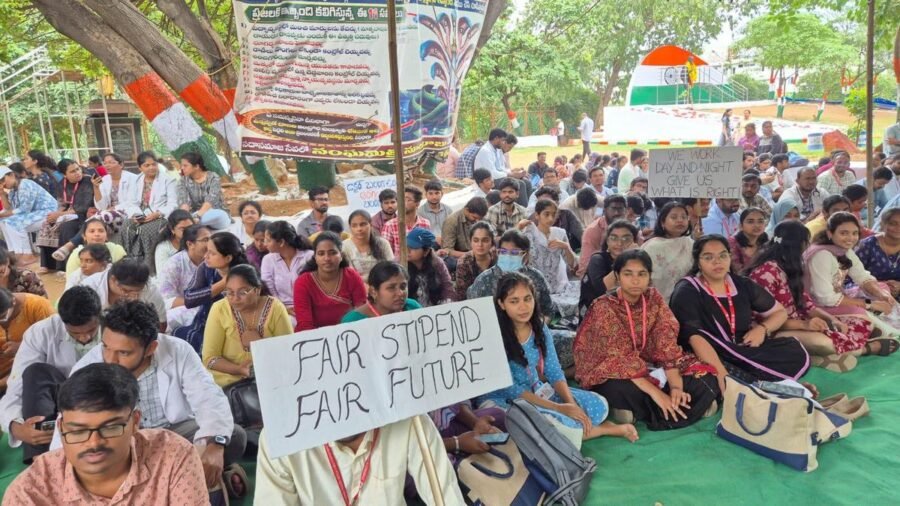
The story so far: Junior doctors across Andhra Pradesh, under the banner of the Andhra Pradesh Junior Doctors’ Association (APJUDA), began a phased strike on August 11, 2026, demanding a stipend revision that has been due since January 1, 2026. What began as a time-bound withdrawal of non-emergency services has since escalated, through repeated rounds of failed talks with the State government, into a withdrawal of emergency services as well from August 17, affecting Intensive Care Units, casualty wards, and labour rooms in government medical colleges and teaching hospitals across the State.
How did the protest begin?
The dispute traces back to Government Order No. 287, issued by the Health, Medical and Family Welfare Department on December 17, 2009, which provides for a biennial revision of junior doctors’ stipends by about 15%, linked to inflation. Revisions followed in 2019 and 2024. The one due from January 1, 2026, did not come through even after seven months, prompting APJUDA to send its first formal communication to the department in July and threaten a strike from August 4. The government sought a week’s time through the Director of Medical Education to negotiate with the Finance Department and the Health Secretary, and the strike was put on hold.
How did talks break down?
With no written assurance forthcoming, APJUDA issued a fresh notice for August 11. A day’s postponement was sought again, this time to hold a two-day meeting at the APIIC Building in Mangalagiri, with representatives from every government medical college asked to attend. At the meeting, the government offered an annual hike of 3% for postgraduate junior doctors and 5% for house surgeons and interns, against APJUDA’s demand for 30%, a figure corroborated independently by both a senior health official and the Indian Medical Association, Andhra Pradesh State (IMA AP State). The official told that the department had, since receiving APJUDA’s first communication in July, been studying stipend revision models followed in Tamil Nadu and Kerala. While acknowledging the demand was “justified,” the official described the 30% figure as “abnormal,” and said the government was “exploring all options.”
Doctors have cited two broad justifications for 30%. Andhra Pradesh’s inflation rate of around 5% a year works out to roughly 10% over the two years since the last revision, they say, and the 2026 revision is meant to be a catch-up for that period rather than a purely forward-looking hike. They have also pointed to a sharp rise in workload, including a three-hour increase in outpatient department timings over the past year and the added burden of digitising health records.
What are the other two demands?
APJUDA has also sought strict adherence to National Medical Commission norms in recruiting MSc and PhD holders to clinical faculty posts, saying recent recruitment has exceeded the NMC’s prescribed cap of under 15% for such appointments, and it opposes a proposed increase in the retirement age of doctors from 62 to 65 years, which it says would shrink recruitment opportunities for younger doctors entering government service.
How widespread is the strike?
All 19 government medical colleges in the State are participating, APJUDA said, including six established in the past two years and older institutions such as Andhra Medical College in Visakhapatnam, Guntur Medical College, Siddhartha Medical College in Vijayawada, Kurnool Medical College, and the medical college in Kadapa. The association estimates around 9,000 junior doctors are involved statewide.
How has the strike progressed?
Phase I (August 11): Withdrawal of non-emergency services from 9 a.m. to 1 p.m., with emergency and ICU services maintained.
Phase II (August 12 onwards): Complete withdrawal of non-emergency services, extended to 9 a.m.-4 p.m., alongside a voluntary relay hunger strike. Emergency and ICU services continued to be maintained through this phase.
Revised deadline: APJUDA’s original deadline of August 15, 5 p.m., for a written government response was extended to August 16, 5 p.m., as negotiations continued.
Phase III (from August 17, 8 a.m.): With no satisfactory written response received by the revised deadline, APJUDA began withdrawing emergency services as well, including in Intensive Care Units, casualty and labour rooms, while non-emergency services remain suspended.
Has the medical fraternity weighed in beyond APJUDA?
Yes. IMA A.P. State and the IMA Junior Doctors Network, Andhra Pradesh State, urged the government on August 16 to resolve the 15% stipend revision due under G.O. No. 287 since January 1, 2026, which they said was by then more than seven months overdue. IMA leaders were careful to distinguish this from APJUDA’s separate 30% demand, which they asked the government to “sympathetically consider” as well, citing inflation, workload, and stipend disparities with other States. Dr. S. Balaraju, President, IMA AP State, and Dr. Subhas Chandra Bose Moturi, Hon. General Secretary, IMA A.P. State, jointly appealed to the Health Minister to intervene directly and hold immediate talks with APJUDA, warning that prolonged agitation would serve the interests of neither doctors, the government, nor the public.
What has APJUDA said about patient care?
The association maintained emergency and ICU services through Phases I and II, even as postgraduates, many already working 36 to 48 hours a week and, in some cases, up to 90 hours, joined the protest. Dr. Balagam Dinakar Sai Srinivas, General Secretary, APJUDA, said doctors were sacrificing “valuable time, which we joined this profession to spend caring for patients.” Phase III marks a departure from that position. IMA credited junior doctors for their “responsible approach towards patient care” through the earlier phases and appealed to the public to see the agitation as “not directed against patients.”
What happens next?
APJUDA has said it will not agree to further postponement without a written commitment specifying a firm timeline for a Government Order. “As of now, August 16 is the deadline. From August 17, we will also halt emergency services,” Dr. Dinakar said. With that phase now in effect, and both APJUDA and IMA calling for the Chief Minister, Deputy Chief Minister, and Health Minister to intervene directly, the stand-off’s resolution will depend on whether the government moves beyond verbal assurances to a written order.
Shehzad Poonawalla quits BJP, cites ‘pressing financial and personal circumstances’
By Sohail Khan · 17 Aug

Rooftop solar in Tamil Nadu gets a fresh boost
By Sohail Khan · 17 Aug
Leave a Reply