Why Afghanistan celebrates its Independence Day on August 19
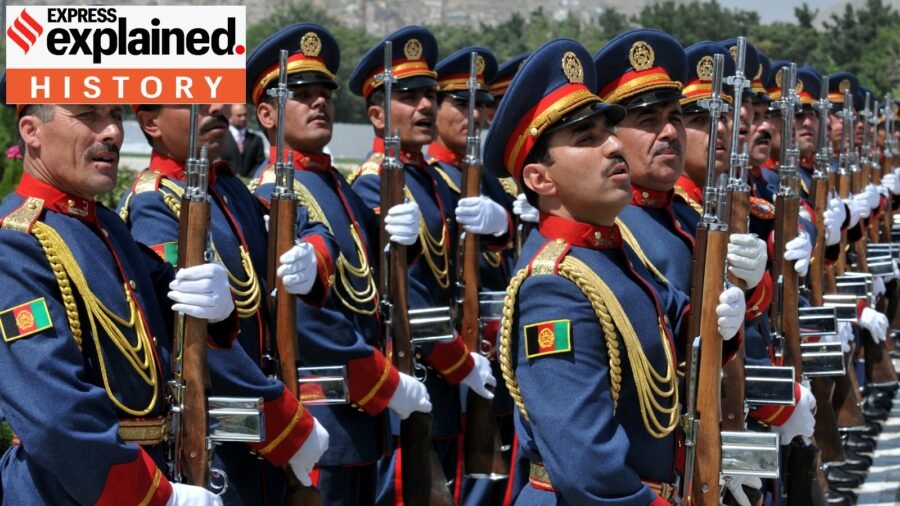
On August 19 every year, there are celebrations and festivities in Kabul and other parts of Afghanistan. Some 107 years ago, the Treaty of Rawalpindi was signed between the British Indian government, represented by Sir A H Grant, and Afghanistan, represented by Sardar Ali Ahmad Khan, marking Afghanistan’s independence in its foreign affairs from British control.
The Treaty was signed on August 8, 1919, while Afghanistan observes its Independence Day on August 19, marking its regained control over its foreign affairs after the Third Anglo-Afghan War.
What explains this 11-day difference between the two events? Here’s what triggered the Third Anglo-Afghan War, the links between the Treaty of Rawalpindi and the Durand Line, and where the border dispute between Pakistan and Afghanistan stands today.
The war behind the date
Amanullah Khan came to the Afghan throne in February 1919, after his father Habibullah was assassinated. In his coronation address, he declared full independence from Britain.
From Eidgah mosque in Kabul, he declared, “I vow that the Afghan government, like all the other independent powers of the world, should have full freedom inside and outside of the country… Our government in Afghanistan will reform our nation and our nation can achieve the right place among the civilised nations of the world.”
Months later, in May, that declaration triggered the Third Anglo-Afghan War.
The fighting was short and militarily inconclusive. But it was enough to force Britain to the table, leading to the signing of the Treaty of Rawalpindi on August 8, 1919. Under this, Britain recognised Afghanistan’s right to conduct its own foreign affairs — a right it had ceded after the Second Anglo-Afghan War four decades earlier.
Story continues below this ad
Amanullah Khan chose a date 11 days later to declare Afghanistan’s sovereignty and self-rule, to distinguish the date of signing the treaty from that of Afghanistan’s independent future.
Faiz Ahmed, an associate professor of history at Brown University, wrote in a piece for the American Historical Association: “Such symbolism, he thought, was necessary not only to unite his multiethnic country, but also to put it on the map for other audiences and purposes. From Constantinople to Calcutta, Afghanistan’s independence represented the triumph of an Asian Muslim state against the world’s premier imperial power at a time when European colonies and protectorates outnumbered independent countries in the Global South.”
In the years that followed, he led the country to modernisation, opened schools for girls, sent women abroad to study, built the country’s first modern roads, and set up its postal and telegraph network.
An official from the Afghan Consulate in Mumbai told , “After we got our Independence, good things happened to our country. The first railway line was set up in 1922, the first women’s voting rights were given by King Amanullah in 1919, the first Constitution came into being in 1923, and there was development and modernisation work that followed.”
Story continues below this ad
The western model of development eventually triggered a revolt, led by Tajik military leader Habibullah Kalakani, which forced Khan to abdicate his throne in 1929.
Unsettled Durand Line
The treaty did not settle the frontier itself. That question goes back further — to November 1893, when Amir Abdur Rahman Khan and the British diplomat Sir Mortimer Durand agreed on a line separating British India’s sphere of influence from Afghanistan’s.The 2,600-km “Durand Line”, cutting through the mountains of the Pashtun land in between, was originally meant to demarcate British-controlled territory from the Afghan state.
The Durand Line was a result of Britain’s “Forward Policy” era — a period shaped by the political and diplomatic rivalry between the British and Russian empires in Central and South Asia during the 19th and early 20th centuries.
Under the 1919 Treaty, Afghanistan formally accepted the border arrangements it had earlier agreed to. Britain read this as a reaffirmation of the Durand Line. But Kabul has since argued that the 1893 Agreement demarcated the area as a buffer zone and was never intended to be permanent, though the original text does not mention an expiry date of the treaty. The Afghan Consulate official also reiterated that the Durand Line was “a buffer zone”.
Story continues below this ad
When Pakistan was created in 1947, the border hardened overnight. The official said, “Pakistan was created on Indian and Afghan soil. The agreement we signed was with the Britishers; they left, so there should be a new border agreement.”
King Zahir Shah, the then ruler of Afghanistan, refused to recognise Pakistan in 1947. And Afghanistan became the only country to vote against Pakistan’s admission to the UN.
The official further added, “We in Afghanistan consider the Abaseen River, the Pashto name for the Indus, as our border. The Durand Line has separated families. There are brothers and sisters on both sides of the border. Unless both governments ensure free movement of people, trade and development across the line, life will remain very difficult for the people living in these areas.”
Where border dispute stands today
The border dispute between Pakistan and Afghanistan has transformed from a traditional security issue into a human security crisis. Pakistan has fenced large stretches of the Durand Line, while Afghanistan has objected to the fencing and what it considers unilateral attempts to alter the frontier.
Story continues below this ad
Since February 2026, Pakistan and Afghanistan have fought their most serious border confrontation in decades. It began with Pakistani strikes on alleged militant targets — which Kabul condemned as violations of its sovereignty — and subsequent Taliban retaliation along the Durand Line, across the Afghan provinces of Kunar, Khost, Paktia, Paktika, and Kandahar.
The result has been civilian deaths, displacement, disrupted trade, and families being forced from their homes. As of August, more than 800 people have been killed and thousands injured. As per UN figures, over 115,000 people have been displaced in Afghanistan.
What was once a dispute over a line on a map has therefore become a question of where people can live, move, trade and feel safe. Pakistan has formally proposed that the Taliban recognise the Durand Line as an international border in exchange for de-escalation. But since 1893, no Afghan government to date — be it monarchists, radicals, mujahideen, or the current Taliban — has accepted the Durand Line.
A smoke and mirrors summit in which Xi emerged with the upper hand
By Sohail Khan · 28 Sep
Why must a woman always trade curiosity about the world for safety?
By Sohail Khan · 28 Sep
Best places in India to see tigers in the wild
By Sohail Khan · 28 Sep