What we lose when we stop seeing migrants as people
A photograph that has been trapped in my mind for the last few days is of a girl, around my age, wearing a football jersey which could easily be mistaken for Atlético Madrid’s, smiling at the camera with a field stretching out behind her and a goalpost standing in the distance. Faten Ben Omar El Azizi drowned last month while trying to cross into the Spanish exclave of Ceuta. Playing in a women’s football league in Morocco, while working part-time in a cemetery where she is now buried, was not enough, and so she decided that the crossing was worth the risk.
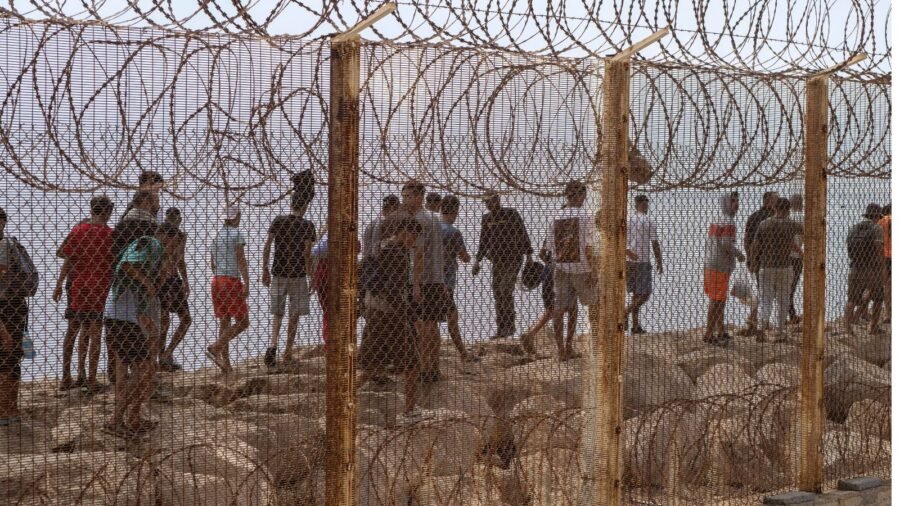
El Azizi’s is just one story among nearly 150 others of those who drowned or were crushed to death in a stampede at the border between Morocco and Ceuta last month, and, according to the International Organisation for Migration, among the at least 3,400 people who died or went missing last year while trying to reach Europe.
Advertisement
What is the natural human response to a tragedy like Ceuta? Grief, surely? Shock, perhaps even anger, at the circumstances that could make thousands of people decide that risking death was preferable to remaining where they were. But listen to the reaction of much of the European political establishment — including Spain’s left-wing leader Pedro Sánchez, who labelled the mass influx a “violation of Spain’s territorial integrity” — and you encounter a vocabulary so impoverished that there appears to be little to say beyond “security” and “legality”.
Italy’s Giorgia Meloni spoke of “illegal immigration” and border defence; Germany’s Friedrich Merz demanded that Morocco take back “illegal migrants” and stressed the need to protect the EU’s external borders; Portugal stressed the “integrity of the Schengen system”, while Finland and Denmark likewise focused on border controls and Schengen. US President Donald Trump, of course, had to weigh in; he used the word “invasion”. The terms may vary from country to country, but the instinct to exclude and vilify is unmistakably similar.
The familiar and obvious claim is that crossing a border illegally is, in fact, illegal. But an illegal act does not make a human being illegal, even if that has become the dominant way of seeing such a person. There is, as migration scholar Nicholas De Genova argues, nothing matter-of-fact about the “illegality” of a migrant; it is not an inherent characteristic of the person but a status produced through the state’s immigration law and its enforcement. The natural rights of that person — which John Locke would describe as pre-political rights that exist independently of any government — are the same as yours and mine, the so-called “legals”.
Advertisement
The second common counterargument is security and crime: That illegals break the law and make host countries dangerous to live in. Empirically, however, the evidence does not support a simple relationship between immigration and higher crime. Several studies, including one examining 21 European countries (‘I May Be an Immigrant, but I Am Not a Criminal’, 2021), have found no relationship between immigration and violent crimes, while research using data from 30 OECD countries has found no statistical evidence that rising immigration increases violent or property crime. And in the US, a substantial body of research finds that immigrants generally commit crimes at lower rates than US-born people, including research specifically examining undocumented immigrants.
Beyond the terminology and statistics, why have we come to treat migration as an aberration that must be dealt with quickly and with an iron hand, rather than as a force that has shaped the course of history and society? People have been moving for thousands of years, transforming the linguistic and cultural landscapes of entire continents, long before the modern nation-state insisted that everyone belongs somewhere and therefore requires permission to enter somewhere else. Migration is an ancient human phenomenon, but the discourse around it today is confined within a remarkably narrow and young framework of borders.
The irony is that for much of modern history, it was the Europeans who were moving. Millions crossed the Atlantic, settled in the Americas, moved to Australia and New Zealand, travelled across Africa and Asia, and built new lives. That history is not described using the vocabulary now reserved for migrants arriving in Europe. European mobility was framed as exploration, settlement, opportunity or empire-building rather than as a threat to the societies receiving them, even as colonial expansion wiped out indigenous peoples in many parts of the world.
And are we really going to gloss over the fact that European colonialism, repeated interventions, disease, wars, and financial and foreign-policy decisions helped shape many of the conditions from which 21st-century migration emerges? Syrians, Afghans, Iraqis, Palestinians and Libyans, among others, did not simply appear at Europe’s borders out of nowhere. Their journeys are shaped by wars, political upheavals, economic inequalities and historical relationships in which Europe and the US have often been participants, sometimes decisively so. Of course, Western policy is not the sole cause of migration, but the movement of people between Europe or the US and the rest of the world cannot be separated entirely from the history of Western intervention and extraction.
All of this matters because the language we use to describe migration is not abstract; it shapes how we see the people who migrate. Talking about borders and sovereignty cannot mean switching off our ability to see the human being on the other side, or the factors that have forced them to undertake their perilous journeys. That is why I keep returning to El Azizi. If our response to her death begins and ends with whether she was legally entitled to cross a line on a map, then what it exposes is not only the limits of migration policy, but also our inability to see in another human being the same dignity we would demand for ourselves.
The writer is copy editor, . saptarshi.basak@expressindia.com
How plea against Election Commissioners appointment law went to a larger Supreme Court bench
By Sohail Khan · 23 Sep
From Jamui in Bihar to the heart of Delhi: How moral policing mutates into sexual violence
By Sohail Khan · 23 Sep
Shah Rukh Khan on the ‘green flag’ for a happy marriage: ‘Make adjustments so both of you…’
By Sohail Khan · 23 Sep